

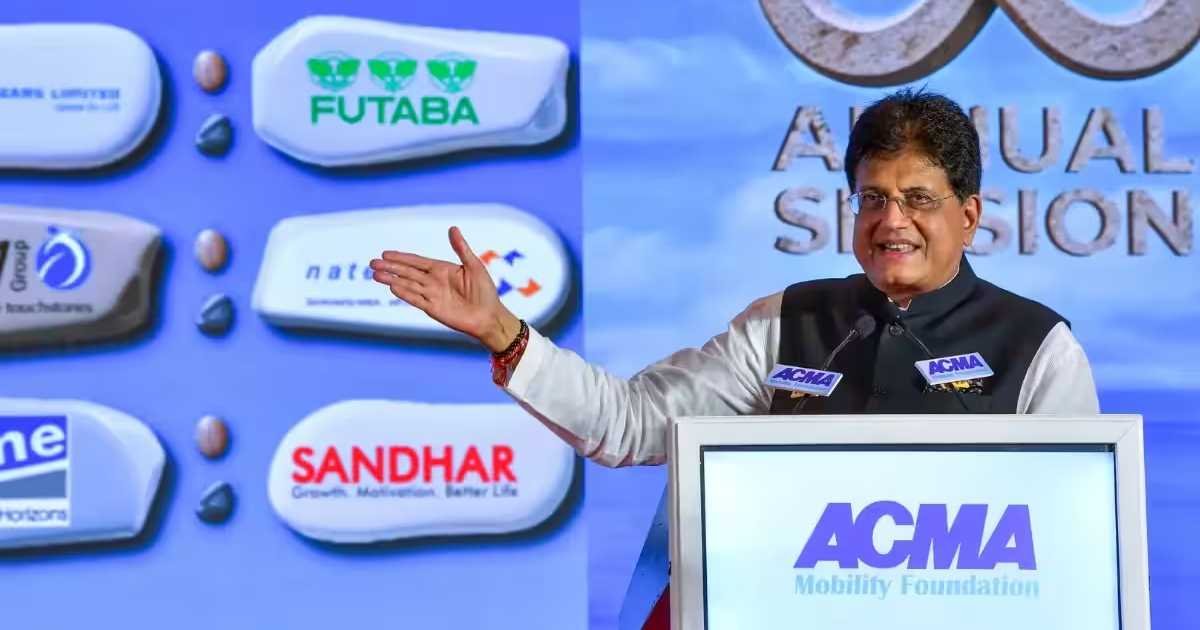
New Delhi: Commerce and Industry Minister Piyush Goyal urged the auto component industry to expand globally and build stronger supply chains.
He made the call while addressing the 66th Annual Session of the Automotive Component Manufacturers Association (ACMA) in New Delhi on September 2.
Goyal said the sector had developed the ability to make quality products at globally competitive prices. Therefore, he asked companies to move beyond domestic operations and establish manufacturing bases in developed markets.
The minister said the industry’s international trade stood at nearly USD 50 billion. Imports and exports accounted for about half each of that trade.
However, he stressed that greater international investment and business expansion should now emerge from ACMA members. He also said imports could support economic growth, but this should not be seen as a call for higher imports.
India has also expanded market access through nine trade agreements finalised during the past four to five years. According to Goyal, these agreements cover 38 developed countries with a combined GDP of USD 60 trillion.
He said earlier trade agreements signed before 2014 covered economies with a combined GDP of about USD 10 trillion at current value. In contrast, the newer agreements provide wider two-way market access.
Goyal also praised ACMA for its role in trade negotiations. The association has sought zero-duty access for Indian auto components while supporting reciprocal market opening.
Meanwhile, the minister said India remained the fastest-growing among the world’s large economies despite global uncertainty. He cited India’s 7.8% growth and said the auto sector and ACMA were recording high double-digit growth.
He added that around five million passenger cars were expected to be sold during the year. Electric vehicles were also seeing strong demand, with some models carrying waiting periods of up to six months.
Auto component industry gets policy and trade push
Goyal said the government was strengthening industrial capacity and supply chains through several programmes. These include support for the auto component industry, speciality steel manufacturing and the semiconductor sector.
He also highlighted the technical textiles production-linked incentive scheme. The minister said technical textiles have important applications in the automotive sector.
Furthermore, Goyal invited companies to use new industrial parks being developed across India. He said 20 smart and industrial cities were already underway.
He also proposed dedicated spaces for international partnerships. In particular, he suggested parks focused on US-India cooperation and specialised facilities for auto component manufacturing.
The minister said the government wanted regular feedback from industry. He called for companies to share their challenges, ideas and requirements so that reforms could address practical business needs.
Goyal also highlighted cooperation between India and the United States in critical minerals. He said such partnerships could help create resilient supply chains and support the auto component industry’s ambition of becoming a USD 500 billion global industry.
The minister urged companies to strengthen domestic sourcing where supply-chain gaps remain. He also called for greater movement up the value chain.
According to him, companies should develop integrated, high-value solutions. They should also design, manufacture and supply products that meet leading global standards.
Goyal further asked the industry to give greater attention to safety. He said companies should not leave responsibility for safety entirely to the government.
Technology, he added, should play a larger role in manufacturing. Artificial intelligence could help improve quality control and identify changing customer requirements.
He also pointed to growing demand for customised vehicles in the United States and Europe. Therefore, he called for stronger safety features and greater technological capability.
On vehicle scrappage, Goyal said the government and industry should make scrapping old vehicles financially attractive. He said manufacturers should provide fair value to consumers who replace older vehicles.
US seeks deeper automotive partnership with India
US Ambassador to India Sergio Gor said the US-India automotive relationship had reached a “historic high point”. He said both countries were working together on the future of mobility.
Gor described Indian auto component manufacturers as increasingly sophisticated and reliable partners. He also highlighted cooperation on supply-chain resilience.
The ambassador invited Indian manufacturers to consider investments in the United States. He cited greenfield assembly units, research and development centres and distribution networks as possible avenues.
He also pointed to Indian companies already operating in the US automotive ecosystem. These included Bharat Forge, Sundaram Clayton and Mahindra.
Gor said wider cooperation between the two countries also covered pharmaceuticals, defence, information technology, data centres and space.
He highlighted the Pax Silica Declaration and said India was among the first countries invited to join the initiative.
At the same event, British Deputy High Commissioner for Western India and Trade Commissioner for South Asia Harjinder Kang highlighted the expanding India-UK automotive partnership.
Kang referred to the India-UK Vision 2035, the UK’s modern industrial strategy and the India-UK CETA. The trade agreement came into force on July 15, 2026.
He said 99% of UK tariff lines and 90% of Indian tariff lines had moved to zero or very low duties. Streamlined customs procedures are also expected to support trade.
Kang said CETA would deepen automotive supply chains and encourage joint ventures. It would also give auto component manufacturers tariff-free access to each other’s markets.
He highlighted British capabilities in advanced engineering and zero-emission mobility. These include electric motors, batteries, hydrogen technologies, lightweight composites and software-defined vehicle systems.
The discussions therefore placed global expansion, trade access and supply-chain resilience at the centre of the auto component industry’s next phase of growth.
