

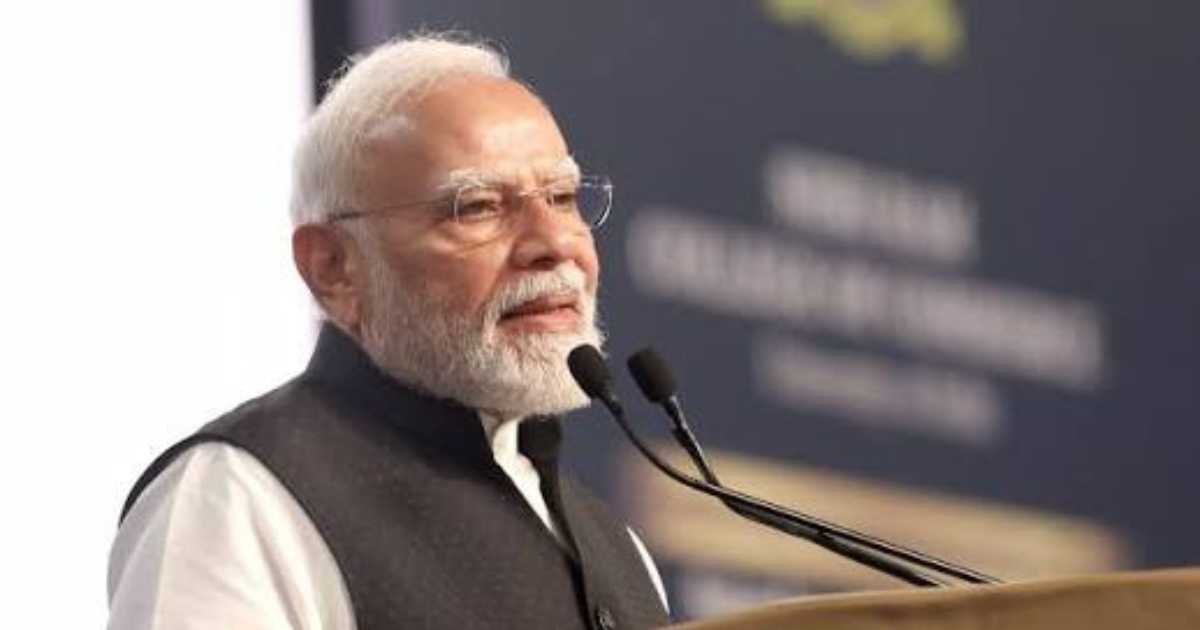
New Delhi: Fintech innovation must move beyond payments and drive wider financial inclusion, credit, insurance, savings and pensions, Prime Minister Narendra Modi said.
Addressing the Global Fintech Fest 2026 in Mumbai, Modi said India’s fintech sector had reached a new stage of growth. He called for faster innovation and stronger links with global financial systems.
RBI Governor Sanjay Malhotra and Global Fintech Fest Chairman Kris Gopalakrishnan attended the event. Innovators, leaders and investors from India and abroad also joined the gathering.
Modi said this was his third consecutive year at the Global Fintech Fest. He linked the repeated participation to the importance of the fintech sector for a developed India.
He said every visit brought more youth, energy and possibilities. Risk-taking capacity was also increasing, while young Indians were pursuing bolder dreams.
As a result, Modi said his confidence in India’s future as a developed country had become stronger.
The Prime Minister also referred to Ganeshotsav, which was due to begin in Maharashtra and across the country within days. He extended his wishes to delegates after invoking Lord Ganesh before the event.
Modi then highlighted the global economic environment. He said the world was passing through conflicts and uncertainty.
Energy and commodity supply chains remained under pressure, while trade tensions continued. These conditions had persisted for several months.
The April-June quarter had been particularly challenging, he said. Even in that environment, India recorded 7.8 per cent growth.
Modi said India’s growth had given the world fresh confidence. He added that this growing trust was visible among fintech leaders and investors at the event.
Another sign, he said, was India’s sovereign rating. A Japanese credit rating agency had recently upgraded India’s sovereign rating to the A category.
The upgrade followed a gap of three decades, Modi said. He described the development as evidence of confidence in India’s growth momentum and macroeconomic stability.
Structural reforms undertaken in recent years had also strengthened that confidence, he said. Modi added that India’s “reform express” would continue at a faster pace.
India’s fintech story, he said, had been extraordinary. At the centre of that story was the Unified Payments Interface, or UPI.
Modi said discussions about Indian fintech would remain incomplete without UPI. The payment system had transformed how millions of people accessed banking services.
UPI completed 10 years on 25th August, he noted. A decade earlier, Modi said, some people had doubted his statement that banking services would reach people through their fingertips.
Those doubts had not reflected the reality faced by millions of Indians, he said. Many people from those families had never even entered a bank.
Today, however, those same groups have become major drivers of fintech growth in India. Modi said this transformation demonstrated the scale of financial inclusion enabled by technology.
In August alone, more than 2,400 crore transactions took place through UPI, according to Modi. He said the figure showed the system’s enormous scale.
During the time delegates had been sitting at the event, he said, more than 5 million UPI transactions had taken place in every 10-minute period on average.
Modi cited French President Emmanuel Macron’s view that UPI was more than a technology story. He said Macron had described it as a civilizational story.
UPI has also expanded beyond India, Modi said. It is now live in 11 countries, allowing users to make payments abroad directly from Indian bank accounts.
The Prime Minister said this progress represented only the first stage. He asked whether India should now consider its fintech success complete.
Modi said his 25 years in policy and governance had reinforced one principle. After reaching a milestone, he said, he immediately began preparing for a bigger goal.
India’s next objective should therefore be to connect UPI with payment systems in other countries. Such integration had already been achieved with Singapore.
Because of that link, Modi said, transactions between India and Singapore could take place much like transactions between neighbourhoods of the same city.
He called for similar connections with other countries and markets. The priority should include countries with large Indian populations and those where India has major trade interests.
Countries willing to work with India should also be included, Modi said. Such connections could expand the reach and usefulness of India’s digital payment infrastructure.
The Prime Minister also linked this effort to remittances. Large numbers of Indians work abroad and send money home.
Indians are the world’s largest community in terms of money sent back home, Modi said. However, transaction costs reduce part of the money transferred.
UPI could lower those costs and help funds reach Indian families faster, he said. Therefore, stronger international payment links could deliver direct benefits to overseas Indians.
Modi also called for India to develop and promote its own financial technology standards. He compared the opportunity with the card payment system.
India currently uses standards designed elsewhere for card payments, he said. At the time those standards were adopted, the country did not have an alternative.
That situation has now changed, according to Modi. India has its own option and can create standards while connecting them with the wider world.
He expressed confidence that the fintech sector could take this work forward.
Technology, Modi said, remained one of the most effective tools for inclusion. UPI had demonstrated that traditional financial models could be extended through digital systems.
Where traditional banks and branches could not reach, UPI had taken banking services to people, he said. This ability to reach underserved groups should remain a defining feature of fintech.
Modi said payments currently accounted for a large share of the fintech market. The sector must now move to the next level.
He called for higher shares of credit, insurance, savings, investments and pension services. Fintech companies, he said, could bring more people into these areas.
The Prime Minister argued that a large pool of economic strength remained outside traditional financial models. Some of it was also not being addressed effectively.
For a developed India, unlocking that potential was necessary, Modi said. He pointed to PM SVANidhi as an example of what digital finance could achieve.
Street vendors form the backbone of cities, he said. Yet many had remained outside the formal banking and credit systems.
PM SVANidhi connected millions of street vendors with the formal financial system. Beneficiaries now also have access to the SVANidhi credit card, which provides a formal credit tool.
Studies, Modi said, showed that beneficiaries’ average annual income had increased by more than 20 per cent. Their families had also seen improvements in housing, nutrition, healthcare access and children’s education.
The government has therefore decided to extend the scheme until 2030, he said.
Fintech innovation can expand access beyond digital payments
Modi said PM SVANidhi could not have achieved the same success without UPI. The digital payment system had played a major role in connecting beneficiaries with formal financial services.
The next step, he said, was to use fintech to increase wider economic activity. He illustrated the opportunity through a small shop owner who receives digital payments every day.
Her digital transactions create a clear record of income and expenses. If her business grows beyond the stage where small capital is enough, she may need more funds for goods and equipment.
Traditional credit models may not serve such small businesses efficiently, Modi said. However, fintech can study their economic activity and identify their financing needs.
There are many such businesses across the country, he added. Their needs can be analysed, anticipated and addressed through technology-based financial models.
Modi said curated credit models could help such businesses scale. He described this as a likely area where the next chapter of fintech would be written.
India had already demonstrated speed and scale in payments, he said. Now the sector must increase the share of financial services beyond payments.
Delivery partners and people doing small jobs offer another example. They earn money regularly but may need savings and pension products.
Fintech can make these services easier to access, Modi said. Insurance and other financial products could also become as simple as making a payment through a QR code.
The Prime Minister then turned to emerging technologies. He said the first quarter of the 21st century had ended and India was now in 2026.
The second quarter of the century was opening new possibilities, he said. Agentic AI, tokenisation and quantum technologies could create new opportunities in finance.
The challenge was to turn those possibilities into real-world impact. Modi proposed four areas where the fintech industry should set clear goals.
First, India must build top-quality cyber security. Second, the industry should develop its own ethical data protection standards.
Third, India needs a strong regulator-industry innovation ecosystem. Fourth, the country should create a fintech consumer protection index.
Such an index could provide transparent ratings for companies, Modi said. Consumers and other stakeholders could then assess firms against common protection standards.
If India tests its fintech sector against these parameters, Modi said, the industry could become a gateway to countless possibilities.
He stressed that India already had the experience and systems needed for implementation. Therefore, the sector should move quickly.
Modi said the success story of Digital India was ready for a new chapter. The fintech journey so far had rested on scale, scope and secure systems.
Democratisation of technology and public trust had also formed key pillars of that journey. These values, he said, must remain central to the next generation of fintech.
The Prime Minister called for continued innovation while retaining those core principles. He said India had an opportunity to build a fintech ecosystem with global reach.
UPI’s international expansion could form one part of that effort. Broader financial services could form another, particularly in credit, insurance, savings and pensions.
Stronger consumer protection and cyber security could also improve trust. At the same time, domestic standards could help India shape global financial technology systems.
Modi’s remarks placed financial inclusion at the centre of the sector’s next phase. He said technology must reach people and businesses that traditional systems often struggle to serve.
The experience of street vendors showed how digital payments could support access to formal credit. Similar models could help small businesses obtain financing based on real economic activity.
The wider fintech ecosystem could also connect workers with savings, insurance and pension products. Such services could become easier to use through simple digital interfaces.
International integration remained another major priority. Modi called for UPI links with more payment systems and stronger connections with countries where Indian communities and trade are significant.
The approach could also reduce the cost and time involved in remittances. Overseas Indians could therefore benefit directly from wider digital payment connectivity.
India’s ability to create its own standards could further strengthen its position. Modi said the country should develop standards that can also connect with global systems.
At the same time, he warned against treating the current fintech success as the final destination. The next phase must focus on wider financial services and stronger global integration.
Emerging technologies could accelerate that transition. However, Modi said India must also ensure cyber security, ethical data use, regulatory cooperation and consumer protection.
The fintech industry would therefore need to combine innovation with responsibility. Trust, he said, would remain essential as financial technology reaches more people.
Modi also linked fintech growth with the broader objective of building a developed India. Greater financial access can help people and businesses participate more fully in economic activity.
He said India’s experience had already demonstrated what scale and technology could achieve. UPI had brought millions of people into digital banking and payments.
The next challenge is to replicate that impact across other financial services. Credit, insurance, investments, savings and pensions can all become more accessible.
India must also use its fintech strengths globally, Modi said. Connections with foreign payment systems can help create a wider digital financial network.
Such an approach would support Indian consumers, workers and businesses. It could also strengthen India’s position as a global fintech leader.
The Prime Minister concluded by urging the sector to maintain its ambition. He extended his best wishes to participants at the Global Fintech Fest 2026.
He said the future of Indian fintech would depend on next-generation innovation built on scale, security, inclusion and public trust.
