

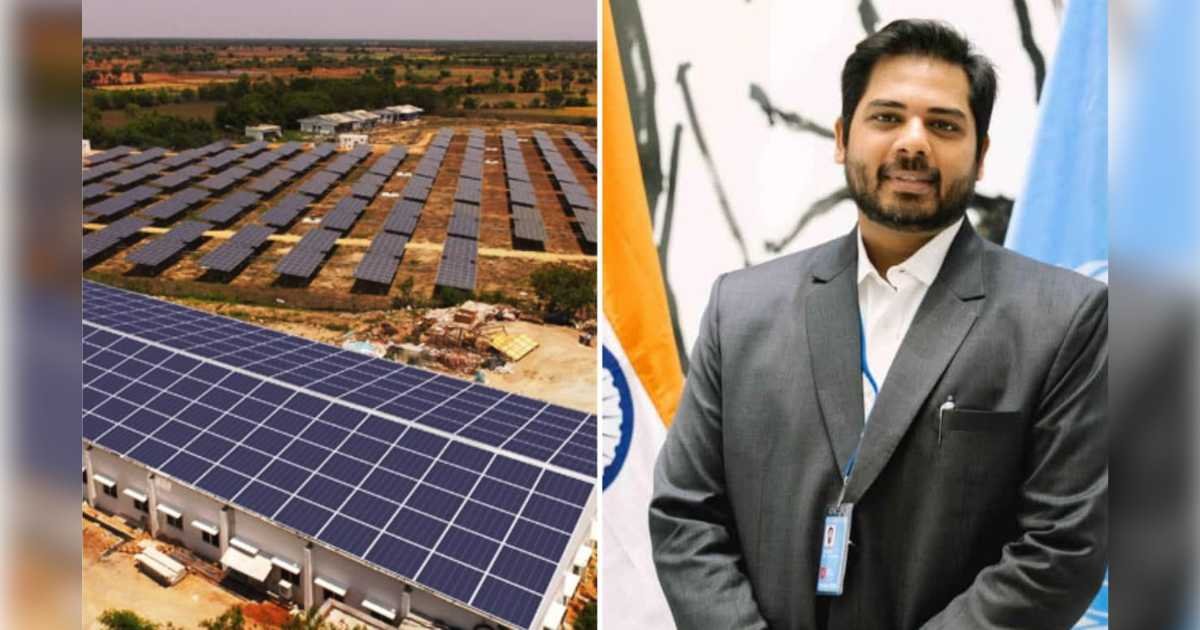
Hyderabad: Peddapalli MP Gaddam Vamsi Krishna has secured a European patent for his eco-friendly energy-generating roof invention.
The European Patent Office (EPO) approved the invention after examining application No. 17902782.6. It has assigned the technology Patent No. 3601699.
Vamsi Krishna said the grant marks recognition for an Indian innovation in sustainable energy. He also said the approval strengthens protection for the technology outside India.
The inventor filed the application on 14 November 2017. Its priority date was 31 March 2017, based on an Indian application. In its communication dated 10 September 2026, the EPO listed Gaddam Vamsi Krishna as the applicant and patent proprietor.
The invention, known as ATUM, combines roof material with solar power generation. It uses solar cells laminated with specially treated fibre cement boards. As a result, the system can serve as a roof while producing electricity.
Vamsi Krishna said the concept aims to make the roof itself a power-generating asset. He also highlighted strength, weather resistance and appearance as key features.
ATUM moves towards wider European protection
Meanwhile, the EPO decision covers several contracting states. These include Austria, Belgium, Germany, France, the United Kingdom, Italy, the Netherlands, Spain, Sweden, Switzerland and Turkey, among others.
The European Patent Bulletin 26/41 is scheduled to publish the grant on 7 October 2026. After that, the patent can move towards national validation in EPC states.
Where applicable, the grant can also support Unitary Patent protection in participating EU member states. The technology already holds patent protection in India, the United States and South Africa.
According to the source, ATUM can generate 20 to 40 per cent more power than conventional solar roofs over the same area. The system targets affordable housing, net-zero buildings and commercial establishments.
In addition, the technology combines electricity generation with the basic function of a building roof. Its developers aim to offer a sustainable energy option without requiring a separate conventional solar installation.
