

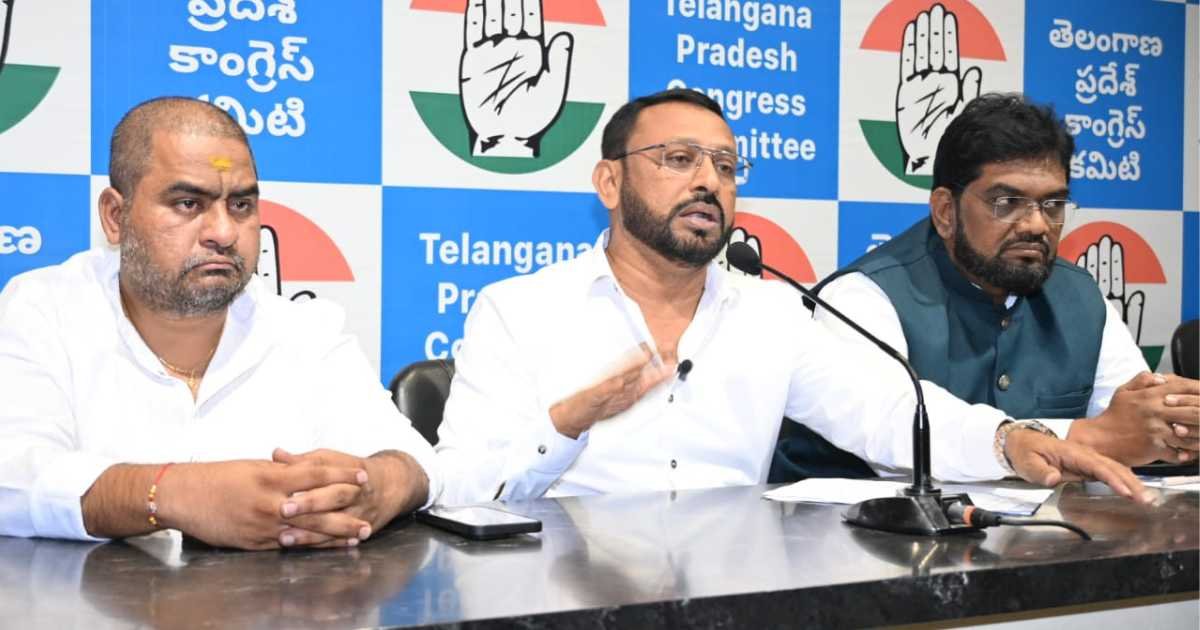
Hyderabad: TPCC spokesperson Syed Nizamuddin has demanded the withdrawal of the proposed Merchant Discount Rate (MDR) on higher-value UPI merchant payments.
Nizamuddin warned that the added cost could move through Hyderabad’s wholesale-retail supply chain. He said traders and consumers could ultimately feel its impact.
He made the remarks at a press conference at Gandhi Bhavan on Wednesday. Hyderabad DCC President Syed Khalid Saifullah, Bahadurpura Assembly in-charge Rajesh and senior Congress leader Advocate Jagan Mohan Reddy attended the event.
From October 15, eligible person-to-merchant UPI transactions above Rs 2,000 will attract a 0.4% MDR. The charge will have a maximum cap of Rs 300 per transaction.
However, person-to-person transfers will remain outside the charge. Merchant payments up to Rs 2,000 will also continue under the zero-MDR framework.
Specified small merchants receiving up to Rs 1 lakh a month through UPI QR payments will also retain the exemption. The Centre has said around 96% of merchant transactions by number will remain unaffected.
Nizamuddin said the 96% figure did not show the full impact. In his view, the remaining higher-value transactions could account for a much larger share of payment value.
He said traders could respond to the added expense in several ways. They could absorb the cost, reduce discounts, adjust prices or favour cash payments for larger transactions.
“Merely saying that the consumer will not be charged MDR does not settle the economic question. If the merchant has to bear a new cost on every eligible higher-value UPI sale, who eventually absorbs that cost?” he asked.
UPI MDR debate focuses on Hyderabad’s supply chain
Nizamuddin said the issue mattered particularly in Hyderabad because digital payments play a major role in local commerce. He cited July figures showing UPI transactions worth about Rs 24,939 crore in Hyderabad district.
Rangareddy recorded transactions worth Rs 35,119 crore, while Medchal-Malkajgiri recorded Rs 31,748 crore. Together, the three districts recorded nearly Rs 91,800 crore in UPI transactions in one month.
Those figures cover all UPI transactions and not only merchant payments. Nizamuddin nevertheless argued that the scale showed the importance of payment costs to the local economy.
For example, he referred to a tea stall whose individual sales may remain below the MDR threshold. The same trader, however, may buy milk, tea powder, sugar, cups, gas and other supplies through larger transactions.
“If the wholesaler or supplier receiving that payment falls in the chargeable category, that additional cost enters the supply chain. A small trader may sell in tens and hundreds of rupees, but he buys stock in thousands and tens of thousands,” he said.
Nizamuddin specifically cited Begum Bazaar, where wholesalers handle larger invoices on thin margins. A Rs 20,000 eligible transaction would attract Rs 80 MDR, while a Rs 50,000 transaction would attract Rs 200.
Similarly, he raised concerns about Laad Bazaar and Pathergatti. He said bridal, festive, pearl and jewellery purchases can involve higher-value payments.
He also named Hyderabad’s textile, handicraft, hotel and tourism sectors. According to him, these businesses could face similar concerns when eligible transactions attract the charge.
“In Hyderabad, this is not merely a fintech issue. It is a bazaar issue, a trader issue, a karigar issue and a tourism-economy issue,” Nizamuddin said.
He also questioned the Rs 1 lakh monthly UPI receipt limit for the small-merchant exemption. He said businesses could cross the threshold even when their profit remained limited.
The TPCC spokesperson acknowledged the costs involved in maintaining payment networks, cybersecurity and digital infrastructure. However, he questioned how those costs should be distributed.
The Centre has maintained that MDR is not a tax. It has also said the measure aims to support the long-term sustainability and expansion of the UPI ecosystem.
Nizamuddin demanded stronger protection for micro, small and traditional retailers. He also asked the Centre to disclose the value of transactions affected by MDR, rather than only their number.
“If 96% of transactions remain unaffected, the government should also tell people what share of merchant-payment value lies in the remaining 4%,” he said.
