

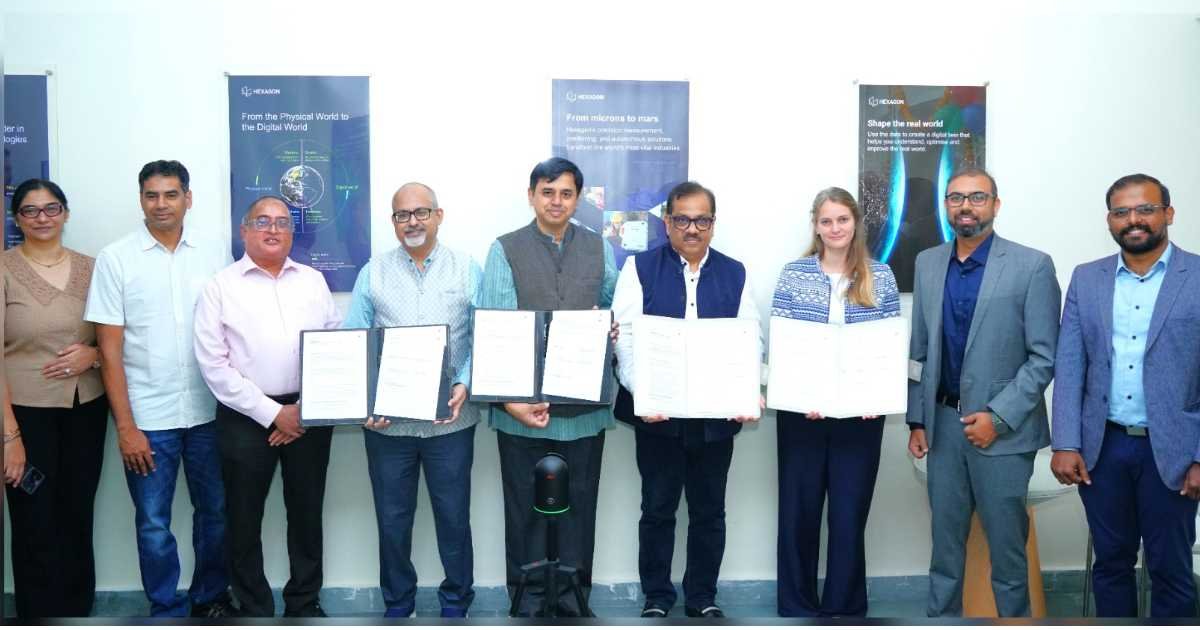
Hyderabad: IIIT Hyderabad and Hexagon R&D India are collaborating to establish the Hexagon Digital Twin Centre of Excellence (CoE). The Centre will come up at IIIT Hyderabad.
The partnership will focus on applied research, education and industry collaboration. It will cover computer vision, spatial computing and digital twins, with artificial intelligence (AI) supporting these areas.
As part of the collaboration, IIIT Hyderabad will provide its students, faculty and researchers access to Hexagon’s advanced precision imaging laser scanner. The equipment includes the Leica BLK360 G2 and its relevant software package.
The scanner will support high-fidelity digital twin creation. In addition, researchers will gain opportunities to work with industry-grade technologies and datasets.
The CoE will serve as a research and innovation platform. It will support prototypes, proofs of concept and solutions for real-world industry challenges.
Furthermore, students and researchers will explore new applications for spatial computing and computer vision. This work will connect academic research with practical industry requirements.
Digital Twin research to support industry applications
The collaboration also builds on Hexagon’s global academic engagements in deep tech and foundational sciences. At the same time, IIIT Hyderabad said the initiative would help raise the AI quotient for India.
Prof. Sandeep K. Shukla, Director, IIIT Hyderabad, said the partnership would give researchers and students access to advanced technologies and real-world spatial data. He added that these resources would create opportunities to take research from the laboratory to practical applications.
“This collaboration with Hexagon will give our researchers and students access to advanced technologies and real-world spatial data, creating opportunities to take research from the lab to practical applications,” Shukla said.
He also said the institute looked forward to building a strong research and innovation ecosystem through the Centre of Excellence.
Meanwhile, Navaneet Mishra, Senior Vice President and Head of Hexagon’s R&D India, said digital representation of the physical world was opening new possibilities across industries.
Mishra said the new Centre would give students and researchers access to Hexagon’s technologies and real-world challenges. Moreover, he described the collaboration with IIIT Hyderabad as an important opportunity for the company.
“The ability to capture, understand and digitally represent the physical world is opening up new possibilities across industries,” Mishra said.
Through the Centre, students and researchers will be able to work with industry technologies and datasets. Therefore, the initiative will provide an environment for testing ideas and developing practical applications.
Nora Hollenstein, VP, AI Hub at Hexagon AB, said Hexagon had research collaborations across the globe. Now, she said, the company was bringing that approach to India.
Hollenstein said the initiative would create an environment where ideas could be tested. Furthermore, she said deeper research could help develop real-world solutions.
The Centre will bring academic research and industry collaboration together. It will also give students and researchers opportunities to explore applications of digital twins, spatial computing and computer vision.
Moreover, access to the Leica BLK360 G2 and related software will support high-fidelity digital twin creation. Researchers can use these resources while developing prototypes and proofs of concept.
The collaboration will also support research into practical industry challenges. As a result, students and faculty will have opportunities to connect research work with industry needs.
Hexagon’s participation will expand its academic engagement in India. Meanwhile, IIIT Hyderabad will gain access to advanced technology and real-world spatial data through the Centre.
The initiative will therefore provide a platform for research, education and innovation. It will bring together AI, computer vision, spatial computing and digital twins within an industry-linked research environment.
