

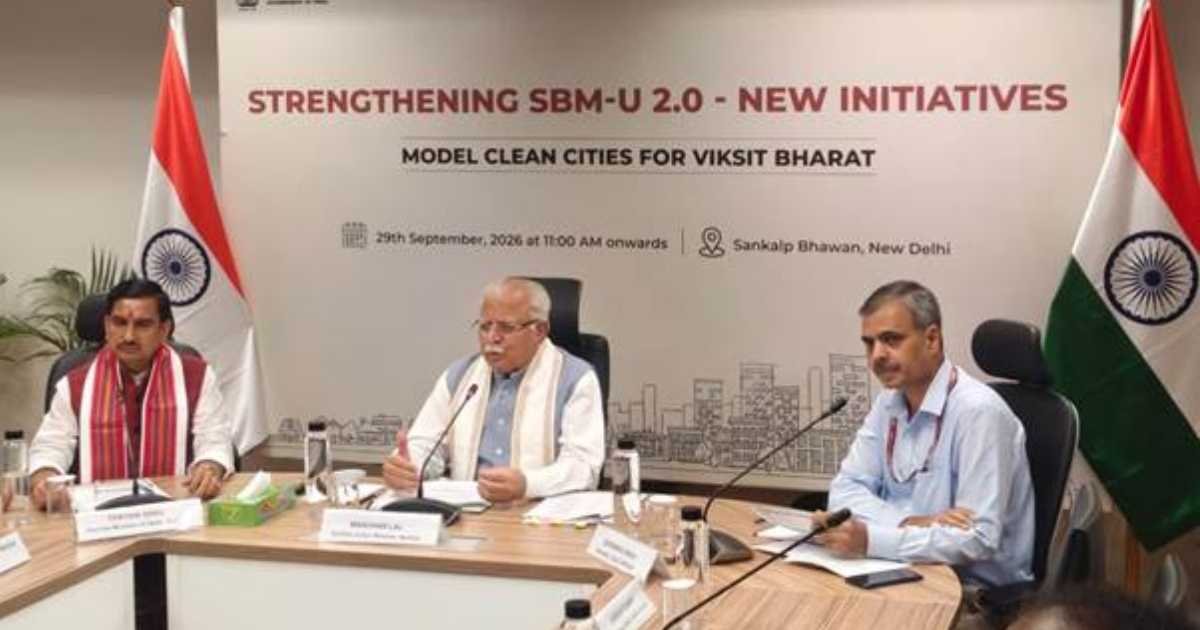
New Delhi: Union Minister for Housing and Urban Affairs Manohar Lal launched the PRAGATI-50 initiative in New Delhi on Tuesday to develop 50 model cities for Swachhata. The initiative covers cities across 24 states and aims to raise standards of urban cleanliness through targeted, KPI-based action and technology-enabled monitoring.
The initiative follows directions given by Prime Minister Narendra Modi during the 51st PRAGATI meeting. The Ministry of Housing and Urban Affairs (MoHUA) has selected the 50 cities under the Swachh Bharat Mission-Urban 2.0 framework.
Lal said the selected cities would demonstrate sustained performance in visible cleanliness. He said the initiative covers major cities, cities of cultural importance, major tourism destinations and economic centres.
The programme will focus on urban cleanliness, solid waste management, used water management, sanitation and citizen participation. Progress will undergo outcome-based assessment and technology-enabled monitoring within a defined timeframe.
Lal said he would personally chair review meetings every other month to track progress. The initiative will use intensive monitoring to assess the performance of the selected cities.
PRAGATI-50 initiative adds digital review and local action
Minister of State for Housing and Urban Affairs Tokhan Sahu said Swachhata has evolved from a people’s movement into a way of life over the past decade. He said the model cities programme would help cities work towards the Garbage Free Cities goal within a stipulated timeframe.
Sahu called on states and Urban Local Bodies to prepare micro-level action plans. He also stressed swift and effective implementation of those plans.
Department of Urban Development Secretary Satendra Singh said the effort would focus on better citizen experience and holistic service delivery. He highlighted a “City as a Whole” approach that includes stakeholders, partners and Urban Local Bodies in planning and implementation.
A Pro-Active Governance and Timely Implementation-like digital review mechanism has been established on the Swachhatam Portal. MoHUA officers will receive responsibility for specific cities and provide regular supervision and handholding.
The Ministry also released technical resources during the programme. These included a Standard Operating Procedure for establishing Secondary Collection Centres for Construction and Demolition Waste and guidelines for source segregation of municipal solid waste under the Solid Waste Management Rules, 2026.
PRAGATI-50 initiative expands innovation and citizen participation
MoHUA also launched the Swachh Bharat Test Bed & Innovation Centre at Durgapur in collaboration with CSIR-CMERI. The national facility will support research, product development, testing, validation, certification and capacity building in sanitation technologies.
The programme also expanded its startup initiative with the launch of the third cohort in collaboration with the Startup Incubation and Innovation Centre at IIT Kanpur. MoHUA said the Swachh Bharat Mission-Urban has engaged 75 startups across the waste value chain over the past decade.
The third cohort includes 13 startups working on sanitation and waste management solutions. Sahu said the cohort marks the achievement of the national target of onboarding and incubating 75 startups under the Mission.
The Ministry also launched a dedicated WhatsApp channel linked to the Swachhata App. The channel will help citizens lodge complaints and seek grievance redressal while participating in efforts to keep cities clean.
Swachhata resources and recycling centre launched
Union Minister Manohar Lal also launched the Swachhata Behaviour Change Digital Kosh. The digital repository brings together ideas, creatives, campaigns and resources aimed at strengthening behaviour change for a cleaner and more sustainable India.
The platform will provide states, Urban Local Bodies and other stakeholders with ready-to-use communication resources, campaign ideas and advocacy materials. It is intended to support knowledge sharing, replication and citizen-focused communication.
As part of Swachhata Hi Seva 2026, Lal inaugurated a Reduce Reuse and Recycle Centre at Sankalp Bhawan in New Delhi. It is envisaged as the first such centre in a Union Ministry office.
The centre will promote sustainable consumption, reuse, resource recovery and circularity in government workplaces. The Ministry said the wider urban sanitation effort is focused on innovation, peer learning and capacity building.
The PRAGATI-50 initiative is part of MoHUA’s broader effort to promote scientific waste management, circular economy practices and sustainable urban systems. The Ministry said these efforts aim to support resilient and future-ready cities as India works towards Viksit Bharat 2047.
