
Hyderabad DCC warned Centre’s MGNREGS changes will hit rural jobs and agriculture

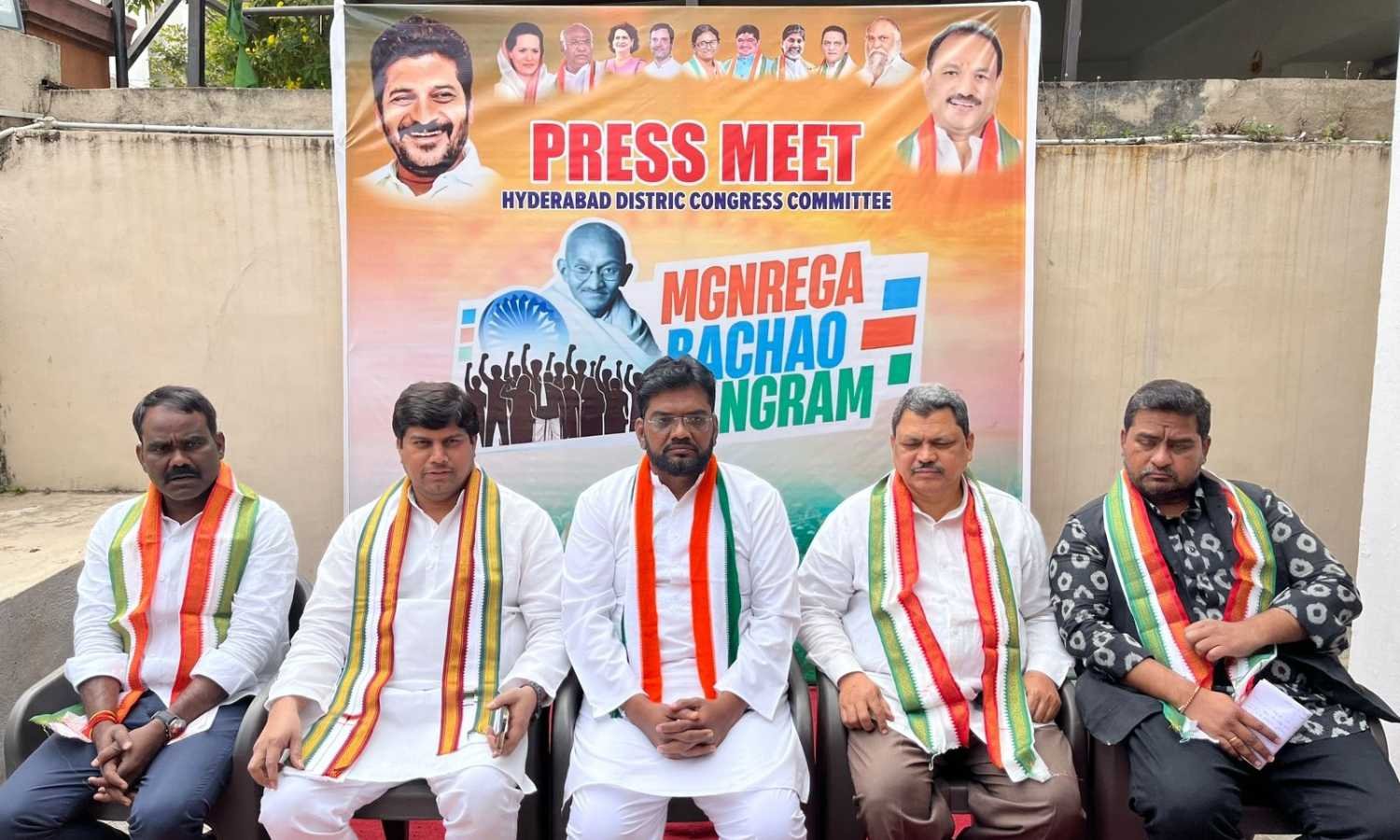
Hyderabad: Hyderabad District Congress Committee president Syed Khalid Saifullah on Saturday warned that the Centre’s proposed MGNREGS dilution would severely damage rural livelihoods, disrupt agriculture and create additional pressure on urban labour markets.
Addressing a press conference at Chintalkunta during the nationwide protest called by the All India Congress Committee, Saifullah said the changes amounted to a direct attack on the constitutional right to work. He alleged that the Union government was deliberately weakening one of the country’s most important social security schemes. Congress Assembly in-charges Rajesh Kumar Pulipati, B. Nagesh, Mohmmed Mujeebullah Shareef, Shaik Akbar and K. Ravi Raj also spoke.
Saifullah said the MGNREGS dilution would push rural workers to migrate to cities in search of livelihood. As a result, urban centres would face added pressure on jobs, housing and infrastructure. At the same time, villages would experience an acute shortage of farm labour, directly affecting agricultural activity.
MGNREGS dilution will disrupt farming and village institutions
Saifullah warned that crops such as paddy and vegetables would suffer due to labour shortages. Consequently, agricultural output would fall and prices would rise. He said the impact would not remain confined to villages but would disturb the entire economic chain linking farms and urban markets.
The Hyderabad DCC president recalled that MGNREGS guaranteed every rural household 100 days of employment annually, with work provided on demand. However, he alleged that the proposed framework would convert this legal right into a discretionary benefit controlled by the Centre.
Raising concerns over wages, Saifullah said earlier provisions ensured minimum wages with periodic revisions. In contrast, he alleged the new system would allow arbitrary wage fixation, deny work during harvest seasons and weaken workers’ bargaining power. He also claimed that the authority of gram panchayats was being eroded through centralised decision-making and the return of contractors.
Saifullah further alleged that the Centre was shifting the financial burden onto states by making them bear a larger share of wage payments. Therefore, he said states might hesitate to generate employment, shrinking rural job opportunities further.
He also criticised delays in wage payments and said MGNREGS wages had barely increased over the past decade despite rising inflation. Moreover, he alleged that digital systems such as Aadhaar-based payments and mobile monitoring had excluded genuine workers.
Saifullah said MGNREGS had acted as a lifeline during the Covid-19 pandemic. Any weakening, he warned, would deepen rural distress, weaken Panchayati Raj institutions and increase forced migration.
As part of the “MGNREGA Bachao Sangram”, he said the Congress would hold village-level meetings, pass gram sabha resolutions and conduct awareness campaigns nationwide. He reiterated demands for rollback of the proposed changes, restoration of the legal right to work, guaranteed wages with accountability and a national minimum wage of ₹400.
