

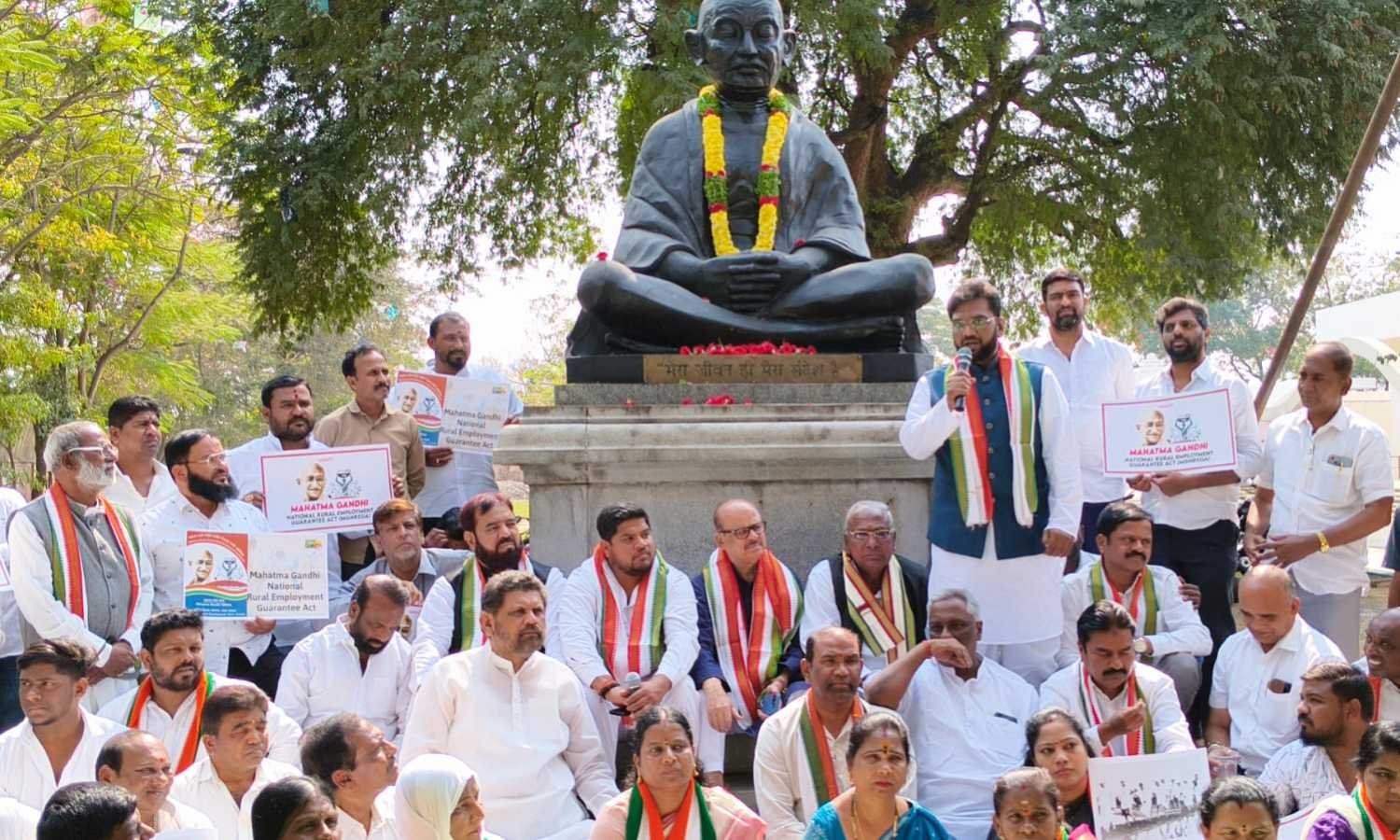
Hyderabad: Hyderabad District Congress Committee president Syed Khalid Saifullah on Tuesday accused the BJP-led NDA government of dismantling MGNREGA, calling it a direct attack on the Right to Work and rural livelihoods.
He raised the allegation while addressing a protest organised near Babu Ghat as part of the Congress party’s nationwide MGNREGA Bachao Sangram campaign. Senior Congress leader and former PCC president V. Hanumantha Rao, Khairatabad DCC president Motha Rohit and other leaders participated in the protest.
Khalid Saifullah said the Centre’s move to rename and restructure MGNREGA weakened the most critical lifeline of rural India. He argued that the scheme provided legal backing to employment and strengthened rural welfare across the country.
Recalling the origins of the programme, he said the Congress-led UPA government under Dr Manmohan Singh enacted MGNREGA two decades ago. Since then, the scheme generated over 180 crore person-days of employment and created nearly 10 crore rural assets, including tanks and roads. He added that it empowered Gram Panchayats to plan development works based on local needs.
Congress flags loss of rights under restructured MGNREGA
Khalid Saifullah alleged that the NDA government was undermining the core principles of MGNREGA. He said the legal guarantee of employment was being converted into a discretionary benefit, with the Centre deciding which Gram Panchayats could access work. According to him, this change stripped rural families of their right to demand employment.
He also warned that dismantling MGNREGA would affect wage security. He said the earlier system ensured minimum wages with annual revisions and year-round work. In contrast, the proposed structure fixed wages arbitrarily and suspended work during harvest seasons, leaving landless workers without income.
Congress leaders further accused the Centre of diluting the powers of Gram Panchayats. Under the original framework, Panchayats planned and executed works without contractors. However, Khalid Saifullah said the new model centralised decision-making and reduced Panchayats to implementing agencies.
He also criticised the proposed cost-sharing mechanism. Earlier, the Centre bore the full wage cost. Now, states must pay 40%, he said. As a result, poorer states may reduce workdays. He warned that women and SC/ST families, who form a large share of beneficiaries, would suffer the most.
