

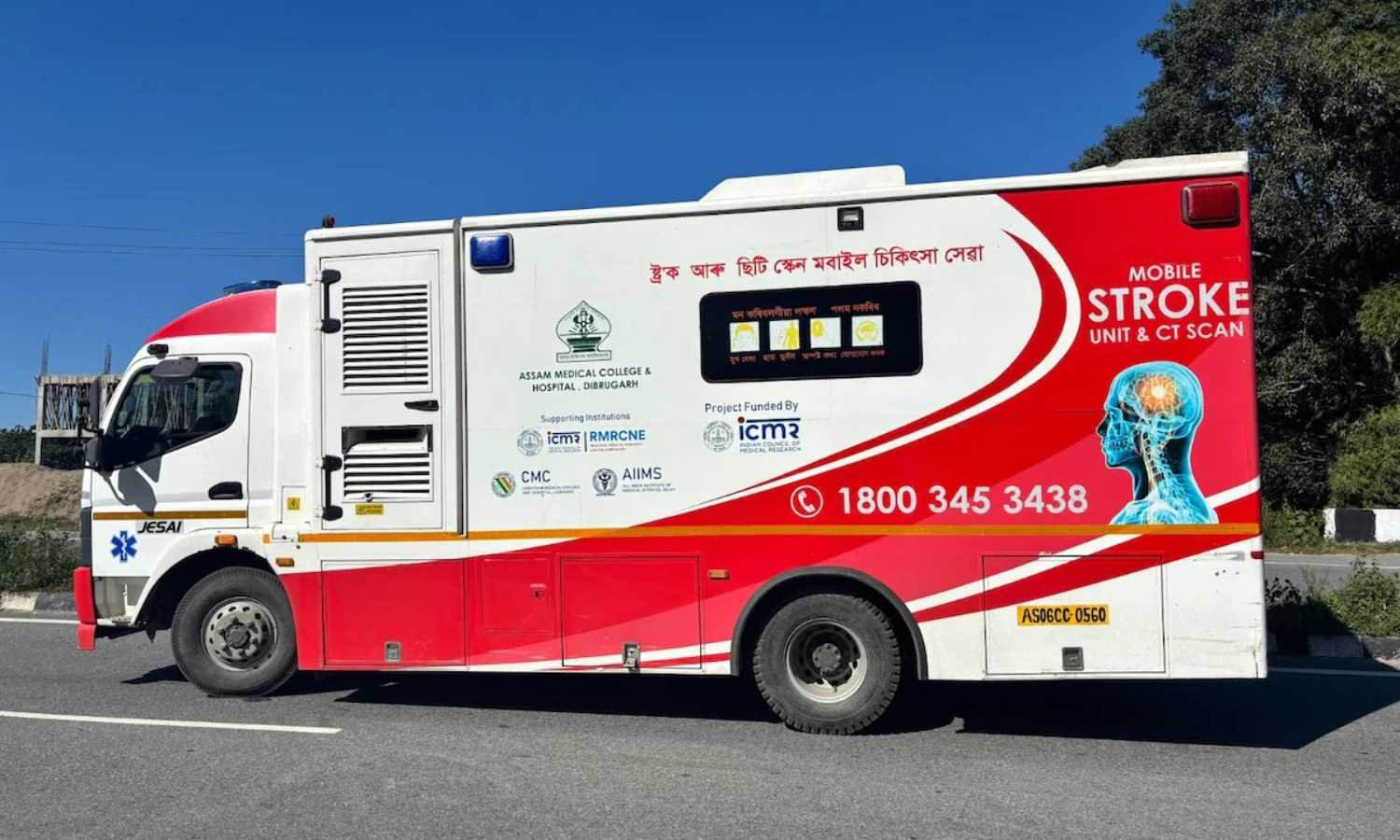
Guwahati: The Indian Council of Medical Research on Thursday handed over two Mobile Stroke Units to the Government of Assam, significantly strengthening stroke care in rural, remote and difficult terrains.
With this move, hospitals can now reach patients faster instead of patients travelling long distances to stroke-ready centres. As a result, critical treatment can begin much earlier. Officials said the initiative reflected the Centre’s focus on taking advanced healthcare to underserved populations, including women and marginalised communities.
Speaking at the handover, Secretary of the Department of Health Research and Director General of ICMR, Dr Rajiv Bahl, said India had become the second country globally to successfully integrate a Mobile Stroke Unit with emergency medical services for rural acute ischemic stroke care. He added that while such units were first developed in Germany, India evaluated them in challenging rural terrain in the Northeast.
According to Dr Bahl, the Assam model proved that advanced pre-hospital stroke care could work even in remote settings. Therefore, he said the results offered strong potential for wider adoption across the country.
Mobile Stroke Unit model cuts treatment delay dramatically
Sharing the state’s experience, Health and Family Welfare Secretary and Commissioner of Assam, P. Ashok Babu, said the handover strengthened the state’s emergency response system. Moreover, state ownership would ensure uninterrupted delivery of the life-saving service and support future expansion.
The Mobile Stroke Unit operates as a hospital on wheels. It carries a CT scanner, point-of-care laboratory, teleconsultation facilities and clot-busting drugs. Consequently, doctors can diagnose stroke early and start treatment near the patient’s home.
This approach is crucial in the Northeast, where difficult terrain and long travel times delay hospital access. To address this, ICMR earlier established a neurologist-led stroke unit at Assam Medical College, Dibrugarh. In addition, physician-led stroke units were set up at Tezpur Medical College Hospital and Baptist Christian Hospital, Tezpur. The Mobile Stroke Units were integrated into this pre-hospital care network.
Officials said the results were transformative. Treatment time dropped from nearly 24 hours to about 2 hours. At the same time, deaths fell by one-third, while disability reduced eightfold. Between 2021 and August 2024, the Mobile Stroke Unit handled over 2,300 emergency calls. Most patients received treatment directly from their homes, aided by integration with the 108 ambulance service, which expanded coverage to a 100-km radius.
