

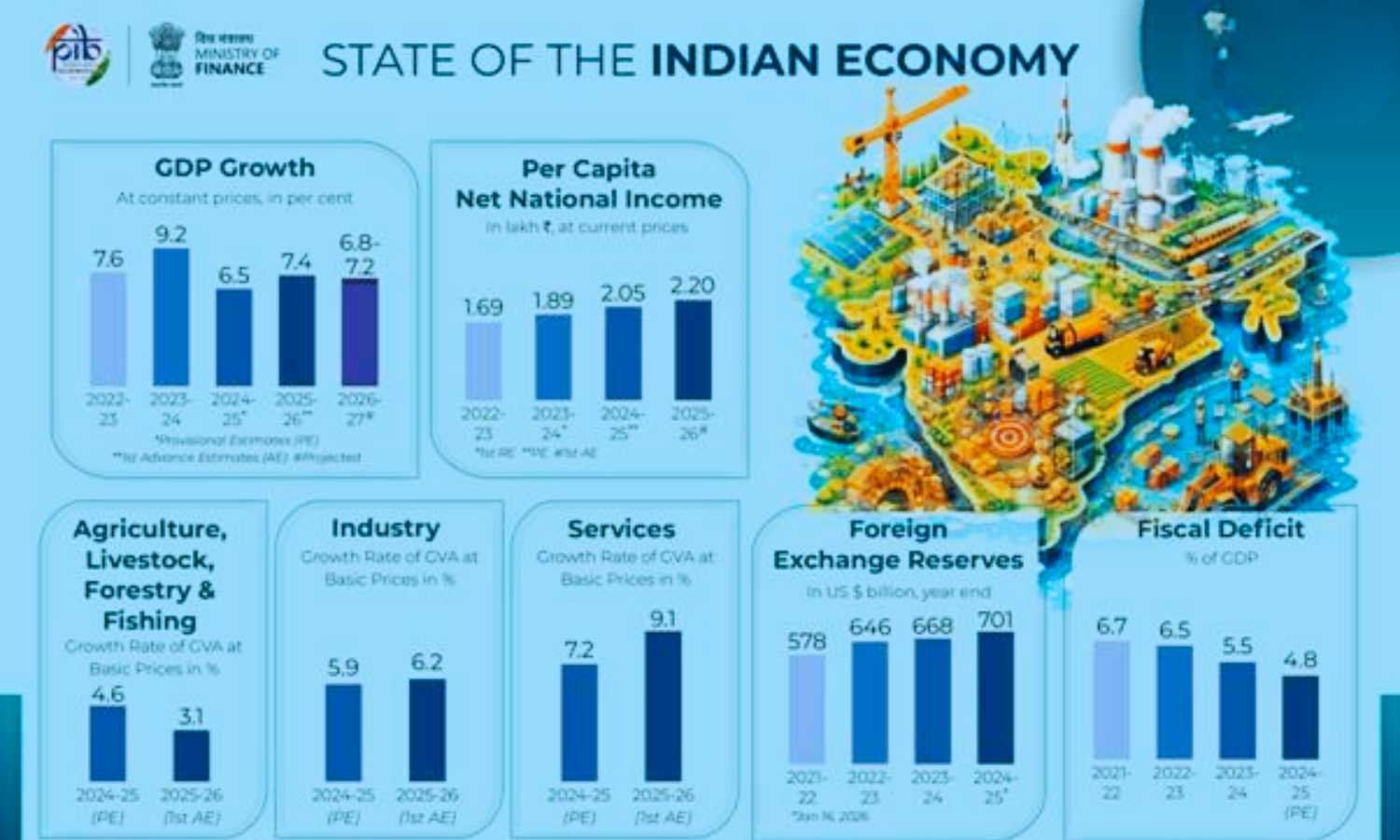
New Delhi: The Economic Survey 2025-26 projected India’s real GDP growth for FY27 in the range of 6.8–7.2%, signalling a transition towards a high-growth and resilient economy supported by stable macroeconomic fundamentals and broad-based sectoral performance.
The Survey, tabled on January 30, said India entered FY26 with strong momentum despite global uncertainties. It highlighted historically low inflation, improving labour market indicators and strengthening external buffers as key pillars of resilience. According to the First Advance Estimates, real GDP and gross value added were projected to grow by 7.4% and 7.3% respectively in FY26, reflecting robust demand conditions.
Inflation averaged a record low of 1.7% during April–December 2025, driven by easing food and fuel prices. The Reserve Bank of India subsequently lowered its inflation forecast for FY26 to 2.0%, while maintaining a benign outlook supported by favourable supply-side conditions and tax rationalisation measures.
Agriculture continued to stabilise rural demand, with the sector estimated to grow by 3.1% in FY26 following a favourable monsoon. Industrial activity gathered momentum, led by manufacturing, while services remained the dominant growth engine with an estimated expansion of 9.1% in FY26.
Economic Survey 2025-26 highlights sectoral and fiscal strength
The Economic Survey 2025-26 noted that manufacturing GVA accelerated sharply in the first half of FY26, aided by Production Linked Incentive schemes that attracted investments exceeding ₹2 lakh crore and generated over 12.6 lakh jobs. India’s innovation ecosystem also improved, with the country’s Global Innovation Index rank rising to 38th in 2025.
Services increased their share in GDP and GVA to historic highs, reinforcing India’s position as the world’s seventh-largest exporter of services. Total exports reached record levels of USD 825.3 billion in FY25, while services exports alone touched USD 387.5 billion.
Employment indicators strengthened alongside growth. Total employment rose to 56.2 crore in Q2 FY26, while the unemployment rate declined to 4.8% in December 2025. Female labour force participation increased to 35.3%, reflecting improved inclusion.
On the fiscal front, prudent management resulted in improved revenue buoyancy, rising capital expenditure and three sovereign credit rating upgrades in 2025. Gross GST collections crossed ₹17.4 lakh crore during April–December 2025, while effective capital expenditure rose to about 4% of GDP in FY25.
The Survey also highlighted supportive monetary conditions. The RBI reduced the repo rate to 5.25% by December 2025 and injected durable liquidity to ensure adequate credit flow. Banking sector health improved further, with gross NPAs at multi-decade lows and credit growth accelerating to 14.5% year-on-year in December 2025.
Overall, the Economic Survey 2025-26 concluded that India’s macroeconomic stability, strong services exports, comfortable foreign exchange reserves and advancing financial inclusion have strengthened the economy’s capacity to sustain growth while withstanding external shocks.
To ensure food security and support our farmers, the Department of Fertilizers and @RailMinIndia have achieved unprecedented coordination in FY 2025-26. A “Whole-of-Government” approach is ensuring no shortages during critical Kharif and Rabi seasons.#BalancedUseOfFertilizers pic.twitter.com/Ps9wCYUUOy
— Department of Fertilizers (@fertmin_india) January 30, 2026
