

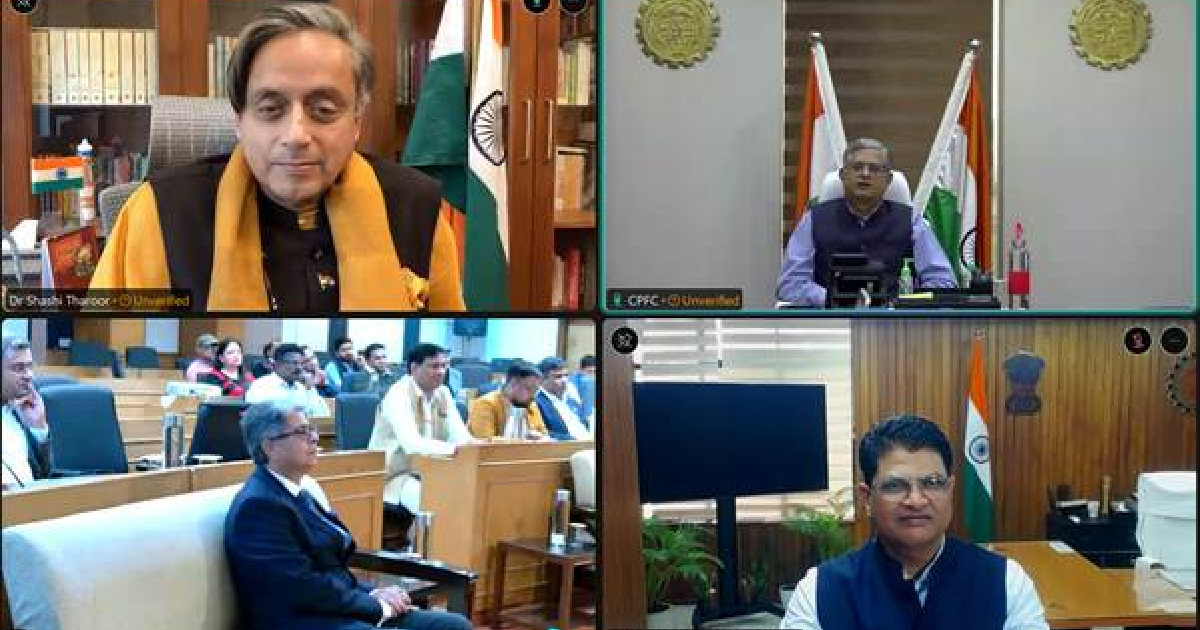
New Delhi: Shashi Tharoor described governance as a moral contract between the State and citizens during the 24th edition of Reimagining Governance: Discourse for Excellence (RGDE), hosted by the Employees’ Provident Fund Organisation (EPFO).
Delivering the keynote address, he urged public institutions to anchor reforms in dignity, trust and courage. The session marked the second anniversary and conclusion of Season One of RGDE, an institutional dialogue platform under the aegis of the Pandit Deendayal Upadhyaya National Academy of Social Security (PDUNASS).
Shashi Tharoor governance moral contract and reform vision
Tharoor stressed that transparency, accountability and participation must function alongside efficiency and empathy. According to him, governance cannot rely on compliance alone; instead, it must reflect moral responsibility.
He cautioned against equating digitisation with reform. Rather, he argued that institutions must redesign inefficient processes instead of merely digitising them. Sustained Government Process Re-engineering, he said, remains essential for meaningful change.
Highlighting a modern paradox, Tharoor noted that citizens still face repeated demands to prove identity and eligibility despite advanced digital systems. Therefore, governance should move toward integration and seamless delivery that reduces procedural hardship.
He also underlined that grievance redressal systems are instruments of democratic respect, not favour-granting platforms. Public service delivery, he added, must rest on dignity, empathy and institutional trust.
At the same time, he advocated a scientific temper in governance through evidence-based policy and data-driven review. However, he warned that knowledge without ethics can distance institutions from the people they serve.
His closing remark drew strong response: when governance becomes truly just, citizens no longer feel governed but cared for.
Launched on Good Governance Day in December 2024, RGDE has evolved into a reflective forum within EPFO. Over two years, discussions led to initiatives such as a “Compassion in Governance” module inspired by Kailash Satyarthi, process simplification efforts and strengthened ethics training. A joint diploma programme in Labour Law and Social Security with Gujarat National Law University is also in the pipeline.
Central Provident Fund Commissioner Ramesh Krishnamurthy reaffirmed EPFO’s commitment to citizen-centric and technology-enabled services. Meanwhile, PDUNASS Director Kumar Rohit highlighted the platform’s role in strengthening ethical leadership.
The session concluded with an interactive exchange moderated by Regional PF Commissioner Uttam Prakash. Responding to a question on Artificial Intelligence, Tharoor remarked that while AI can analyse data, it cannot replace human judgment or democratic accountability.
With this event, RGDE formally closed Season One. Season Two is expected to return with deeper engagement and renewed design.
