
Ispahani Tea: a Hyderabad-born tea legacy shaped by discipline, trust and enterprise continuity
Origins shaped by conviction and clarity of purpose


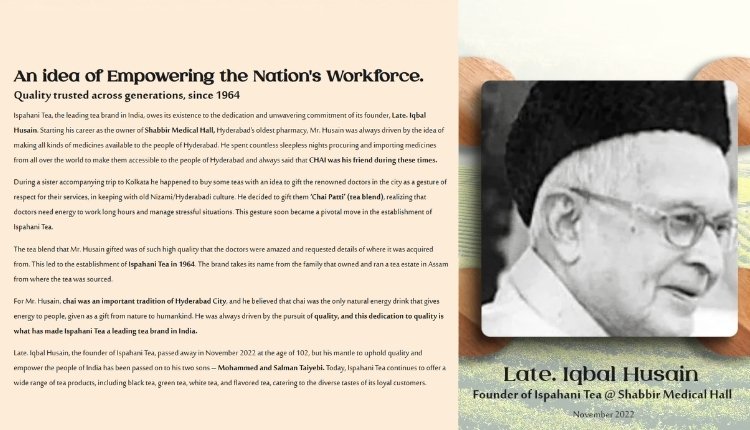
The establishment of Ispahani Tea in 1964 was not an accidental commercial venture, but the outcome of a deeply considered worldview held by its founder, Iqbal Hussain. A trained pharmacist by profession, Hussain carried into business the same principles that guided his medical training: discipline, consistency, ethics and social responsibility. For him, commerce was not merely about trade volumes; it was about influence. He believed that everyday products had the potential to shape routines, habits and even relationships.
Tea, in particular, held symbolic and practical significance in his thinking. It was not just a beverage. It represented energy for long working hours, companionship during conversation and an emotional bridge across diverse communities. In a culturally layered city like Hyderabad, tea already carried social weight. Hussain recognised that within this everyday ritual lay an opportunity to build something enduring.
A pivotal episode further clarified the direction of his enterprise. During a visit to Kolkata, Hussain presented carefully curated premium tea blends as a gesture of appreciation to a group of doctors. The response was striking. The recipients valued not only the flavour but the rare balance of strength, aroma and consistency in the blends. Their appreciation revealed an untapped demand for tea that did not fluctuate in quality from batch to batch.
Encouraged by this experience, Hussain formally founded Ispahani Tea in Hyderabad in 1964. The city’s long-standing chai culture, deeply woven into its social and commercial fabric, offered the ideal setting. From the very beginning, the brand was structured around method rather than speed. Quality control was prioritised, sourcing relationships were stabilised and blending standards were standardised. Hussain deliberately avoided aggressive advertising or opportunistic shortcuts. His guiding principle was simple: trust built through consistency would sustain the brand longer than promotional campaigns ever could.

Consolidation through steady, trust-based growth
The early decades of Ispahani Tea were characterised by gradual expansion rather than rapid geographical ambition. The company did not pursue sudden national visibility. Instead, it focused on building a dependable distribution ecosystem within Hyderabad and its adjoining markets.
Households, tea stalls and neighbourhood kirana stores became the brand’s core touchpoints. In these spaces, repeat consumption mattered more than novelty. Customers who purchased Ispahani Tea once often returned, reinforcing a cycle of habit-based loyalty. This slow but steady reinforcement allowed the brand to embed itself within everyday routines.
By the late 1980s and early 1990s, Ispahani Tea had built a structured and reliable distribution network across the Old City, emerging residential colonies and growing commercial hubs. The brand had by then positioned itself as a dependable, everyday tea. Its appeal resonated particularly with working families and small businesses that valued stable taste and affordability over experimentation.
This consolidation phase did not rely on dramatic rebranding. Instead, it was built on repetition, reliability and word-of-mouth credibility.
Generational transition and structured expansion
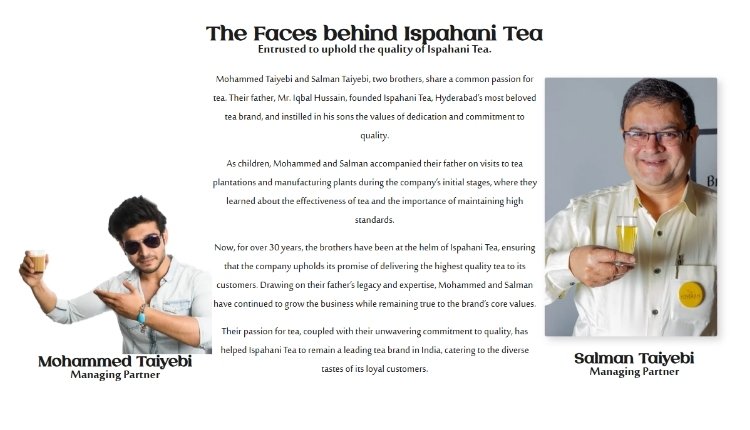
The next major shift in Ispahani Tea’s journey came with the transition of leadership to the founder’s sons, Mohammed Taiyebi and Salman Taiyebi. This generational change did not disrupt the brand’s core identity; rather, it introduced structured modernisation while retaining the foundational philosophy.
Mohammed Taiyebi concentrated on internal systems. His focus lay in refining supplier networks, strengthening operational frameworks and implementing scale-oriented controls. As production volumes expanded, he ensured that taste profiles and blending standards remained unchanged. Packaging formats were modernised, procurement channels streamlined and internal processes documented with greater precision.
Salman Taiyebi, meanwhile, directed attention outward. He focused on strengthening brand visibility, enhancing retail presence and expanding consumer interaction. Recognising evolving urban consumption patterns, he helped transition the brand from purely packaged products to experience-oriented formats.
This dual leadership approach created balance. While one strengthened operational discipline, the other expanded brand engagement. Together, they positioned Ispahani Tea for diversification without diluting its original identity.
Portfolio expansion and layered brand architecture
Over time, Ispahani Tea evolved into a multi-tiered brand structure. Its core range consists of strong black tea blends sourced from Assam, Darjeeling and the Nilgiris. These blends are designed for daily consumption and high repeat purchase cycles, ensuring consistency across households and commercial tea points.
To address shifting consumer preferences, the portfolio also includes green and white teas catering to lighter and health-oriented consumption habits.
A significant milestone in brand extension was the launch of Finjaan in 2002. Positioned as a premium and wellness-driven sub-brand, Finjaan introduced herbal and speciality blends suited for gifting, lifestyle consumption and curated tea experiences. This strategic differentiation allowed Ispahani Tea to enter higher-value segments without disturbing its mass-market foundation.
Another notable expansion is Bhai ki Chai, a café-style concept that reimagines tea as a social engagement space. While rooted in familiar flavours, it adopts a contemporary presentation format. This concept strengthens the brand’s connect with younger and urban consumers, expanding its relevance across demographics.
Experiential retail and flagship presence
A defining milestone arrived in 2022 with the opening of Ispahani Tea’s first flagship retail outlet at Mir Alam Mandi in Hyderabad’s Old City. The choice of location was deliberate. Establishing the flagship in a historically significant and culturally vibrant market reflected confidence in the brand’s origins.
The outlet serves as a comprehensive showcase, integrating classic tea blends, Finjaan speciality offerings and experiential components associated with Bhai ki Chai. It represents a strategic move towards direct consumer interaction through owned retail spaces rather than relying solely on distribution networks.
Key milestones in chronological perspective
• 1964: Ispahani Tea founded in Hyderabad by Iqbal Hussain
• 1967: Introduction of early flavoured tea variants
• 1990: Structured expansion of distribution across Hyderabad
• 2002: Launch of Finjaan herbal and speciality tea range
• 2022: Opening of the first flagship store at Mir Alam Mandi
Market position within Hyderabad
Within Hyderabad’s competitive beverage landscape, Ispahani Tea occupies a distinctive category. It is neither positioned as a short-term trend brand nor confined to luxury niche status. Instead, it represents a stable, volume-driven enterprise rooted in everyday life.
Hyderabad’s tea culture is shaped by long working hours, dense commercial interactions and neighbourhood social exchanges. Ispahani Tea aligns closely with these patterns. Its primary strength lies not in advertising intensity but in familiarity, accessibility and decades of accumulated trust.
As the city expanded geographically and economically, the brand evolved alongside it, maintaining continuity while adapting to scale.
Franchise expansion and entrepreneurial relevance
In its current phase, Ispahani Tea emphasises franchising as a structured growth pathway. Its long-standing operational history, diversified product formats and strong consumer recall offer a stable entry point for entrepreneurs.
Key advantages for franchise partners include six decades of brand trust, multiple retail formats ranging from packaged tea outlets to café-style concepts, centralised sourcing and standardised blends, alignment with high-frequency daily consumption, and scalability across both residential and commercial zones.
Rather than relying solely on premium positioning, the franchise framework is designed around predictable demand, repeat customers and operational clarity.
Continuity and adaptive enterprise
From Iqbal Hussain’s founding vision to the stewardship of Mohammed Taiyebi and Salman Taiyebi, Ispahani Tea’s journey demonstrates disciplined continuity and structured adaptation. The brand reflects Hyderabad’s cultural rhythms while sustaining generational leadership.
As it expands through franchising and experiential retail formats, Ispahani Tea continues to balance heritage with enterprise discipline – a Hyderabad-born brand structured for longevity and sustainable growth.
