

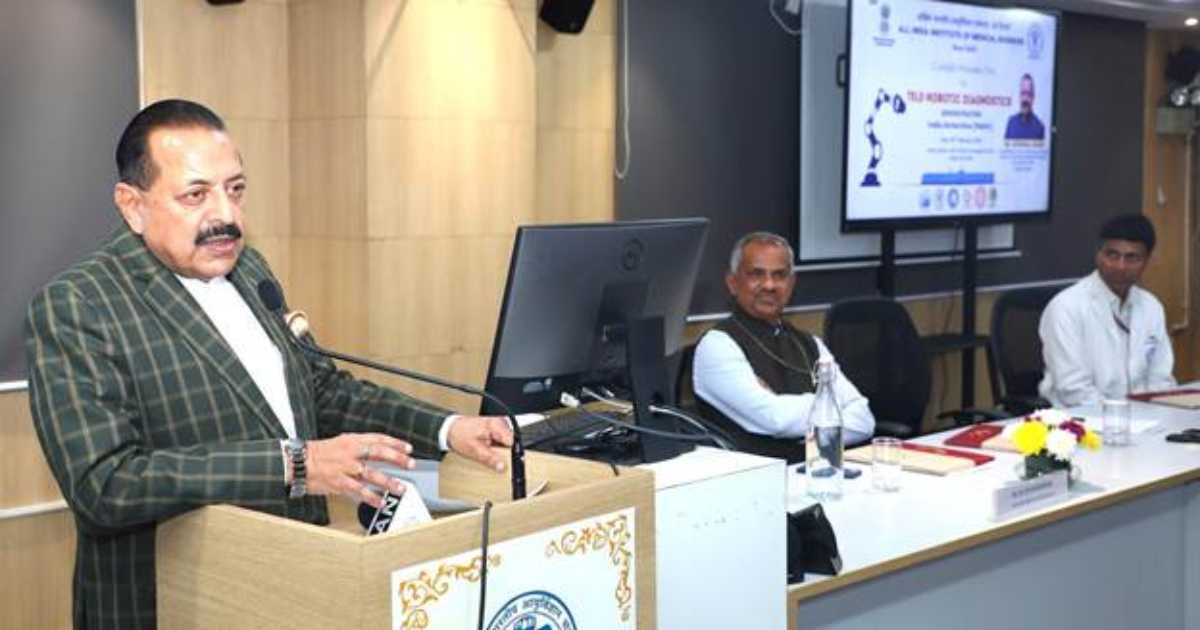
New Delhi: Union Minister Dr Jitendra Singh witnessed a live demonstration of Tele-Robotic Ultrasonography linking AIIMS New Delhi with Maitri Research Station in Antarctica, calling it a new dimension in AI-enabled healthcare. The system enabled radiologists in Delhi to conduct ultrasound scans on a volunteer stationed over 12,000 km away.
Developed jointly by AIIMS New Delhi and IIT Delhi in collaboration with the National Centre for Polar and Ocean Research under the Ministry of Earth Sciences, the indigenous system integrates AI, robotics and real-time medical expertise. The robotic arm, fitted with an ultrasound probe, offers six degrees of freedom and replicates precise hand movements of a trained sonographer.
With force-sensing safety features and less than one-second image delay, the platform supports emergency-focused assessments. These include FAST scans, abdominal evaluation, cardiac assessment and trauma screening. Therefore, doctors can take timely decisions even in extreme environments.
Tele-Robotic Ultrasonography expands remote healthcare access
Dr Jitendra Singh said the initiative reflects the Prime Minister’s “whole of science” and “whole of government” approach. He noted that institutions across ministries collaborated to make the innovation possible. According to him, such convergence expands specialist healthcare beyond geographical barriers.
The system is designed for remote and extreme locations like Antarctica. It helps determine whether a patient can receive treatment locally or requires evacuation. In Antarctica, airlifting remains costly and logistically complex. Hence, the technology could significantly reduce emergency evacuations.
Dr M. Ravichandran, Secretary, Ministry of Earth Sciences, said the innovation strengthens India’s scientific presence in polar regions. He described it as a model of inter-ministerial synergy.
The Minister also highlighted the rural-urban healthcare divide. He said technologies such as telemedicine, AI-driven diagnostics and robotic intervention can bridge gaps in specialist care. Moreover, he pointed to India’s advances in deep ocean research, Arctic policy, the Antarctica Act and digital health infrastructure as part of integrated scientific governance.
Dr Jitendra Singh stated that innovations emerging from India’s scientific ecosystem are expanding access to quality healthcare. He said such efforts reinforce India’s journey towards becoming a developed nation powered by science and technology.
