
Decarb Solutions: bridging the transition gap between fossil fuel dependency and Net Zero ambition


DeCarb™ a leader in both environmental solutions and the emerging carbon credits market, with as the flagship technology bridging immediate impact and long-term sustainability goals.
While world is investing trillions of dollars on Renewable energies & infrastructure for alternate energy solutions like green hydrogen, electric vehicles, and planting trees to protect environment. While billions of litres of fuel are still being burned inefficiently and polluting.
Every day, industries across transport, mining, marine, and power generation burn fuel inefficiently. This incomplete combustion doesn’t just waste money, it releases harmful emissions into the air our families breathe, accelerates climate change, and increases India’s dependence on costly crude oil imports. Decarb Solutions doesn’t just help industries comply with regulations, With India’s Net Zero 2070 commitment and the upcoming Carbon Trading Scheme (CTS) by 2026,
DeCarb Solutions bridges this gap
Our technology works with existing engines, existing fuels, and existing infrastructure. Immediate emission reductions without waiting for tomorrow’s solutions.
Our Solution:
DeCarb™ Technology: The Science of Cleaner Combustion, Revolutionizing Fuel at the Molecular Level, next-generation, biodegradable fuel conditioner doesn’t just treat it transforms fuel molecules converting complex clusters into simpler linear forms before combustion enables:
- Complete Combustion: More energy extracted from every drop Fuel
- Cleaner Engines: No harmful deposit buildup
- Lower Emissions: Significantly reduced Pollution
- Immediate Savings: from Day 1
Validation:
- Scientifically tested at IIT Hyderabad and BITS Pilani
- Compliant with BS VI, EN590, ASTM
- Verified by NABL-Certified laboratories
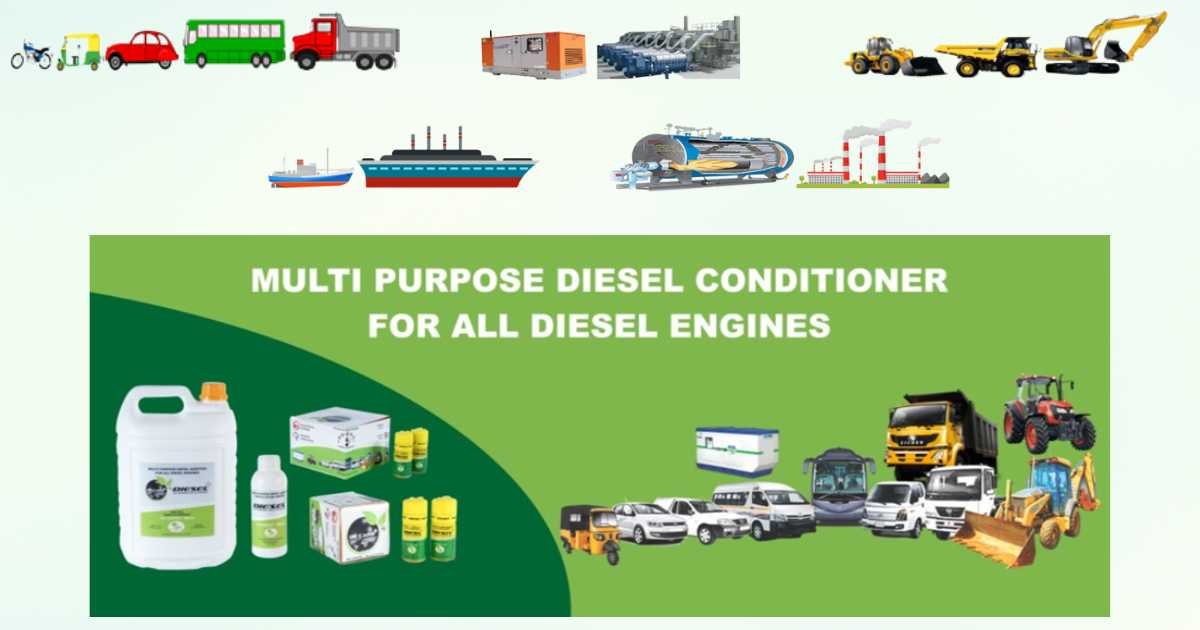
“DeCarb” designed to enhance fuel efficiency and Reduce Carbon Emissions across diesel-powered vehicles, generators, marine vessels, industrial boilers, and heavy machinery. by providing a scalable decarbonization solution that enables businesses to earn operational costs.
Key Highlights:
- Fuel Efficiency Improvement: Up to 8-12% reduction in fuel consumption.
- Emission Reduction: Cuts CO₂, NOx, SOx, and particulate matter (PM) emissions.
- Carbon Credit Opportunity: Enables industries to monetise emission reductions.
- Target Markets: Transportation, shipping, power generation, and industrial sectors.
- Scalability: Designed for rapid adoption across India and global markets.
ESTABLISHED RESULTS
As the world moves toward Net Zero, Decarb Solutions positions itself in the transition gap
Across the world, governments are committing to Net Zero targets. Europe has tightened emission regulations. The United States is accelerating clean energy investments. India has pledged to achieve Net Zero by 2070. Emerging economies are balancing development with decarbonisation.
The global conversation often centres on renewable energy – solar parks, offshore wind farms, green hydrogen corridors and electric mobility. Yet beneath the ambition lies a practical reality: the global economy still runs largely on fossil fuels.
Heavy transport relies on diesel. Shipping depends on marine fuels. Mining, manufacturing and construction are powered by fuel-intensive equipment. Even as renewable capacity grows, fossil fuels remain deeply embedded in industrial systems.
This creates a critical transition challenge.
How can emissions be reduced immediately within systems that cannot yet be replaced?
It is within this global transition gap that Decarb Solutions positions its work – not as a replacement for renewable energy, but as a technology aimed at making existing fuel systems cleaner and more efficient.
The overlooked layer in decarbonisation
Global Net Zero roadmaps acknowledge a phased transition. While renewables expand, fossil fuel use will not disappear overnight. Infrastructure, cost structures and industrial dependencies make that clear.
In many regions, especially developing economies, large-scale electrification of heavy industry remains financially and technically complex. Ships cannot instantly convert to electric propulsion. Mining fleets cannot immediately transition to hydrogen. Long-haul freight still depends heavily on diesel.
Transitional efficiency technologies therefore become relevant.
Decarb Solutions develops fuel-conditioning technology designed to improve combustion performance within existing engines and industrial systems. Instead of requiring new infrastructure, the solution integrates into current fuel use.
The premise is straightforward: when fuel burns more completely, less of it is wasted and fewer harmful emissions are produced.
Combustion efficiency as climate strategy
Combustion inefficiency contributes significantly to fuel waste and pollution. Incomplete burning leads to:
- Higher fuel consumption
- Increased particulate matter
- Carbon deposits in engines
- Emission of carbon monoxide, nitrogen oxides and unburned hydrocarbons
- Reduced engine life
Improving combustion does not eliminate fossil fuel use, but it reduces the environmental impact per unit of fuel consumed.
The company’s (Decarb Solutions) biodegradable fuel conditioner is blended with diesel, furnace oil, marine fuels and certain alternative fuels. It aims to improve atomisation and fuel-air mixing, enabling more complete combustion.
The potential impact operates at two levels:
- Reduced fuel consumption
- Lower emissions per litre burned
For industrial operators, this is not only an environmental question but also an economic one. Fuel represents one of the largest operating costs in heavy industry. Even marginal improvements in efficiency can translate into significant financial savings across large fleets and industrial operations.
The global compliance shift
Climate policy is evolving worldwide. Carbon pricing mechanisms are expanding. Emission reporting requirements are tightening. Investors are scrutinising ESG disclosures more closely than ever before.
As carbon markets mature, measurable emission reductions gain financial significance.
For industries operating under carbon pricing regimes, lowering emissions is not merely reputational – it directly affects compliance costs and profitability. Technologies that offer quantifiable fuel savings and emission reductions may therefore become part of broader decarbonisation strategies.
Decarb Solutions positions its model within this evolving regulatory environment. Its proposition is that improving combustion efficiency can contribute to emission reduction targets without requiring capital-intensive infrastructure overhaul.
![Decarb Solutions: Cleaner Combustion Technology for Net Zero Transition]()
The bridge between fossil dependency and renewable ambition

The global energy transition is often framed as a binary shift from fossil fuels to renewables. In reality, it is more layered.
Renewables expand. Electrification increases. Hydrogen projects develop. Carbon capture technologies evolve. At the same time, fossil fuels remain in use during the transition.
Bridge technologies operate in this intermediate space.
They do not replace renewables. They do not eliminate fossil fuels. Instead, they attempt to reduce the environmental cost of existing energy systems while the broader transition unfolds.
For developing economies – where energy demand continues to rise – such bridge mechanisms can provide incremental emission reductions without disrupting industrial growth.
Industrial testing and real-world deployment
Efficiency technologies face credibility challenges. Laboratory performance does not always translate to industrial environments. Heavy equipment, marine engines and industrial boilers operate under extreme and variable conditions.
The company’s development narrative includes laboratory validation as well as field testing across industrial sectors. Extended operational trials in mining environments, for example, expose technologies to high-load, high-stress conditions typical of real-world industry.
For global adoption, independent testing and verifiable performance metrics remain critical. Industrial decision-makers prioritise measurable data over theoretical claims.
In a market where fuel additives and performance enhancers are common, differentiation depends on documented efficiency gains and emission reduction evidence.
Economic logic in climate transition
Climate action is often portrayed as a cost burden. However, efficiency-based solutions introduce a different narrative – one of cost optimisation aligned with environmental benefit.
When fuel consumption decreases:
- Operating costs decline
- Emission output reduces proportionally
- Maintenance cycles may extend
- Equipment longevity may improve
- This alignment between profitability and sustainability is central to industrial adoption.
In sectors such as shipping, mining and long-haul transport, fuel accounts for a substantial share of operational expenditure. Small percentage improvements can scale significantly across fleets and facilities.
As carbon accounting becomes integrated into corporate financial reporting, the economic case for emission reduction technologies strengthens.
Compatibility with global fuel standards
One of the challenges in scaling fuel-related technologies internationally is regulatory compatibility. Fuels are governed by strict standards across regions – including BS VI in India, EN standards in Europe and ASTM standards in North America.
Technologies that interact directly with fuel must operate within these regulatory frameworks to ensure compliance and safety.
Global positioning requires compatibility across diverse fuel types and specifications. Without that, adoption remains geographically limited.
The company emphasises compliance with major international fuel standards, allowing potential application across different markets.
Climate transition in developing economies
Emerging economies face a dual challenge: reducing emissions while continuing industrial expansion.
Unlike developed countries that built infrastructure decades ago, many developing nations are still constructing roads, ports, power plants and industrial corridors. Energy demand growth remains strong.
In this context, transitional efficiency technologies may play a larger role than often acknowledged.
While renewable energy expansion accelerates, heavy industries still rely on fossil fuels. Combustion optimisation can reduce cumulative emissions over the transition period.
Cumulative emissions matter. The total carbon released between now and 2070 influences global temperature outcomes. Reducing emissions incrementally across existing systems can therefore contribute meaningfully to climate goals.
The evolving role of carbon markets
As compliance carbon markets expand globally, emission reductions acquire measurable monetary value.
Carbon credits and offset mechanisms increasingly integrate into corporate sustainability strategies. For emission reduction to qualify under compliance frameworks, it must be:
- Measurable
- Verifiable
- Transparent
Technologies that operate within fuel systems must demonstrate quantifiable emission reduction metrics to participate meaningfully in carbon markets.
If validated within regulatory systems, combustion efficiency improvements could contribute to carbon reduction accounting in certain sectors.
A layered transition, not a single leap
The global energy transition will not unfold through a single technological breakthrough. It will involve:
- Renewable capacity expansion
- Electrification
- Hydrogen integration
- Carbon capture deployment
- Behavioural change
- Efficiency optimisation
Efficiency often receives less public attention than renewable megaprojects, but it forms a foundational layer of decarbonisation strategy.
Improving how energy is used – not just how it is generated – is equally critical.
Combustion optimisation, in this sense, represents a refinement strategy. It operates within current energy systems while the broader structural transformation continues.
From local innovation to global relevance
Climate technology companies increasingly emerge from regions previously considered outside traditional clean-tech hubs. As developing economies take larger roles in global climate action, innovation ecosystems diversify.
A firm focused on improving fuel combustion may not capture the headlines of solar giga-factories or battery megaplants. Yet its relevance lies in practicality.
The global transition gap – between fossil dependency and renewable maturity – creates space for technologies that reduce environmental impact today.
As Net Zero timelines approach and regulatory frameworks tighten, industries worldwide will likely explore every viable pathway to reduce emissions without compromising operational continuity.
In that evolving landscape, technologies aimed at cleaner combustion may find increasing relevance – not as a final destination in decarbonisation, but as a bridge in the journey.
Because in the global climate transition, refinement and replacement must move together.
