

New Delhi: The Union Government launched the EEZ Access Pass to enable sustainable fishing in India’s Exclusive Economic Zone and unlock high-value marine resources beyond coastal waters.
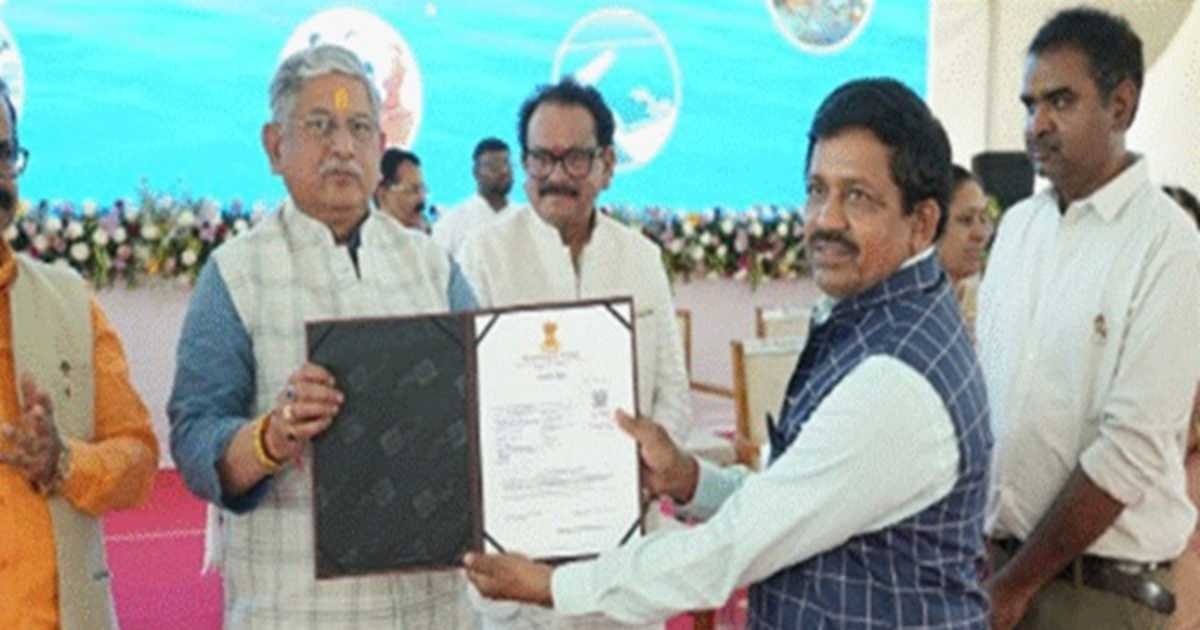
Union Minister for Fisheries, Animal Husbandry and Dairying and Panchayati Raj Shri Rajiv Ranjan Singh rolled out the initiative for all 13 coastal States and UTs from Veraval, Gujarat on February 20. During the event, he handed over passes to 37 fishermen representing 24 fisheries cooperative societies.
The move followed the Union Budget 2025–26 announcement of a framework to utilise fisheries resources in the EEZ and high seas. India has a coastline of about 11,099 km and an EEZ of nearly 24 lakh square kilometres. However, most fishing activity currently remains within 40–50 nautical miles of the shore, leaving deeper waters under-utilised despite strong tuna potential.
The government notified the Sustainable Harnessing of Fisheries in the Exclusive Economic Zone Rules, 2025 on November 4, 2025. These rules provide the legal basis for responsible harvesting while protecting marine ecosystems and fishers’ livelihoods.
EEZ Access Pass issued free through ReALCRaft portal
Under the new framework, mechanised and large motorised vessels must obtain the EEZ Access Pass through the upgraded ReALCRaft portal. The government will issue the pass free of cost in a time-bound and transparent manner. Traditional non-motorised crafts remain exempt, thereby safeguarding small and artisanal fishers.
The ReALCRaft platform, developed by NIC and the Department of Fisheries, offers online services for vessel registration and licensing. Moreover, it integrates with the Marine Products Export Development Authority and the Export Inspection Council for catch and health certificates. This single-window system improves traceability and supports seafood exports to premium markets.
The Department of Fisheries will also conduct structured training through CIFNET and the Fisheries Survey of India. In addition, a Joint Working Group with the Ministry of Cooperation will promote the role of cooperatives in deep-sea fishing and value chains.
The government is installing one lakh transponders free of cost to improve sea safety. So far, over 50,000 devices have been fitted to enable real-time tracking and distress alerts. Nearly 6 lakh fisher families receive annual livelihood support during lean seasons, while accident insurance now covers up to ₹5 lakh for more than 33 lakh fishers.
