

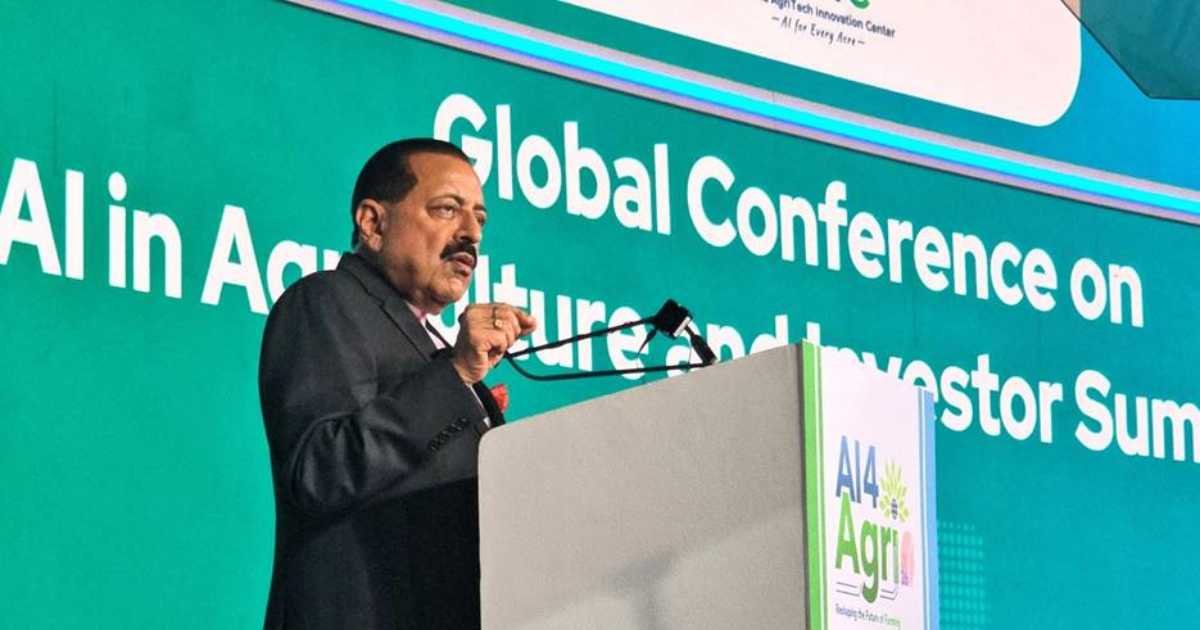
New Delhi: The Agri-AI push will power India’s next agricultural revolution, Union Minister Dr. Jitendra Singh said at the AI4Agri 2026 Summit in Mumbai.
Addressing the Global Conference on AI in Agriculture and Investor Summit 2026, he positioned artificial intelligence at the centre of farm policy and research. He said AI can deliver scalable solutions to erratic weather, market gaps and low productivity. Even a 10% productivity gain for 600 million farmers across the Global South would create the largest poverty-reduction opportunity of the century, he added.
Linking the Agri-AI push to the ₹10,372-crore India AI Mission, he said the programme is building sovereign compute capacity and datasets. He highlighted BharatGen’s “Agri Param”, a domain-specific model that works in 22 Indian languages. As a result, farmers can access advisories in their own language.
He said the Department of Science and Technology is backing an open India AI Stack to ensure interoperability. In addition, the Anusandhan National Research Foundation is funding AI research with IITs, IISc and ICAR for farm applications.
Agri-AI push targets national data commons and value gain
Dr. Jitendra Singh said AI-enabled advisories could unlock ₹70,000 crore in annual value. If each of India’s 140 million farm holdings saves ₹5,000 a year, the cumulative gain would be significant, he noted. He cited Maharashtra’s ₹500-crore MahaAgri-AI Policy 2025–29 as a model and said the Centre would align with such initiatives.
The Union Budget 2026–27 has proposed Bharat-VISTAAR, a multilingual AI tool integrating AgriStack and ICAR systems. This platform will offer customised advisories and reduce farm risks. Moreover, the focus remains on small AI models trained on Indian soil, climate and crop data.
He called for a National Agri-AI Research Network linking DST, state governments, ICRISAT and ICAR. The proposed framework will build India-specific datasets for crops, soil and climate. Furthermore, he urged investors to back scalable platforms rather than isolated pilots.
Concluding, he said farmers need AI that delivers practical value. He stressed that India aims to act as a co-architect of global agri-AI frameworks rather than a passive recipient.
