

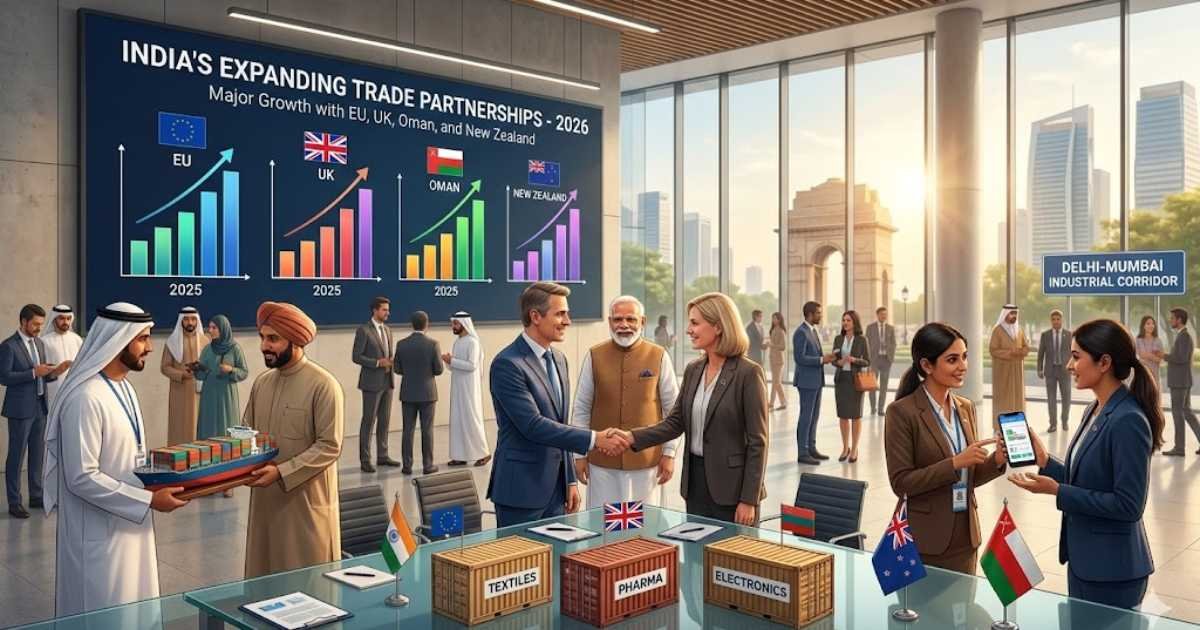
New Delhi: India trade partnerships entered a decisive phase in 2026 as the country expanded its free trade agreement (FTA) network and strengthened global economic integration.
According to the UNCTAD Trade and Development Report 2025, India ranks third among Global South economies in trade partnership diversity. Moreover, its diversity index score surpasses that of all Global North economies. This reflects resilience amid tariff uncertainties and evolving global demand.
India’s expanding FTA network has improved market access and strengthened integration into global value chains. Consequently, export-oriented sectors are scaling production while services trade continues to show steady growth.
India trade partnerships gain momentum in 2026
In January 2026, India concluded negotiations on the landmark India–EU Free Trade Agreement, often described as the “Mother of All Deals.” The agreement provides preferential access across 97% of EU tariff lines and immediate duty elimination on 70.4% of tariff lines covering 90.7% of India’s exports. Labour-intensive sectors such as textiles, leather, marine products, gems and jewellery and processed foods are set to gain significantly.
During FY 2025-26, India also concluded FTAs with the United Kingdom, Oman and New Zealand. The India-UK Comprehensive Economic and Trade Agreement grants duty-free access to nearly 99% of India’s exports and eases mobility for professionals. Similarly, the India-Oman CEPA offers zero-duty access on over 98% of Oman’s tariff lines, while New Zealand eliminated duties on 100% of tariff lines from the date of entry into force.
Earlier agreements continue to deliver gains. The India-UAE CEPA has already pushed bilateral trade beyond USD 100 billion. Meanwhile, the India-Australia ECTA and the India-EFTA TEPA are driving export growth, services cooperation and long-term investment commitments.
Beyond concluded agreements, India expanded its negotiation agenda in 2026. It formally launched FTA negotiations with the GCC, concluded the first round of talks with Israel and advanced discussions with ASEAN, Mexico and Canada. In addition, India reached a framework understanding with the United States for an interim trade arrangement.
Domestic reforms support exporter competitiveness
Alongside global agreements, India strengthened domestic enablers. The Trade Connect ePlatform now offers tariff explorer services, helping exporters utilise FTA benefits effectively. Furthermore, the Export Promotion Mission and the Credit Guarantee Scheme provide liquidity and financial stability.
Regulatory reforms extended export credit tenors, eased realisation timelines and allowed electronic sealing for factory-to-port cargo movement. Budget 2026-27 also removed the ₹10 lakh value cap on courier exports and expanded duty-free input coverage.
Together, these measures reinforce India trade partnerships by combining international market access with domestic competitiveness. As a result, India is positioning itself as a trusted and resilient player in global trade, aligned with its long-term vision of Viksit Bharat.
