

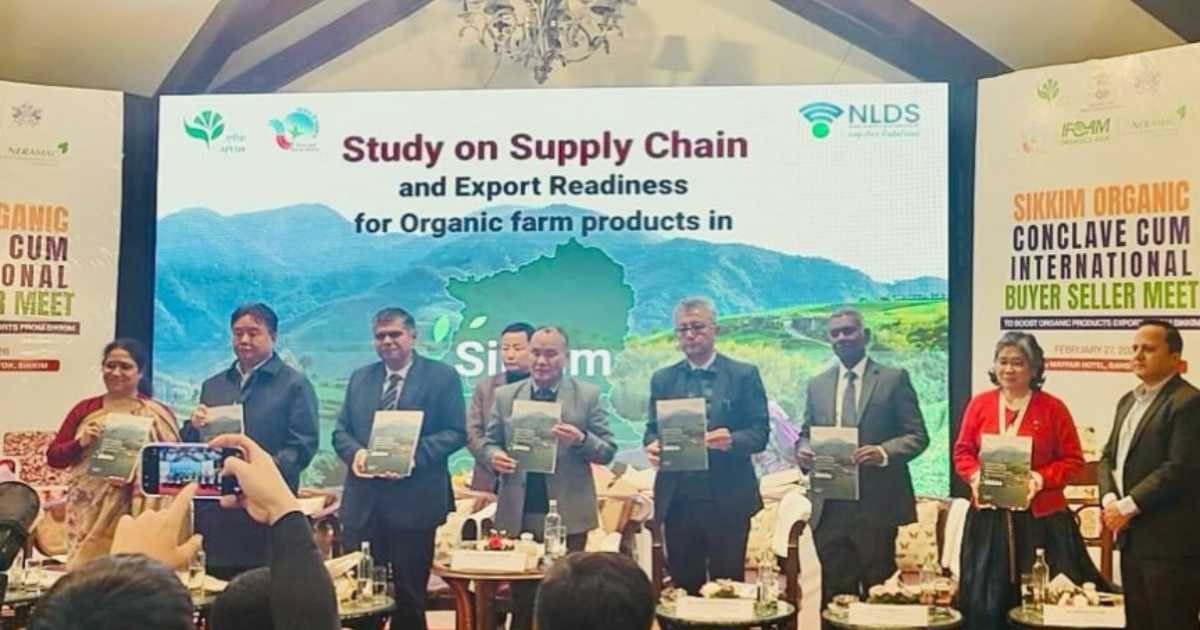
Gangtok: The Agricultural and Processed Food Products Export Development Authority organised the Sikkim Organic Conclave in Gangtok, bringing together international buyers, exporters and farmer groups to boost organic exports.
APEDA held the conclave in collaboration with the Government of Sikkim and in association with IFOAM-Asia. During the event, officials released a Knowledge Report on supply chain and export readiness of Sikkim’s organic produce.
The report, prepared by NICDC Logistics Data Services Ltd., outlined a roadmap to strengthen export infrastructure. It recommended streamlined processes, better aggregation and transparent price discovery. Moreover, it called for strategic market positioning to improve competitiveness while ensuring sustainability and traceability.
Around 40 buyers from 17 countries attended the meet. These included participants from South Korea, UAE, Mongolia, Saudi Arabia, Oman, Singapore, Norway, Kuwait and the United Kingdom. In addition, about 20 Indian exporters joined structured business sessions with nearly 100 Farmer Producer Organisations from Sikkim.
Knowledge report anchors Sikkim Organic Conclave roadmap
The Department of Agriculture and Horticulture, Government of Sikkim, coordinated the buyer–seller interactions. The Sikkim Organic Farming Development Agency also supported the initiative. As a result, exporters and FPOs explored new trade linkages and long-term supply partnerships.
An exhibition featuring 12 exhibitors showcased certified organic products. These included Large Cardamom, GI-tagged Dalle Khursani, Sikkim Mandarin, Buckwheat, Turmeric and Orchids. Consequently, international buyers showed interest in the State’s export-ready produce.
Sikkim became India’s first fully organic state in 2016. Later, the United Nations Food and Agriculture Organization conferred the Future Policy Gold Award on the State in 2018 for its leadership in organic farming.
Officials also conducted a technical session on the 8th Edition of the National Programme for Organic Production. The session explained updated regulations and labelling requirements. Furthermore, it highlighted compliance standards and international equivalence norms to strengthen India’s credibility in global organic trade.
In the second phase, international buyers will visit organic production clusters in Sikkim. They will observe certified farming practices and post-harvest handling systems. Therefore, organisers expect stronger farm-to-market linkages and improved buyer confidence.
Through the Sikkim Organic Conclave, APEDA aims to expand market access, build exporter capacity and position the State as a key contributor to India’s organic export growth.
