

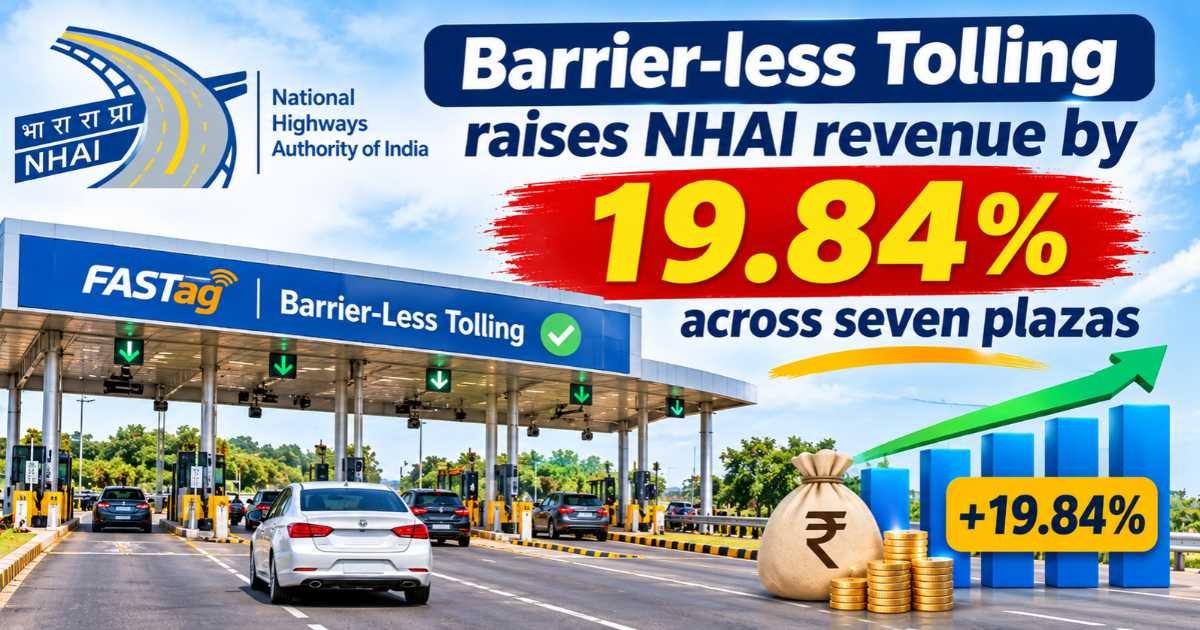
New Delhi: National Highways Authority of India (NHAI) has recorded a 19.84% rise in net toll revenue across seven operational plazas using Multi-Lane Free Flow (MLFF) technology. The increase reflects the system’s performance against the corresponding pre-MLFF revenue baseline.
The seven plazas generated around Rs. 538.95 crore in cumulative net revenue. This compares with approximately Rs. 449.72 crore during the corresponding pre-MLFF period. Consequently, NHAI earned an additional Rs. 89.23 crore.
The barrier-less tolling system allows vehicles to pass through toll points without stopping. It aims to reduce congestion, travel time, fuel consumption and vehicular emissions. Moreover, the technology is improving toll collection efficiency and transparency.
NHAI launched the system at Choryasi Fee Plaza in Gujarat on May 1, 2026. It subsequently introduced the technology at Mundka, Daulatpura, Gharaunda, Manoharpura, Shahjahanpur, Paranur, Nemili and Chenasamudram.
As of October 31, 2026, seven plazas were included in the cumulative performance assessment. Nemili and Chenasamudram were excluded because they became operational in November.
Revenue growth across operational plazas
Manoharpura in Rajasthan recorded the highest revenue increase among the seven plazas at 24.51%. Paranur in Tamil Nadu followed with 26.95%, while Mundka in Delhi registered 23.55%. Choryasi in Gujarat recorded 23.06%.
Gharaunda in Haryana reported a 17.39% increase. Shahjahanpur in Rajasthan recorded 16.57%, while Daulatpura in Rajasthan registered 15.66%. The average increase across the seven plazas stood at 21.10%, while the combined weighted increase was 19.84%.
The assessment compared revenue from each plaza since its MLFF launch with the period immediately before implementation. NHAI said transaction volumes also recorded significant growth. At the same time, collection costs declined.
The rise in revenue alongside higher transaction volumes and lower collection costs indicates improved collection coverage. It also points to reduced revenue leakage and better realisation of applicable user fees.
Around 60% of the value of e-notices issued across these plazas has already been recovered. This indicates the role of technology-based enforcement in collecting unpaid user fees from vehicles that initially avoided payment.
NHAI strengthens enforcement against toll evasion
NHAI has reported cases of vehicle owners masking, concealing or tampering with registration number plates to avoid toll payments. The authority is coordinating with State Governments and enforcement agencies to take action against such violations.
Police check posts have been established at selected MLFF locations. At Gharaunda Fee Plaza, for instance, officials intercept vehicles involved in such practices and issue challans under relevant provisions of the Motor Vehicles Act, 1988.
Meanwhile, NHAI is deploying artificial intelligence-based systems to identify vehicles involved in toll evasion. These include Vehicle Fingerprinting technology and integration with the VAHAN database to trace registered owners.
The authority is also issuing e-notices to recover unpaid user fees. In cases where notices remain unpaid, applicable VAHAN services are being restricted under the prescribed enforcement framework.
NHAI plans to expand barrier-less tolling across the National Highway network. It will also strengthen technology-driven monitoring and enforcement with State Governments to prevent toll evasion and protect public revenue.
