

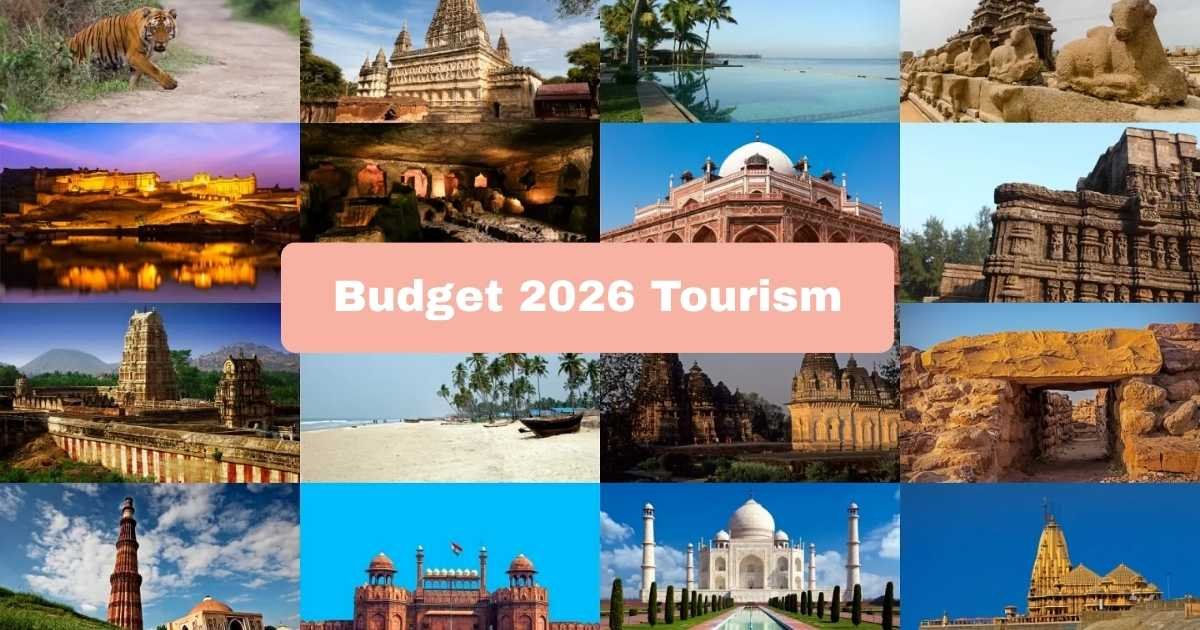
New Delhi: The Budget 2026 tourism strategy outlines an ambitious roadmap to position the sector as a major engine of economic growth, employment generation and regional development.
Tourism currently contributes 5.22 percent to India’s GDP in total impact terms, with a direct share of 2.72 percent. Additionally, the sector supports 13.34 percent of total employment, including 5.82 percent direct jobs. Therefore, policymakers have prioritised tourism as a high-impact growth driver.
The Union Budget 2026–27 proposes several targeted interventions. These include preservation of temples and monasteries, development of pilgrimage centres and improvement of connectivity across Arunachal Pradesh, Sikkim, Assam, Manipur, Mizoram and Tripura. Moreover, the government will develop five major tourism destinations across Purvodaya states and deploy 4,000 electric buses to enhance last-mile connectivity.
Budget 2026 tourism focuses on heritage and eco growth
A new scheme for Buddhist circuit development in the North-East will strengthen infrastructure at spiritually significant sites. At the same time, eco-tourism initiatives will promote mountain and nature trails in Himachal Pradesh, Uttarakhand, Jammu and Kashmir, Araku Valley and Podhigai Hills. Turtle nesting trails and bird-watching corridors will further expand biodiversity-based tourism offerings.
The Budget also announced development of 15 archaeological sites, including Lothal, Dholavira, Rakhigarhi, Sarnath, Hastinapur and Leh Palace, into experiential cultural destinations. Authorities will create interpretation centres, curated walkways and improved visitor amenities to enhance engagement.
In addition, the government plans to upgrade the National Council for Hotel Management into a National Institute of Hospitality. This reform aims to align academic training with industry needs. A pilot programme will upskill 10,000 tourist guides through structured hybrid training models.
India will also host the first Global Big Cat Summit in 2026, reinforcing leadership in wildlife conservation and eco-tourism diplomacy. Furthermore, five regional medical hubs will promote the country as a global medical tourism destination.
A National Destination Digital Knowledge Grid will document heritage assets and support data-driven planning. Consequently, these measures integrate infrastructure, digital systems, conservation and skill development into a unified growth framework.
Overall, the strategy positions tourism as a resilient pillar of India’s long-term economic expansion while ensuring sustainability and community participation.
