

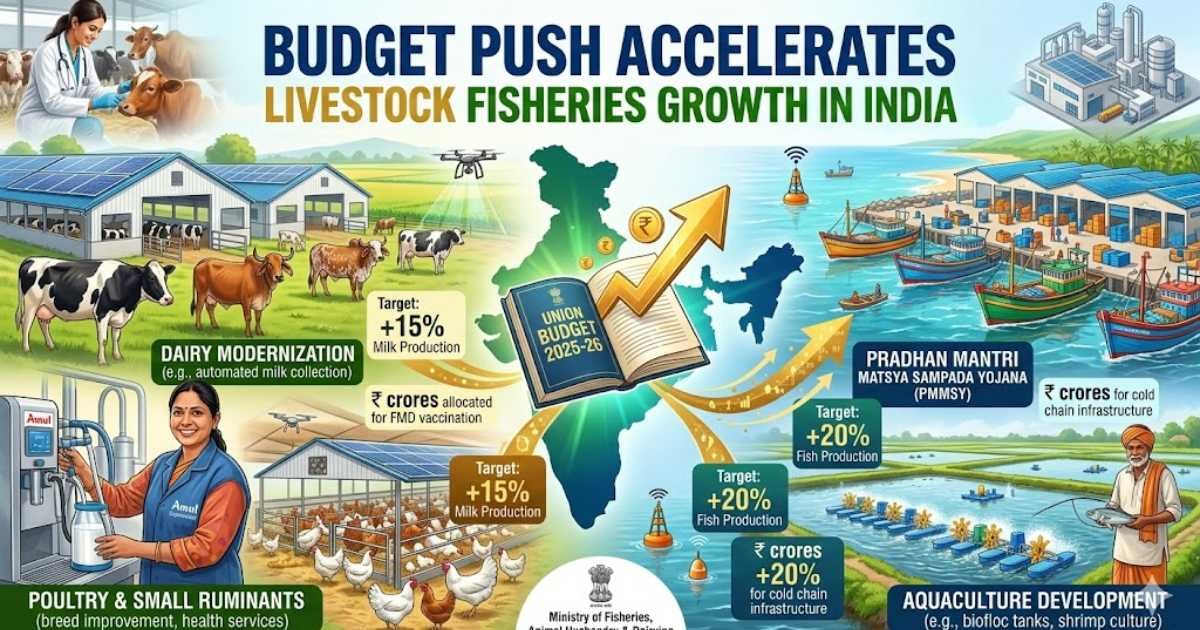
New Delhi: The Union Budget 2026–27 sharply increased allocations for animal husbandry and fisheries, accelerating livestock fisheries growth and reinforcing their role in rural income diversification.
The Department of Animal Husbandry & Dairying received ₹6,153.46 crore, a 16 percent rise from ₹5,302.83 crore in FY 2025–26. Similarly, the fisheries sector secured a record ₹2,761.80 crore. These allocations strengthened ongoing reforms aimed at boosting productivity, exports, and market access.
Between FY15 and FY24, the livestock sector’s Gross Value Added rose nearly 195 percent at current prices, recording a CAGR of 12.77 percent. Livestock and fisheries have sustained annual growth rates of 5–6 percent and 8.74 percent respectively over the past decade. As a result, they now form a stable income base for small and marginal farmers.
India maintained its position as the world’s largest milk producer, contributing nearly 25 percent of global output. Milk production increased from 146.31 million tonnes in 2014–15 to 247.87 million tonnes in 2024–25. Egg output rose to 149.11 billion in 2024–25 from 78.48 billion a decade earlier. Fish production nearly doubled to 19.77 million tonnes in FY 2024–25.
Policy reforms drive livestock fisheries growth and disease control
Government schemes such as the National Livestock Mission, Rashtriya Gokul Mission, and National Animal Disease Control Programme strengthened breed improvement and disease management. Authorities conducted 14.56 crore artificial inseminations and administered over 125.75 crore FMD vaccinations. Consequently, FMD outbreaks dropped from 132 cases in 2019 to six in 2025, while Brucellosis outbreaks fell to zero.
Bovine productivity also improved steadily. Indigenous cattle yield rose from 927 kg per animal per year in 2014–15 to 1,292 kg in 2023–24. Buffalo productivity increased to 2,161 kg during the same period. These gains directly enhanced farm-level earnings.
In fisheries, production expanded from 95.79 lakh tonnes in 2013–14 to 197.75 lakh tonnes in 2024–25. Inland fisheries drove much of this growth. Seafood exports more than doubled to ₹62,408 crore, reaching over 130 countries. Infrastructure upgrades under PMMSY supported 27,189 transport units and 6,733 retail markets.
Digital reforms further strengthened livestock fisheries growth. Over 36.45 crore livestock were registered under Pashu Aadhaar by January 2026. Meanwhile, the National Fisheries Digital Platform onboarded more than 28 lakh stakeholders, improving access to credit and insurance.
Expanded credit under Kisan Credit Cards supported 39.22 lakh sanctioned applications in animal husbandry and 4.82 lakh in fisheries. Insurance coverage reached 3.3 million beneficiaries. Together, these measures deepened formal market integration and reduced income risks.
With sustained budget backing, institutional reforms, and digital integration, livestock fisheries growth has emerged as a key pillar of rural resilience and national food security.
