

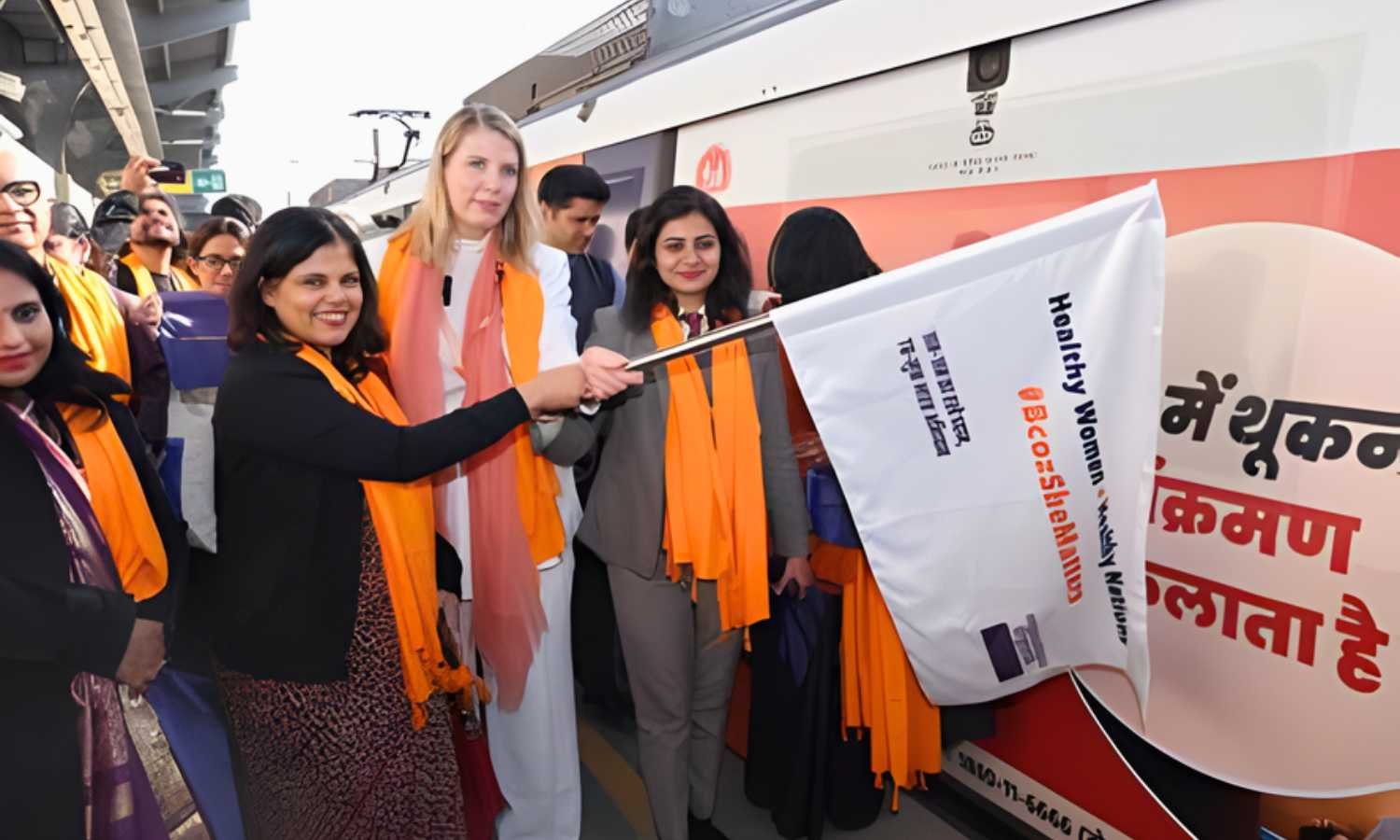
New Delhi: The Union Health Ministry, in partnership with the World Health Organization, launched a month-long Delhi Metro campaign at Sultanpur Metro Station to promote women’s and girls’ health. The initiative runs from 10 December 2025 to 10 January 2026. It aims to reach millions of commuters through messages displayed across metro trains and select stations.
Campaign focus on safety and awareness
The campaign highlights women’s safety, the digital divide, access to mental health support, and awareness on TB and the PC&PNDT Act. Officials said the metro offers a direct and high-impact platform to communicate these themes.
Health Ministry highlights public engagement
Union Health Secretary Smt. Punya Salila Srivastava said a family or a nation cannot progress unless women are healthy. She added that the metro is an effective space to reach the public. She explained that the campaign carries information on TB, digital inclusion, and the PC&PNDT Act inside coaches and on the exterior of trains.
Call for stronger sensitisation
She also addressed concerns around new technologies used for gender determination and selection. She said such practices must stop. Since access to these technologies is increasing, she emphasised the need for stronger awareness and wider sensitisation.
WHO links campaign to global activism
Dr Catharina Boehme, Officer-in-Charge, WHO South-East Asia, said the launch coincides with the conclusion of the 16 Days of Activism against Gender-Based Violence. She described the metro campaign as a continuation of collective action to advance health and safety for women and girls. She further reaffirmed that healthy women strengthen families, communities, and nations.
India’s ongoing programmes for women’s health
India continues to promote women’s health through programmes such as Swasth Nari Sashakt Parivar Abhiyan, PMSMA, Mission Shakti, the Nirbhaya Fund, and Ayushman Bharat. The launch also featured an all-women band, WeBhor, whose performance reflected resilience and empowerment. Later, dignitaries and participants boarded the inaugural ride, symbolising shared commitment to women’s safety.
Appeal for public participation
Dr Boehme thanked the Delhi Metro for supporting the initiative. She urged continued collective effort and encouraged commuters to help spread the message that healthy women form the foundation of a healthy society.
