

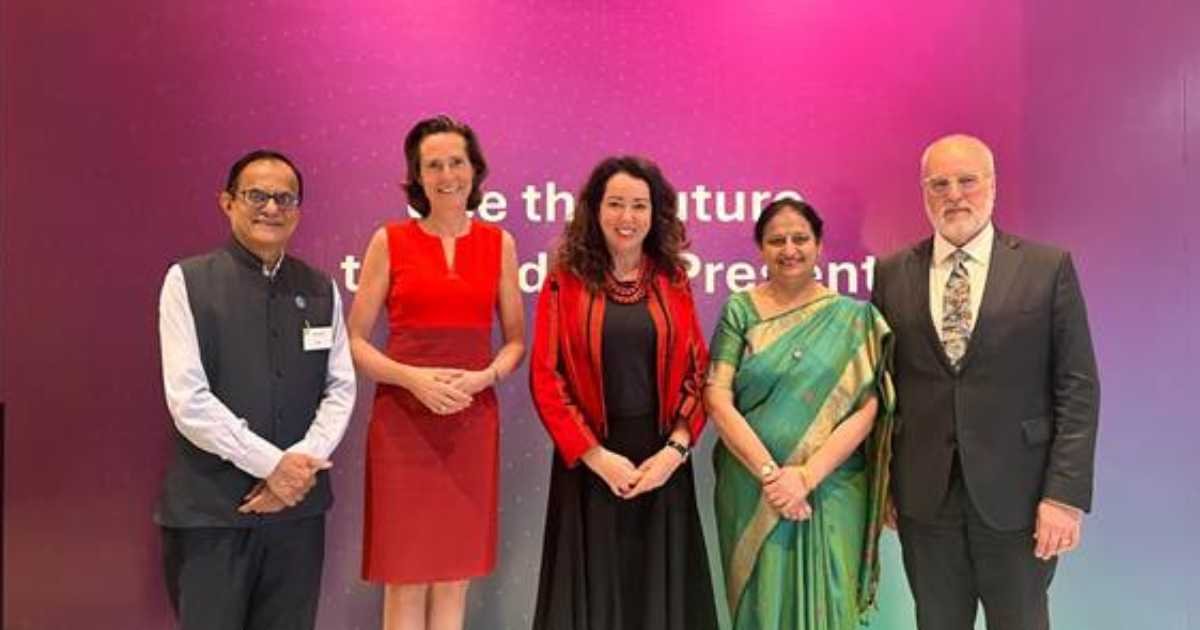
New Delhi: India and Switzerland jointly hosted an Anticipatory Leadership Lab in New Delhi to strengthen cooperation on governance of emerging scientific and technological breakthroughs.
The event was organised by the Office of the Principal Scientific Adviser to the Government of India, the Embassy of Switzerland in India and the Geneva Science and Diplomacy Anticipator.
Principal Scientific Adviser Prof Ajay Sood, Switzerland’s State Secretary for Foreign Affairs Ambassador Alexandar Fasel and Switzerland’s Ambassador to India Maya Tissafi attended the programme.
Scientific Secretary Dr Parvinder Maini and GESDA Director General Prof Marilyne Andersen also participated in the discussions.
The meeting brought together about 60 leaders from academia, government, diplomatic missions, deep-tech startups, businesses and civil society organisations.
Participants discussed major research advances in quantum computing, artificial intelligence, synthetic biology and neurotechnology.

Anticipatory Leadership Lab focuses on future technologies
Addressing the gathering, Prof Ajay Sood said rapid technological progress requires new governance approaches.
He said earlier governance systems worked when technological change occurred over decades. However, emerging technologies are evolving much faster today.
According to him, technologies such as quantum computing, artificial intelligence and synthetic biology will shape global developments over the next 25 years.
Switzerland’s State Secretary for Foreign Affairs Ambassador Alexandar Fasel said understanding scientific breakthroughs has become a diplomatic necessity.
He added that science and technology now influence prosperity, sovereignty and security across the world.
Ambassador Fasel said Switzerland considers anticipatory science diplomacy a priority in its foreign policy and welcomed cooperation with India.
GESDA Director General Prof Marilyne Andersen said anticipatory science diplomacy helps countries prepare for scientific breakthroughs before they create global inequalities or risks.
During the discussions, participants examined how emerging technologies could affect societies in the short, medium and long term.
They also explored opportunities and risks related to public policy, diplomacy and industry.
Experts said governance frameworks for disruptive technologies should rely on scientific anticipation.
Early identification of technological breakthroughs can help countries cooperate before competition or geopolitical tensions dominate global technology debates.
