

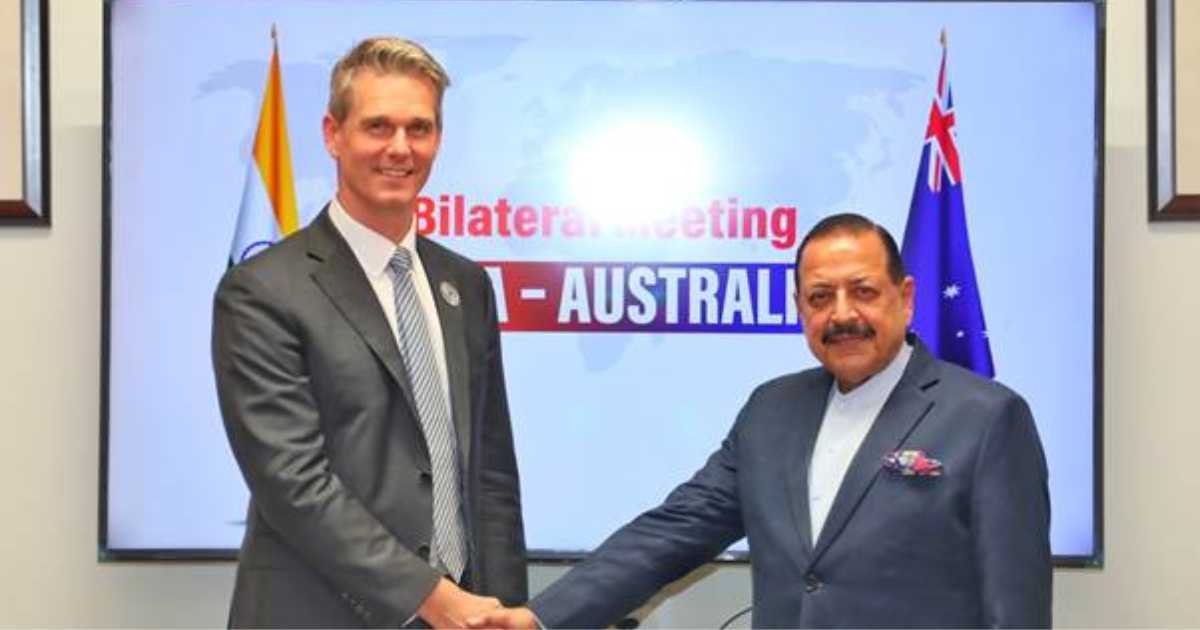
New Delhi: India and Australia agreed to expand India Australia tech collaboration through a mission-driven approach in critical and emerging technologies after talks between Union Minister Dr. Jitendra Singh and Australian Assistant Minister Dr. Andrew Charlton.
The meeting reviewed the 20-year Australia–India Strategic Research Fund framework, which completes two decades in 2026. Both sides finalised five joint research projects under Round-16 of the programme. These projects span critical minerals processing, quantum technologies, advanced manufacturing, climate-resilient agriculture and cellular immunotherapy.
Three projects supported by the Department of Science and Technology focus on electronic waste recycling, green recovery of critical minerals from batteries and resilience in quantum machine learning systems. Meanwhile, two projects backed by the Department of Biotechnology target thermotolerant crops and cellular immunotherapy for viral infections in immunocompromised patients.
Dr. Jitendra Singh stressed that India is pursuing a mission-mode strategy in advanced materials, quantum technologies and AI-enabled research. He also highlighted the BioE3 policy aimed at strengthening India’s bio-economy. Therefore, he called for industry-linked and impact-focused expansion of India Australia tech collaboration.
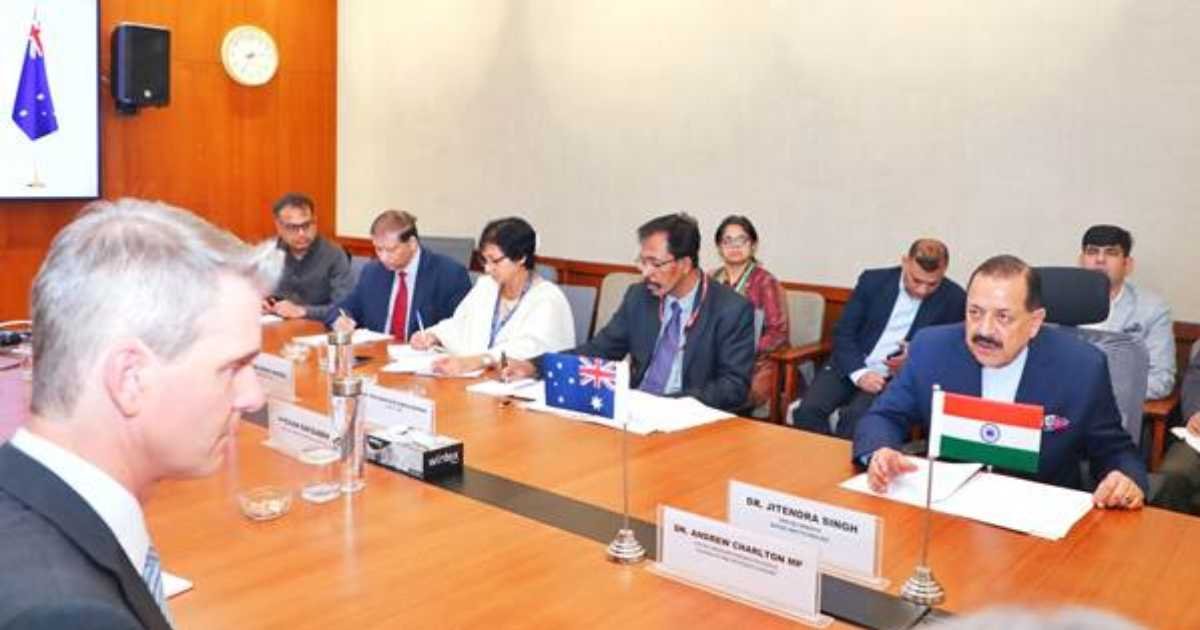
India Australia tech collaboration deepens in quantum and critical minerals
Both Ministers reaffirmed the role of the Joint S&T Committee and Joint Biotechnology Committee as guiding mechanisms. They agreed that future projects should be larger, multi-institutional and aligned with shared national priorities and sustainable development goals.
Launched in 2006, the AISRF has supported more than 370 collaborative activities. Australia committed AUD 90 million between 2006 and 2020, while India’s DST and DBT supported projects worth around ₹140 crore. Joint publications have more than tripled, and the partnership has produced patents and technology demonstrators.
The Ministers also discussed expanding cooperation in space applications such as Earth observation, disaster management and maritime monitoring. In addition, they supported deeper engagement between research institutions, space agencies and private enterprises.
Both sides agreed to strengthen researcher mobility through joint doctoral programmes, industry-linked fellowships and co-supervision models. Consequently, India Australia tech collaboration is set to move toward co-development and co-creation in frontier technologies across the Indo-Pacific region.
