

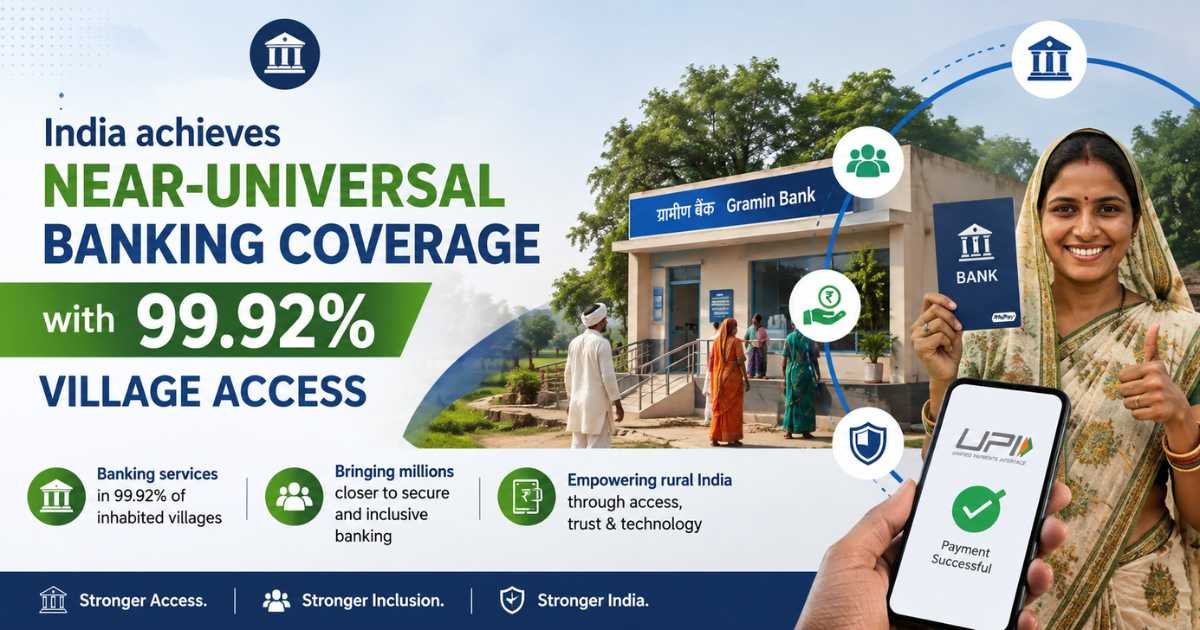
New Delhi: India achieved near-universal banking coverage, with 99.92% of inhabited villages gaining access to a banking outlet within a 5-km radius, the government told the Lok Sabha on Monday.
Minister of State for Finance Pankaj Chaudhary said 6,00,868 of the country’s 6,01,328 inhabited villages now have a bank branch, Business Correspondent (BC) or India Post Payments Bank (IPPB) outlet nearby. The data came from the Jan Dhan Darshak App.
The country has built a strong banking network. It includes more than 1.81 lakh bank branches, 17.36 lakh Business Correspondents and 1.65 lakh IPPB centres as of July 17, 2026.
The government aims to provide a banking outlet within a 5-km radius of every inhabited village. In addition, the Reserve Bank of India allows commercial banks, small finance banks, payments banks, local area banks and regional rural banks to open branches without prior approval. However, they must open at least 25% of new branches in unbanked rural areas.
Moreover, State Level Bankers’ Committees and Union Territory Level Bankers’ Committees continue to identify uncovered areas. They work with state governments, banks and other stakeholders. Banks then decide on new outlets after reviewing RBI guidelines, business plans and commercial viability.
PMJDY expands banking coverage and digital access
As of July 17, 2026, the country had 58.77 crore Pradhan Mantri Jan Dhan Yojana (PMJDY) accounts. These accounts held deposits worth ₹3,12,414 crore.
The government also introduced several digital initiatives to improve farm credit delivery. For example, it launched the Jan Samarth Portal as a single platform for government-backed loan and subsidy schemes. It also supports NABARD’s e-KYC application, KRISHIKA and similar banking applications for beneficiary identification, loan processing and monitoring.
Furthermore, the Department of Agriculture and Farmers Welfare launched the Kisan Rin Portal in September 2023. The portal enables Aadhaar-based beneficiary verification. It also speeds up claim settlements under the Modified Interest Subvention Scheme for Kisan Credit Card loans.
Meanwhile, the government and the RBI strengthened cyber security for digital payments. They set up the India Digital Payment Intelligence Corporation to share real-time fraud alerts. The RBI also introduced Digital Payment Security Controls and the AI-based MuleHunter tool to detect money mule accounts.
In addition, the Ministry of Home Affairs launched the National Cybercrime Reporting Portal and the 1930 helpline. These services help people report cyber financial fraud. The RBI and banks also continue awareness campaigns through SMS, radio programmes and e-BAAT training sessions.
The information was provided by Minister of State for Finance Pankaj Chaudhary in a written reply in the Lok Sabha.
