

Bengaluru: Indian scientists developed a sunlight-powered energy storage device that can capture and store solar energy within a single integrated system, marking a major step towards self-sustaining and eco-friendly power solutions.
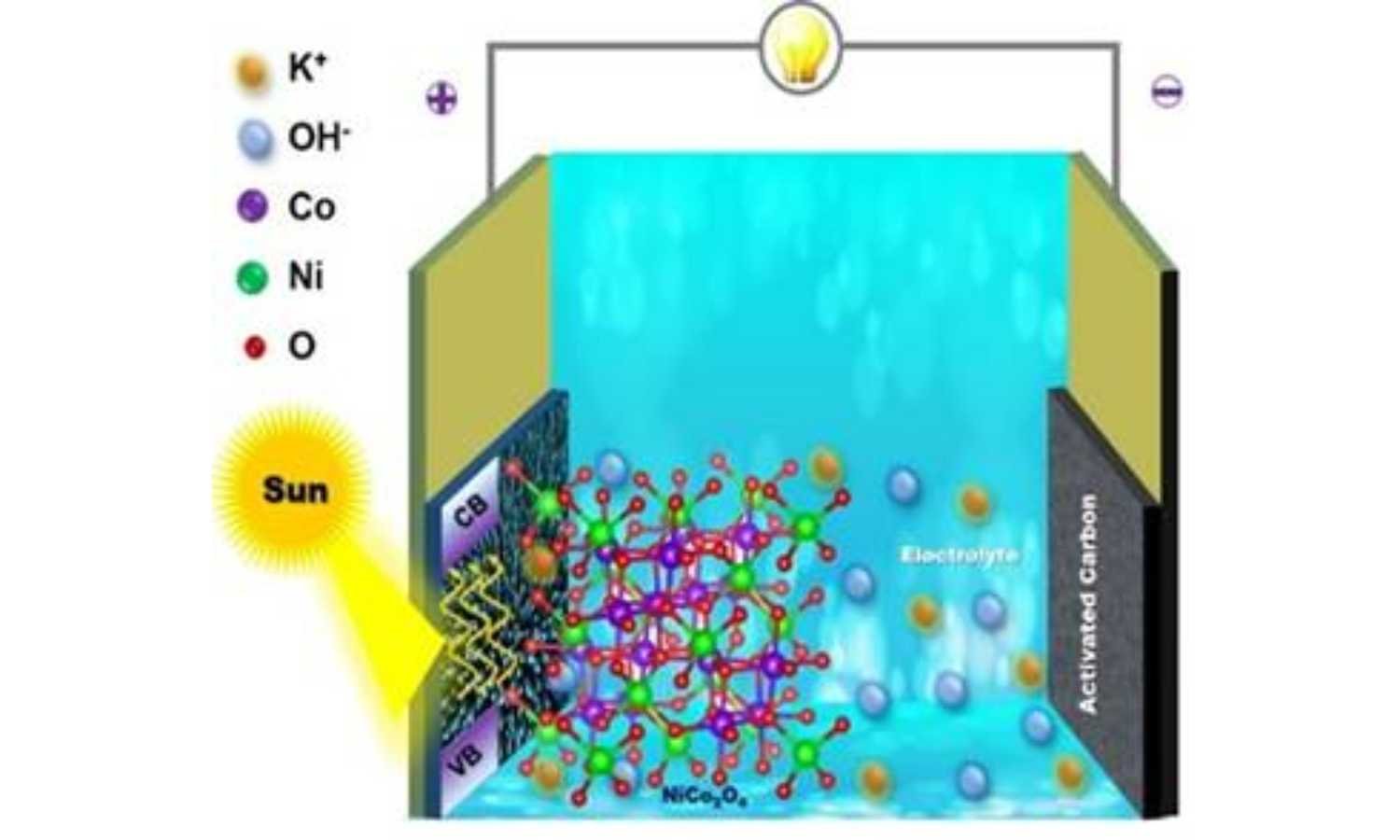
Researchers at the Centre for Nano and Soft Matter Sciences (CeNS), Bengaluru, developed an innovative photo-capacitor that combines solar energy harvesting and storage. The autonomous institute functions under the Department of Science and Technology, Government of India. The new device eliminates the need for separate solar panels and storage units, which often increase system complexity and energy losses.
Traditionally, solar systems use separate components for energy capture and storage. As a result, they require additional electronics to manage voltage and current mismatches. This design raises costs, increases energy loss and limits use in compact or autonomous devices. The newly developed photo-rechargeable supercapacitor addressed these challenges by integrating both processes into one unit.
Under the guidance of Dr Kavita Pandey, the team developed binder-free nickel-cobalt oxide (NiCo₂O₄) nanowires grown on nickel foam using an in-situ hydrothermal process. These nanowires formed a porous and conductive three-dimensional network that absorbed sunlight efficiently while storing electrical charge.
Sunlight-powered energy storage shows high efficiency and durability
Tests showed that the NiCo₂O₄ electrode recorded a 54 per cent rise in capacitance under illumination. The value increased from 570 to 880 mF cm⁻² at a current density of 15 mA cm⁻². Even after 10,000 charge-discharge cycles, the electrode retained 85 per cent of its capacity, demonstrating strong long-term stability.
The researchers also built an asymmetric photo-supercapacitor using activated carbon as the negative electrode. The device delivered a stable output voltage of 1.2 volts. It maintained 88 per cent capacitance retention after 1,000 photo-charging cycles and functioned under light conditions ranging from indoor illumination to intense sunlight.
The team said the integrated design allowed the system to operate without grid access. Therefore, it can support power needs in remote and off-grid regions. Such technology could reduce dependence on fossil fuels and conventional batteries.
Theoretical studies revealed that nickel substitution narrowed the material’s band gap to about 1.67 eV. This property enabled faster charge transport and improved conductivity. The findings explained the high efficiency observed during experiments.
The research, published in Sustainable Energy & Fuels, highlighted a new class of photo-rechargeable energy storage devices. Scientists said the innovation could support India’s clean energy goals and inspire future advancements in renewable energy storage.
