

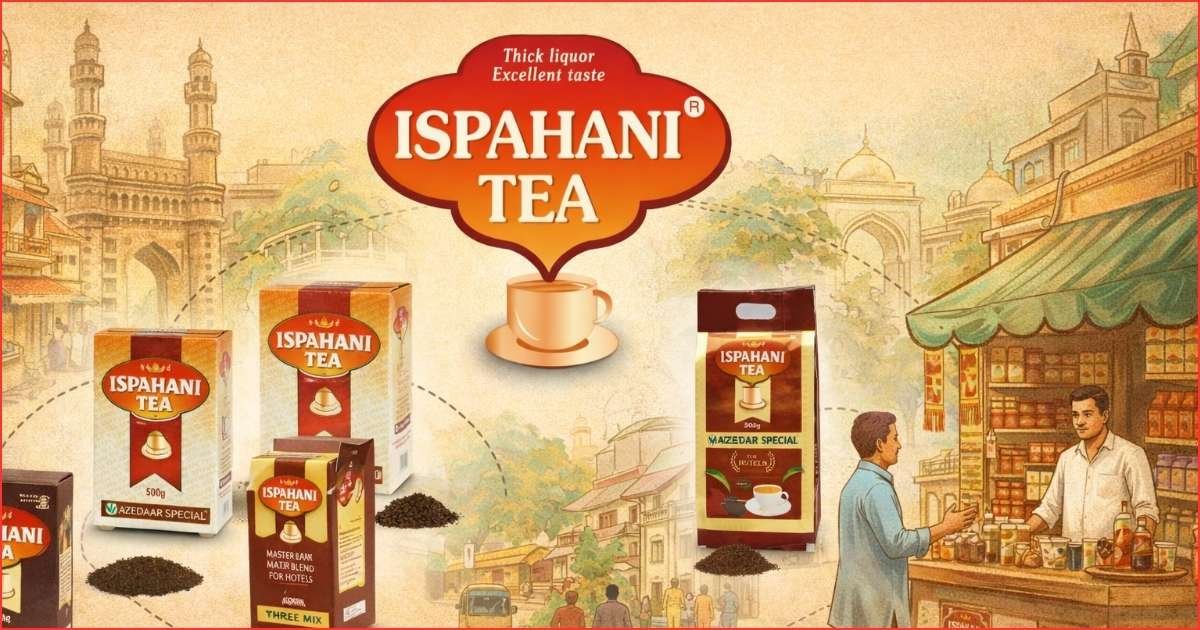
Hyderabad: Ispahani Tea Hyderabad expanded across the city by building steady neighbourhood availability rather than chasing visibility through advertising, with the brand embedding itself into local purchase routines from the 1960s onward.
When the company began operations in Hyderabad in the 1960s, the city’s retail structure had remained local, repetitive and trust-driven. Tea purchases had taken place frequently, and most households had returned to the same retailer or vendor. As a result, proximity and familiarity had shaped buying decisions more strongly than broad brand recall.
That market structure had influenced the brand’s growth model. Instead of spending heavily on visibility, the company had focused on keeping its tea available where daily shopping happened. It had expanded lane by lane and market by market. In doing so, it had aligned its footprint with Hyderabad’s everyday retail geography. Therefore, the brand had entered routine shopping baskets rather than occasional purchases triggered by promotion.
This approach had matched the way neighbourhood retail worked in Hyderabad. Local stores had served not only as transaction points but also as social spaces where habits were reinforced through repetition and observation. Tea brands that had succeeded in such settings had usually become part of daily buying cycles. Ispahani Tea Hyderabad had followed that pattern by prioritising reach inside residential and commercial clusters instead of relying on citywide announcements.
Ispahani Tea Hyderabad followed daily buying patterns
The city’s early tea market had rewarded consistency over spectacle. Consumers had bought tea often, usually in small quantities, and they had valued convenience. Because of that, a nearby and familiar brand had gained an advantage each time a household restocked. That behaviour had favoured a distribution-led strategy.
Ispahani Tea had responded by strengthening its presence in neighbourhood outlets rather than presenting itself as an aspirational product. The logic had remained simple. A tea brand that stayed within easy reach had stood a better chance of becoming the default household choice. Consequently, availability had done the work that advertising often attempted to do in other categories.
The model had also reflected Hyderabad’s social character. In many neighbourhoods, shopkeepers had known regular buyers, and repeated purchases had reinforced trust. Tea had fit naturally into that rhythm because it had been a daily-use product rather than a discretionary indulgence. Thus, the brand’s growth had depended on frequency and access, not on novelty.
As Hyderabad expanded geographically, the company’s approach had moved with the city. New residential colonies, transport corridors and mixed-use zones had created fresh demand. Yet the basic pattern of tea buying had not changed. Households had still depended on nearby stores and familiar vendors. Therefore, hyperlocal presence had remained valuable even as the urban map widened.
The brand’s distribution had adapted to those shifts without changing the fundamentals of access. It had extended into newly growing areas while preserving the same neighbourhood-led method that had supported its earlier expansion. That had allowed the company to remain relevant through different phases of Hyderabad’s development, from compact localities to larger suburban extensions.
Ispahani Tea Hyderabad gained from steady local access
The neighbourhood-centred strategy had also protected the brand from the volatility often seen in trend-led consumption. Visibility-driven brands had sometimes produced sharp spikes in attention, only to face slower repeat demand later. Tea had behaved differently. Since the product had been tied to habit, repeat purchase mattered more than short bursts of awareness.
In that setting, Ispahani Tea Hyderabad had benefited from steady reappearance in kitchens and kettles rather than bursts of promotional momentum. Demand had remained anchored in routine use. So, the brand’s progress had been measured through recurrence in household consumption, not through campaign reach.
That contrast had grown sharper as media and advertising landscapes changed. Consumer goods companies had increasingly relied on large-scale promotion, headline-driven launches and wider messaging. Some local brands had struggled to compete for attention in such an environment. However, tea had remained a category where attention alone had not been enough to dislodge established behaviour.
Hyderabad’s own consumption patterns had reinforced that point. Tea drinkers had rarely switched brands on impulse. Their choices had usually been shaped by familiarity, perceived reliability and past experience. For that reason, a brand already stocked within a neighbourhood had held an advantage that advertising could not easily reproduce.
The economics of tea had also supported this structure. Tea had been purchased repeatedly and often in smaller quantities than many other consumer products. That made convenience central to brand choice. A product that stayed close at hand had become the practical option. Over time, repeated accessibility had strengthened loyalty without requiring overt persuasion.
Ispahani Tea Hyderabad built resilience without spectacle
This distribution-first model had produced a slower but more durable form of branding. Instead of growing through slogans, the brand had become known through repeated presence. Its name had circulated in ordinary exchanges between retailers and customers, inside households and across neighbourhood networks. As those interactions accumulated, recognition had deepened.
That process had lacked the speed of headline-led expansion, but it had created resilience. Since the brand had been woven into everyday routines, it had not depended on occasional attention peaks. The result had been a form of organic brand building rooted in use rather than image.
The later decision to establish a flagship retail presence in Hyderabad’s Old City had not represented a break from that long approach. Instead, it had reflected confidence in the same neighbourhood logic that had sustained the company for decades. The location had reinforced continuity with the city’s established buying culture rather than signalling a dramatic transformation.
The Old City choice had carried symbolic weight because it connected the brand’s retail presence to a part of Hyderabad where local commerce and repeated customer relationships had long mattered. Even then, the move had remained consistent with the brand’s established method. It had extended a familiar strategy into a prominent local setting rather than replacing neighbourhood integration with spectacle.
In a media environment that had increasingly rewarded visibility, Ispahani Tea Hyderabad had offered a different example of growth. It had shown that categories tied closely to daily consumption could benefit more from integration than amplification. For tea, steady access had mattered more than dramatic launches.
That model had resonated in Hyderabad, where familiarity and function had continued to shape everyday consumption. Tea had remained central to daily life not because it had been aggressively promoted, but because it had stayed present. The brand’s expansion through neighbourhoods rather than headlines had reflected a clear reading of that reality.
As the city changed, the company had grown alongside it without demanding constant attention. Its footprint had widened by following the logic of local retail and repeat purchase. In the end, the story of Ispahani Tea Hyderabad had not been one of noise, but of endurance built through proximity, routine and trust.
