
Nadda launches mass drug administration drive for lymphatic filariasis elimination

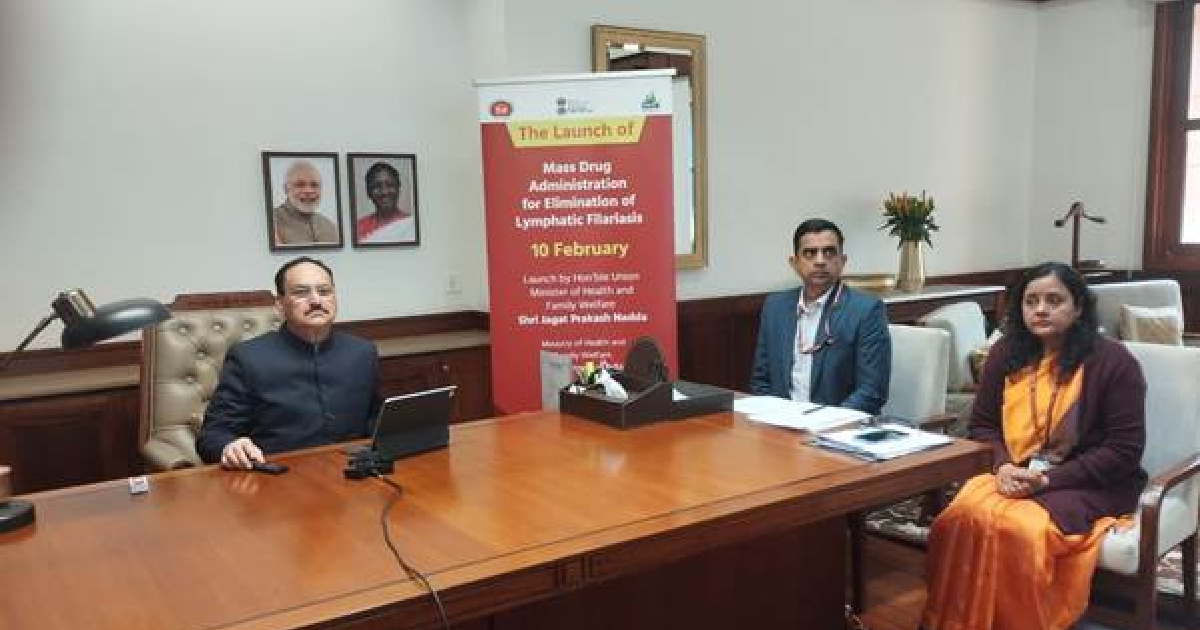
New Delhi: Union Health Minister Jagat Prakash Nadda launched the annual nationwide Mass Drug Administration campaign to accelerate lymphatic filariasis elimination across 12 endemic States, the Health Ministry said.
Shri Nadda inaugurated the campaign through a video conference with State Health Ministers and senior officials. The drive aimed to interrupt disease transmission, reduce morbidity, and ensure equitable access to preventive healthcare for vulnerable populations. The government has set a national target to achieve lymphatic filariasis elimination by 2027.
Lymphatic filariasis, also known as elephantiasis or Haatipaon, spreads through the bite of the female Culex mosquito, which breeds in stagnant and polluted water. The infection damages the lymphatic system and often leads to chronic disability and social stigma. At present, the disease remains endemic in 348 districts across 20 States and Union Territories.
The Ministry reported that 143 districts, accounting for 41%, stopped mass drug administration after clearing Transmission Assessment Survey-1. However, 174 districts across 14 States continued annual MDA due to microfilaria prevalence above one per cent. The remaining 31 districts remained at different stages of assessment. As of 2024, endemic districts reported over 6.20 lakh lymphoedema cases and 1.21 lakh hydrocele cases.
Lymphatic filariasis elimination needs community-driven action
Addressing officials, Shri Nadda reaffirmed the government’s commitment to achieve lymphatic filariasis elimination by 2027, ahead of the global 2030 target. He said the disease affected health, livelihoods, and economic productivity, while also causing long-term social hardship for families.
The Minister highlighted gains achieved through mission-mode implementation of mass drug administration. He stressed the role of directly observed treatment and stronger vector control measures to interrupt transmission. He also flagged last-mile challenges, including public hesitancy and gaps in observed drug consumption, and called for stronger awareness and community engagement.
Shri Nadda underlined the importance of morbidity management and disability prevention, including timely hydrocele surgeries and access to medicines. He said Ayushman Arogya Mandirs could support early screening and treatment. He also noted that hydrocele surgery now falls under Ayushman Bharat–Pradhan Mantri Jan Arogya Yojana.
The current campaign covered 719 blocks in 124 districts across 12 States. Shri Nadda called for a whole-of-government and whole-of-society approach, with active involvement of Panchayat representatives and allied ministries, to consistently reduce microfilaria prevalence below one per cent and achieve a filariasis-free India.
The Ministry said India shifted to a unified annual mass drug administration campaign from February 2026 to improve efficiency. MDA coverage rose from 75% in 2014 to 85% in 2025, while districts stopping MDA after clearing TAS-1 increased significantly. Minister of State officials and senior Health Ministry officers attended the launch.
