

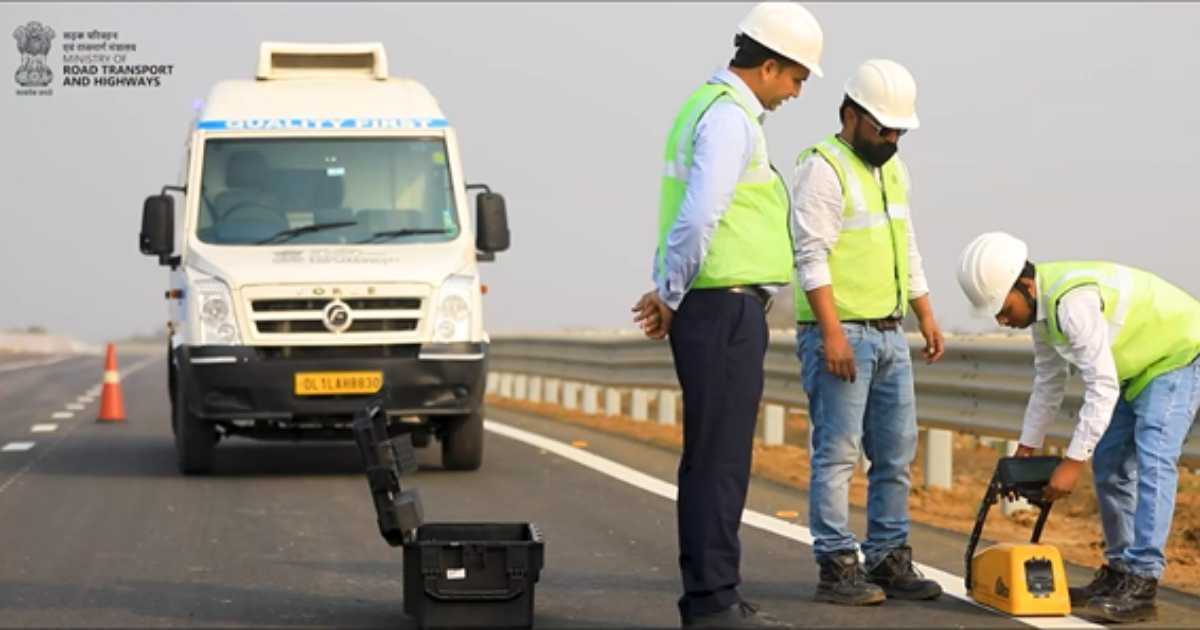
New Delhi: The Ministry of Road Transport and Highways launched a pilot of Mobile Quality Control Vans to monitor construction quality on National Highways in four states.
The pilot covered Rajasthan, Gujarat, Karnataka and Odisha. With this step, the Ministry shifted focus from rapid expansion to assured quality and safety. As a result, officials aimed to strengthen reliability across highway projects.
Under the initiative, Mobile Quality Control Vans act as on-the-move laboratories. Each van carries non-destructive testing tools that check works without stopping construction. Consequently, engineers can detect faults early and correct them quickly.
The vans use rebound hammers to assess surface hardness and estimate concrete strength. They deploy ultrasonic pulse velocity meters to identify cracks and voids inside concrete. In addition, asphalt density gauges verify proper compaction for long-lasting pavements. Light-weight deflectometers measure soil stability, while reflectometers test the visibility of road signs and markings.
Therefore, the system turns quality control into a proactive process. Instead of waiting for defects, teams can act at the construction stage itself.
Mobile Quality Control Vans to expand to 11 more states
The Ministry will share test results from Mobile Quality Control Vans with its field offices. If teams detect deficiencies, officials will initiate corrective steps immediately. Moreover, MoRTH is developing a National Highway Quality Monitoring Portal to upload reports online.
The portal will provide real-time GPS tracking of the vans. This feature will enhance transparency and enable data-driven oversight. At the same time, it will help senior officials review performance across projects.
After the pilot phase, the Ministry plans expansion across 11 states, including Uttar Pradesh, Maharashtra, Bihar, Jharkhand, Andhra Pradesh, Telangana, Tamil Nadu, Madhya Pradesh, Chhattisgarh, Assam and Meghalaya. The Ministry has already invited tenders for this phase. It expects to commission the expanded rollout by June 2026.
Through this expansion, the government aims to build highways not only faster but also with measurable accountability and quality assurance.
