

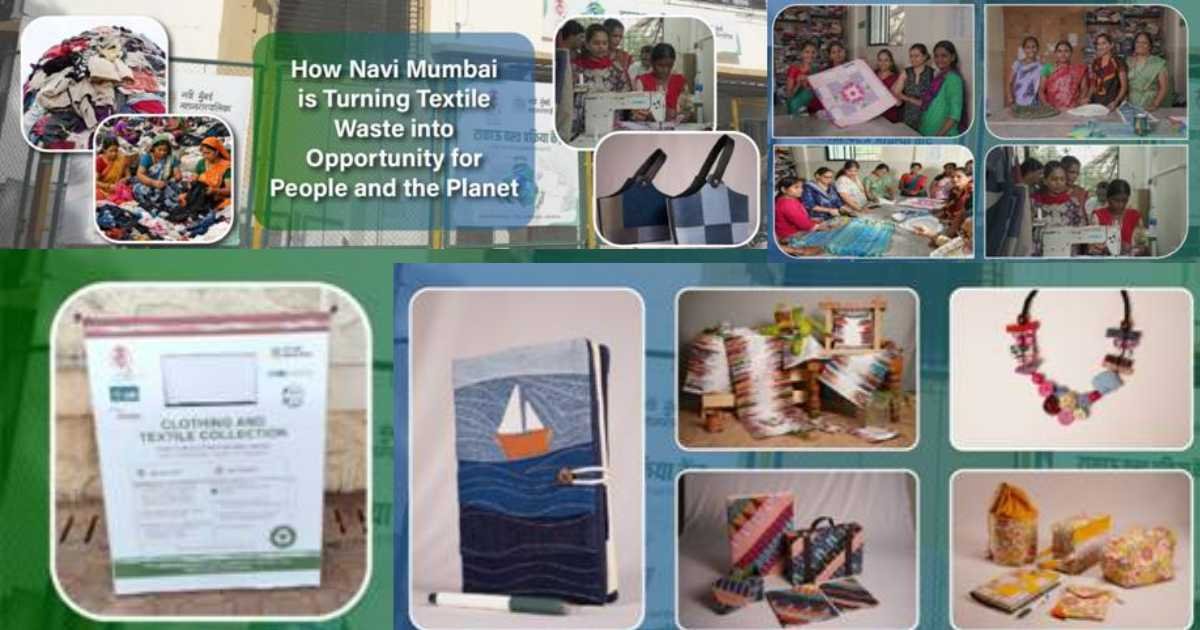
Navi Mumbai: The textile waste Navi Mumbai initiative is transforming discarded fabrics into economic and environmental opportunities through an innovative recovery system.
Under the Swachh Bharat Mission-Urban 2.0, the Navi Mumbai Municipal Corporation has set up a Textile Recovery Facility (TRF) in Belapur. As a result, the project reduces landfill waste while generating livelihoods.
Textile waste Navi Mumbai model promotes circular economy
India generates nearly 7.8 million metric tonnes of textile waste annually. Therefore, cities are increasingly exploring structured systems for recycling and reuse.
In this context, the Navi Mumbai model stands out. It integrates decentralised collection, scientific sorting and community participation. Moreover, textile bins have been placed across housing societies to improve accessibility.
At the TRF, collected materials are weighed, tagged and sorted into reusable, recyclable and reject categories. In addition, advanced tools like fibre scanners help identify materials such as cotton, polyester and silk.
Furthermore, a digital tracking system is being developed to monitor each item’s journey. This ensures transparency and improves decision-making.
Women-led livelihoods drive sustainability efforts
The initiative has created strong livelihood opportunities. More than 300 women received structured training in sorting and upcycling techniques.
Currently, over 150 women earn between ₹9,000 and ₹15,000 per month. As a result, many homemakers have become part of the circular economy workforce.
They convert recovered textiles into bags, garments and home décor items. These products are later showcased at exhibitions, creating market opportunities.
Strong impact and future expansion plans
So far, the project has collected around 30 metric tonnes of textile waste. Out of this, 25.5 tonnes have been scientifically processed.
Additionally, the initiative has reached over 1.14 lakh families through awareness campaigns. It has also conducted multiple workshops and exhibitions to promote recycling.
Although initial challenges included low awareness and resistance to bin placement, authorities addressed them through sustained outreach. Consequently, participation has improved significantly.
Looking ahead, officials plan to establish a permanent, larger facility in Koparkhairane. This expansion will further strengthen textile recovery efforts.
Overall, the initiative shows that waste can become a valuable resource. It also aligns with sustainable development goals by promoting responsible consumption and production.
