

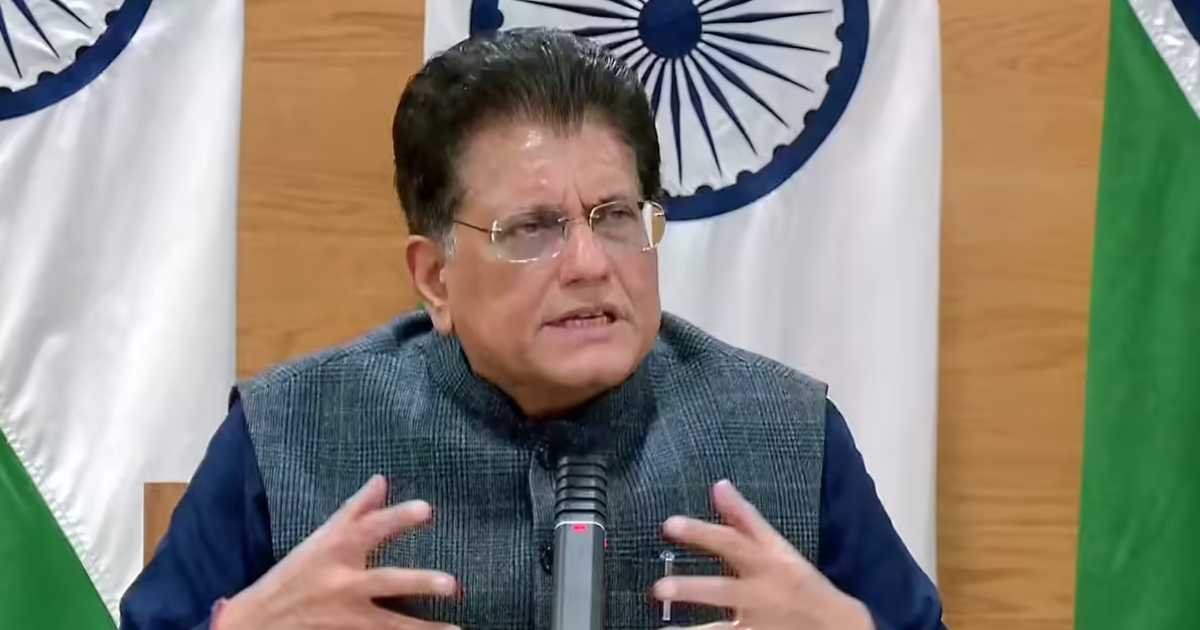
New Delhi: Union Minister of Commerce and Industry Shri Piyush Goyal said Prime Minister Shri Narendra Modi’s Zero Defect vision would anchor India’s manufacturing push and help achieve a $30–35 trillion economy by 2047.
Addressing the first National Quality Conclave virtually, he stated that quality must define India’s manufacturing and export ecosystem. The event was organised by the Department for Promotion of Industry and Internal Trade in partnership with the Quality Council of India.
Goyal said India could not progress merely as a consumer nation. Instead, it must emerge as a globally recognised producer of high-quality goods and services. He added that Brand India should stand for reliability and trust.
Referring to growth projections, he said India aimed to become the third-largest GDP in the next two to two-and-a-half years. He also set a $2 trillion export target within six to seven years. This includes $1 trillion in merchandise exports and $1 trillion in services exports. According to him, the Zero Defect vision remained central to achieving this goal.
Highlighting trade expansion, Goyal said nine Free Trade Agreements signed in the past three to three-and-a-half years with 38 developed nations now covered nearly two-thirds of global GDP and trade. He urged industry to leverage these agreements in sectors such as textiles, leather, footwear and pharmaceuticals.
Five-pillar plan under Zero Defect vision unveiled
Outlining a roadmap, the Minister proposed five pillars to institutionalise quality across manufacturing. First, he called for clear standard operating processes with strict compliance and inspections. Second, he stressed skilling and re-skilling to cut wastage and boost productivity. Third, he advocated benchmarking with global best practices. Fourth, he sought streamlined testing and certification systems. Finally, he emphasised modern testing infrastructure across clusters.
He assured that funds would not be a constraint for quality testing facilities. He encouraged industry to seek support under the Export Promotion Mission for compliance with REACH regulations, CBAM verification, SPS and TBT measures.
Recalling past challenges, Goyal said Indian consumers once searched for “export quality” goods. He said that mindset must end. Uniform standards for domestic and global markets were essential.
Minister of State for Commerce and Industry Shri Jitin Prasada said India must shift decisively to quality-led manufacturing as global opportunities expand. Secretary, DPIIT, Shri Amardeep Singh Bhatia stressed coordinated engagement between government and industry. Chairperson, Quality Council of India, Shri Jaxay Shah said quality must become a daily discipline at the shopfloor level.
The Conclave covered over 20 cities and 14 manufacturing clusters through consultations and Gunvatta Manthan dialogues. It engaged more than 50 regulatory bodies and stakeholders across textiles, leather, footwear and pharmaceuticals. The outcomes will feed into a National Quality Roadmap for Manufacturing.
