

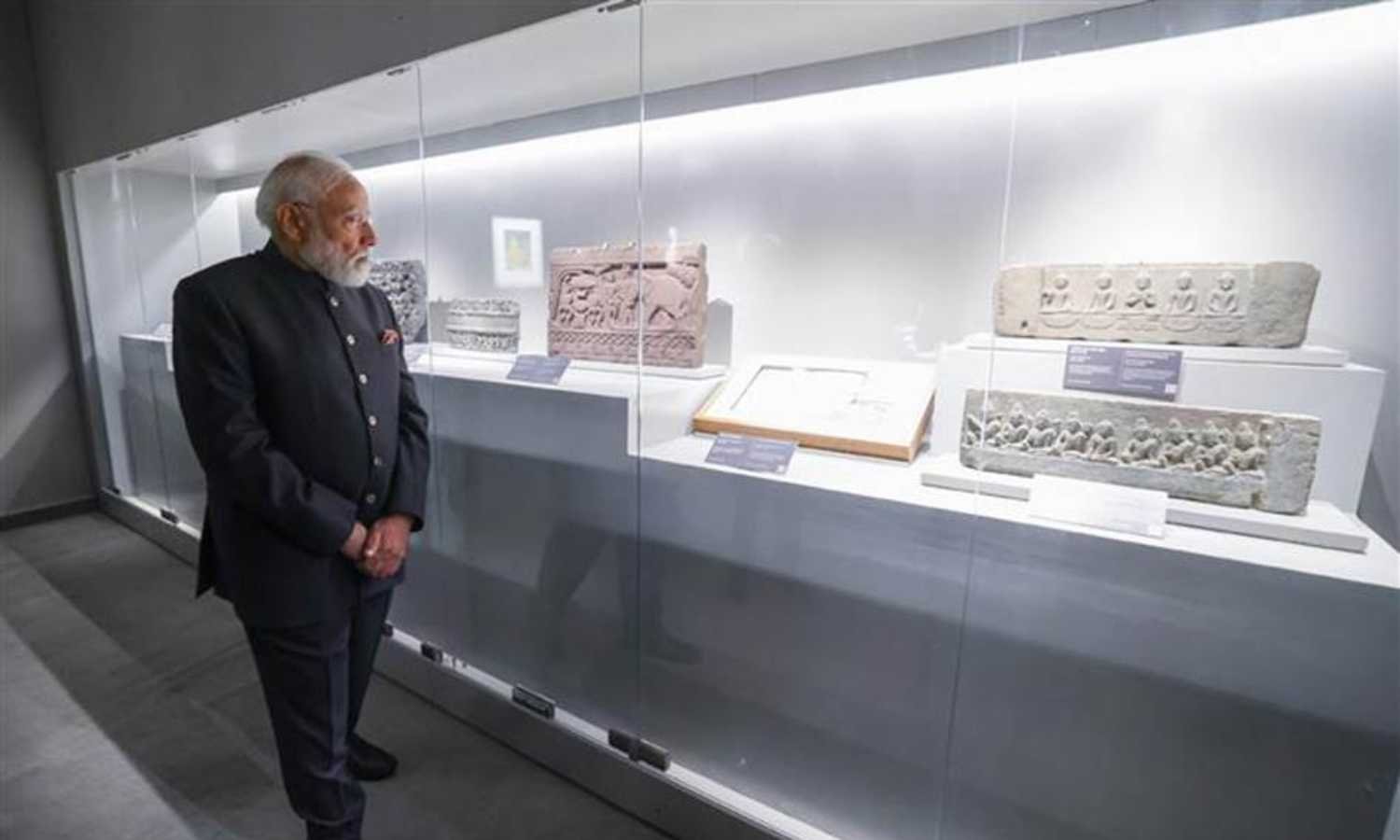
New Delhi: Prime Minister Narendra Modi inaugurated the Piprahwa relics exposition in New Delhi on Friday, marking the return of sacred Buddhist relics to India after more than 125 years.
Addressing the gathering, the Prime Minister said the return of the relics restored a vital part of India’s spiritual heritage. He stated that the nation had waited over a century for this moment. He added that the public would now be able to have darshan of the sacred relics of Lord Buddha and receive His blessings.
The Prime Minister inaugurated the Grand International Exposition titled “The Light and the Lotus: Relics of the Awakened One” at the Rai Pithora Cultural Complex. The Ministry of Culture organised the exhibition. It brought together the most extensive collection of the Piprahwa relics assembled in over a century.
Importantly, the exhibition included relics that recently returned to India from abroad. These artefacts had remained separated for decades. Their reunification marked a major cultural milestone for the country.
Union Minister for Culture and Tourism Gajendra Singh Shekhawat welcomed the Prime Minister at the event. He said the Prime Minister had a rare ability to convert India’s civilisational spirit into governance. Therefore, he described the occasion as inspiring and historic. He also said hosting the Prime Minister on such a day was a matter of pride.
The inauguration commemorated the reunification of the Piprahwa relics after 127 years. The collection includes relics excavated at Kapilavastu in 1898. It also includes findings from excavations conducted between 1972 and 1975. In addition, it features treasures preserved at the Indian Museum in Kolkata.
Moreover, the exhibition displays the Peppé family collection. The Government of India repatriated this collection in July 2025. The intervention halted its auction overseas. Officials described the move as decisive and timely.
Piprahwa relics exposition brings together sacred collections
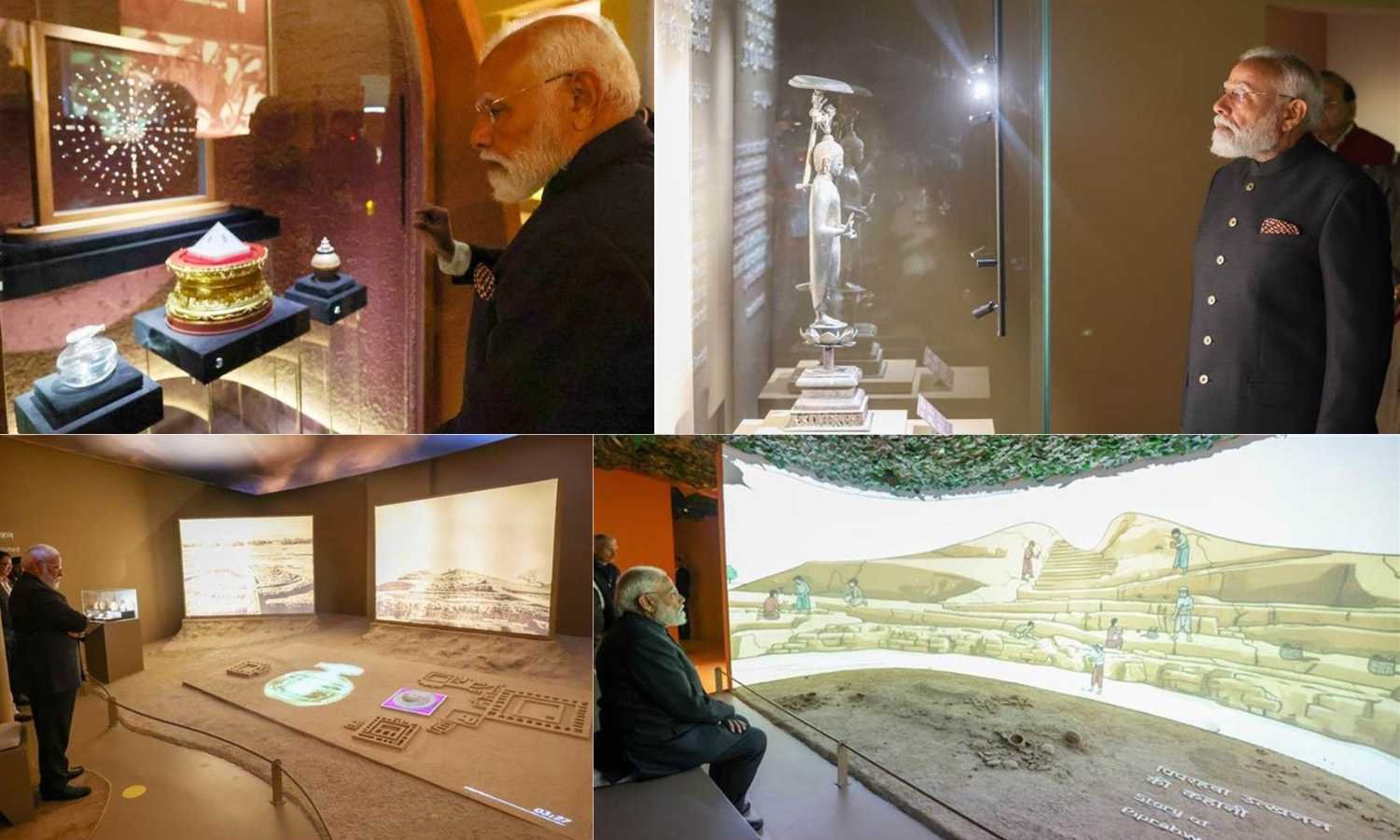
The Piprahwa relics exposition showcased over 80 rare objects spanning from the 6th century BCE to the present era. These objects included sculptures, manuscripts, thangkas and ritual artefacts. It also featured reliquaries and jewelled treasures of exceptional value.
At the centre of the exhibition stood the original monolithic stone coffer. Archaeologists had discovered the sacred relics inside this coffer. Visitors viewed it as the spiritual core of the exposition.
During his visit, the Prime Minister walked through the galleries. He offered khataak and rose petals at a sculpture of the seated Buddha. He also consecrated an ancient seal excavated from the Piprahwa site.
Furthermore, the Prime Minister planted a Bodhi tree sapling at the venue. He signed the visitors’ book. He then released the official exhibition catalogue. Later, he offered Chivar Daan to the Buddhist monks present at the ceremony.
Senior leaders received the Prime Minister on arrival. These included Delhi Chief Minister Rekha Gupta and Lieutenant Governor Vinai Kumar Saxena. Union Ministers Gajendra Singh Shekhawat and Kiren Rijiju were also present. Ministers of State Rao Inderjit Singh and Ramdas Athawale attended as well.
Archaeologist William Claxton Peppé unearthed the Piprahwa relics in 1898. He discovered them at an ancient stupa site identified with Kapilavastu. Scholars regard the find as one of the most significant discoveries linked to the life of the Buddha.
Under Prime Minister Narendra Modi’s leadership, India has intensified its efforts to reclaim lost heritage. So far, the country has repatriated 642 antiquities from abroad. Officials described the return of the Piprahwa relics as a landmark success in cultural diplomacy.
The inauguration drew wide participation. Union Ministers, diplomats and ambassadors attended the event. Buddhist monks, scholars and heritage experts were also present. Students, artists and followers of Buddhism from India and overseas joined the gathering.
The exposition reaffirmed India’s role as the birthplace of the Buddha Dhamma. It also highlighted the country’s continued commitment to preserving and sharing its civilisational legacy with the world.
