

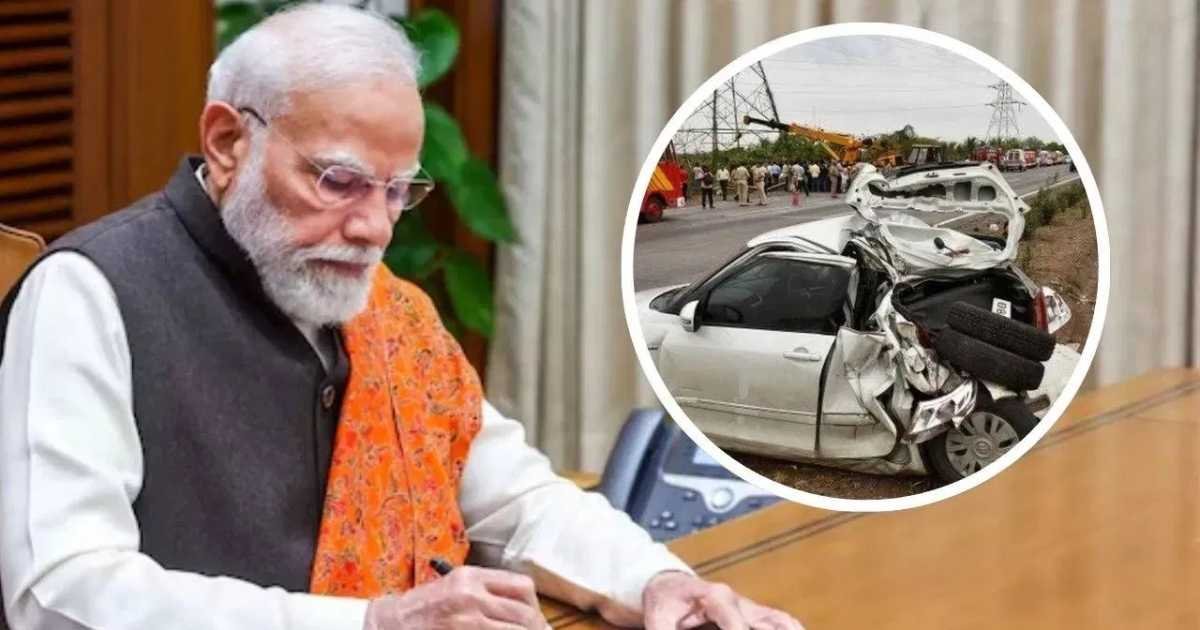
New Delhi: The Centre launched the PM RAHAT scheme to provide cashless treatment for road accident victims. Prime Minister Narendra Modi approved the decision as the first major step after shifting to Seva Teerth.
The PM RAHAT scheme, which stands for Road Accident Victim Hospitalization and Assured Treatment, aims to prevent deaths due to delayed care. India records a high number of road fatalities each year. However, studies show that nearly 50% of deaths can be prevented if victims reach hospitals within the first hour.
Under the PM RAHAT scheme, each eligible victim will receive cashless treatment up to ₹1.5 lakh. This cover will apply for seven days from the date of accident. In non-life-threatening cases, hospitals will provide stabilisation care for up to 24 hours. In life-threatening cases, they will provide care for up to 48 hours. Meanwhile, police must confirm the case on a digital system within defined timelines.
Integration with the 112 Emergency Response Support System will speed up assistance. Victims, Good Samaritans or bystanders can dial 112 for help. They can also obtain details of the nearest designated hospital. As a result, coordination between police, ambulance services and hospitals will improve.
PM RAHAT scheme integrates digital accident and claim systems
The PM RAHAT scheme combines the eDAR platform of the Ministry of Road Transport and Highways with the TMS 2.0 platform of the National Health Authority. Therefore, accident reporting, hospital admission and claim processing will run on a single digital chain. This linkage will reduce paperwork and delays.
Reimbursements will flow through the Motor Vehicle Accident Fund. In insured cases, General Insurance Companies will contribute funds. In uninsured or hit-and-run cases, the Government of India will provide budgetary support. Consequently, hospitals will not face payment uncertainty.
State Health Agencies will examine and approve claims. Thereafter, payments will reach hospitals within 10 days. This timeline aims to ensure uninterrupted emergency treatment.
Each district will appoint a Grievance Redressal Officer. The District Road Safety Committee, chaired by the District Collector or Magistrate, will oversee grievance handling. Thus, accountability will remain at the district level.
Overall, the PM RAHAT scheme seeks to strengthen emergency medical response. By ensuring financial protection and structured coordination, it aims to reduce preventable deaths. In turn, the initiative will support a more responsive and humane road safety system.
