

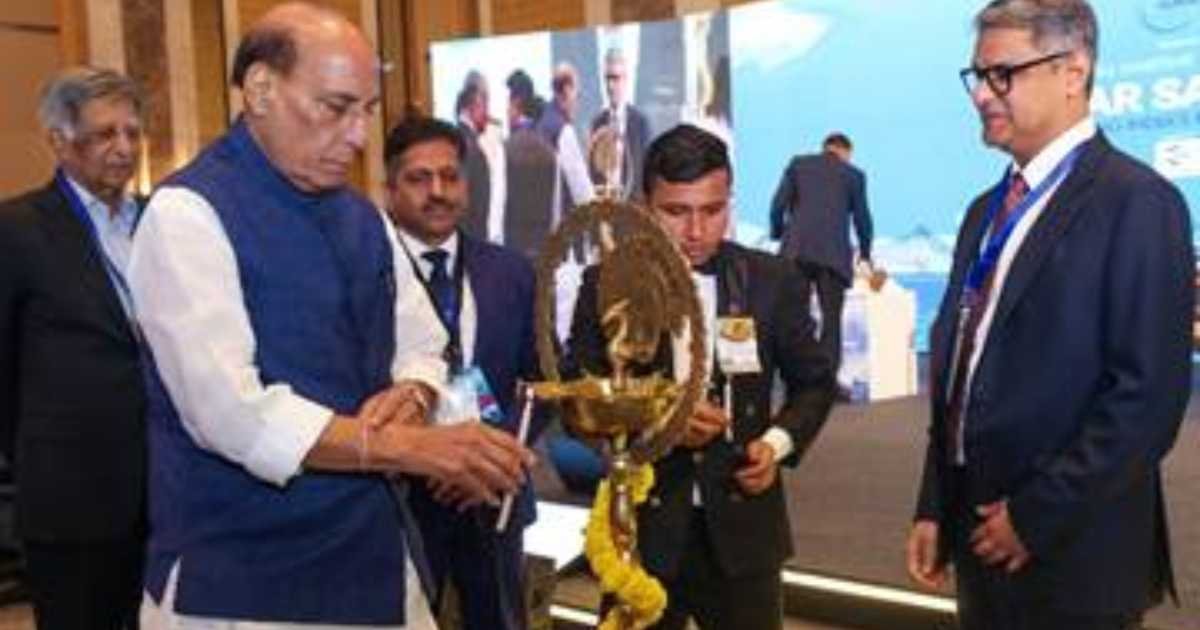
Kolkata: Defence Minister Rajnath Singh said self-reliance remains the only way for nations to stay prepared amid global uncertainty while addressing the Sagar Sankalp dialogue in Kolkata on March 6.
He inaugurated the event titled “Sagar Sankalp – Reclaiming India’s Maritime Glory,” organised by Garden Reach Shipbuilders & Engineers Limited along with a private media organisation.
The minister said global uncertainties are reshaping supply chains and geopolitical alignments. He pointed to tensions in the Middle East and disruptions in global trade as examples of emerging challenges.
According to Rajnath Singh, disturbances in the Strait of Hormuz and the Persian Gulf region directly affect global energy supplies and international commerce.
He added that rapid technological change is also transforming the defence sector. Therefore, India must achieve self-reliance in defence technology to remain ready for future challenges.
Sagar Sankalp dialogue highlights defence exports growth
Rajnath Singh said government reforms have strengthened India’s defence production ecosystem. These reforms emphasise transparency, financial discipline, research and development, and performance benchmarking.
He said defence public sector undertakings play a crucial role in achieving the self-reliance vision. Shipyards such as Garden Reach Shipbuilders & Engineers are receiving special focus to strengthen the domestic industrial base.
The minister said the government aims to transform shipyards into technology hubs. Infrastructure modernisation, digital ship design tools and modular construction techniques are being introduced to meet global standards.
He added that defence exports reached about ₹24,000 crore in the financial year 2024–25. By April 2026, exports are expected to rise to around ₹29,000 crore.
The government has also set a target of ₹50,000 crore in defence exports by the financial year 2029–30.
Rajnath Singh said private companies currently contribute about 25 percent of defence manufacturing in India. He expressed confidence that this share could rise to 50 percent in the coming years.
The minister noted that all warships and submarines ordered for the Indian Navy are being built in Indian shipyards. This includes work from design and engineering to construction and lifecycle support.
He also praised the role of MSMEs, start-ups and indigenous vendors in strengthening the shipbuilding ecosystem.
Rajnath Singh said the government has introduced financial assistance schemes and liberalised foreign investment rules to boost shipbuilding. Investments worth about ₹3 lakh crore are planned under Maritime India Vision 2030 and Maritime Amrit Kaal Vision 2047.
He said the Indian Navy’s readiness and the success of operations such as Operation Sindoor show that the defence sector is moving in the right direction.
The minister added that the government aims to place India among the top 10 shipbuilding nations by 2030 and among the top five by 2047.
