

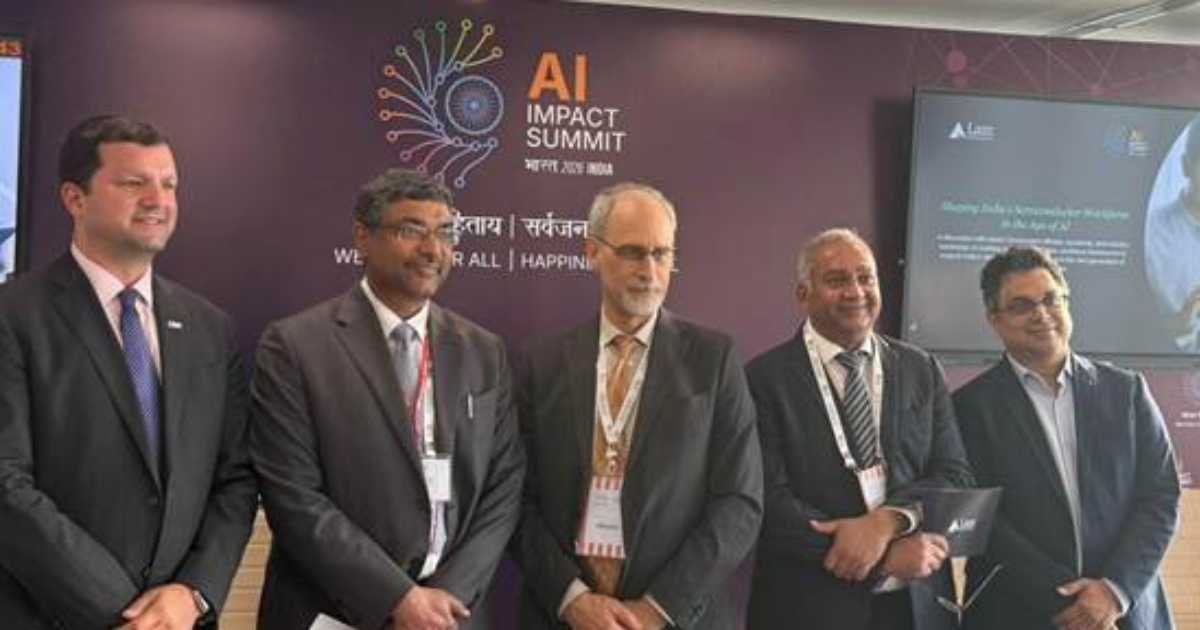
New Delhi: Semiconductor workforce in the age of AI emerged as a national priority at the India AI Impact Summit 2026, with Union Minister Ashwini Vaishnaw outlining India’s roadmap to build deep-end chip talent and scale manufacturing capacity.
Speaking at the session titled “Semiconductor Workforce in the Age of AI,” Vaishnaw said students across India are now actively designing chips. From Assam to Tamil Nadu, institutions are participating in the country’s expanding semiconductor ecosystem. In an AI-driven world, he noted, semiconductors form a foundational layer of national technology architecture.
He emphasised that India must move beyond incremental skilling and focus on deep technical capability. Engineers and technicians need end-to-end understanding of fabrication processes, device physics and advanced manufacturing systems. Such expertise, he said, will determine India’s long-term competitiveness in the AI value chain.
Semiconductor workforce in the age of AI aligns missions
S. Krishnan, Secretary at the Ministry of Electronics and Information Technology, highlighted the convergence between the India AI Mission and the India Semiconductor Mission. He noted that India already contributes nearly 20 percent of the global semiconductor design workforce. However, the next milestone is achieving leadership in advanced manufacturing.
The government has committed to establishing 10 major semiconductor plants across the country. At least four of these facilities will begin production in 2026, while the remaining units will follow in phases. India Semiconductor Mission 2.0 will also extend support to domestic manufacturing of semiconductor equipment, covering the entire ecosystem.
Industry leaders pointed out that established semiconductor hubs took decades to mature. India, by contrast, aims to compress that journey into a shorter timeframe. This acceleration requires close collaboration between academia, equipment suppliers and fabrication units.
Collaborative models such as IISc’s SemiFirst programme were cited as examples of industry-aligned training. The initiative combines simulation-led learning with exposure to real fabrication subsystems, preparing students for the operational complexity of modern semiconductor manufacturing.
Participants concluded that infrastructure alone will not define success. Instead, the semiconductor workforce in the age of AI will determine whether India becomes a trusted global manufacturing and technology partner in the coming decades.
