

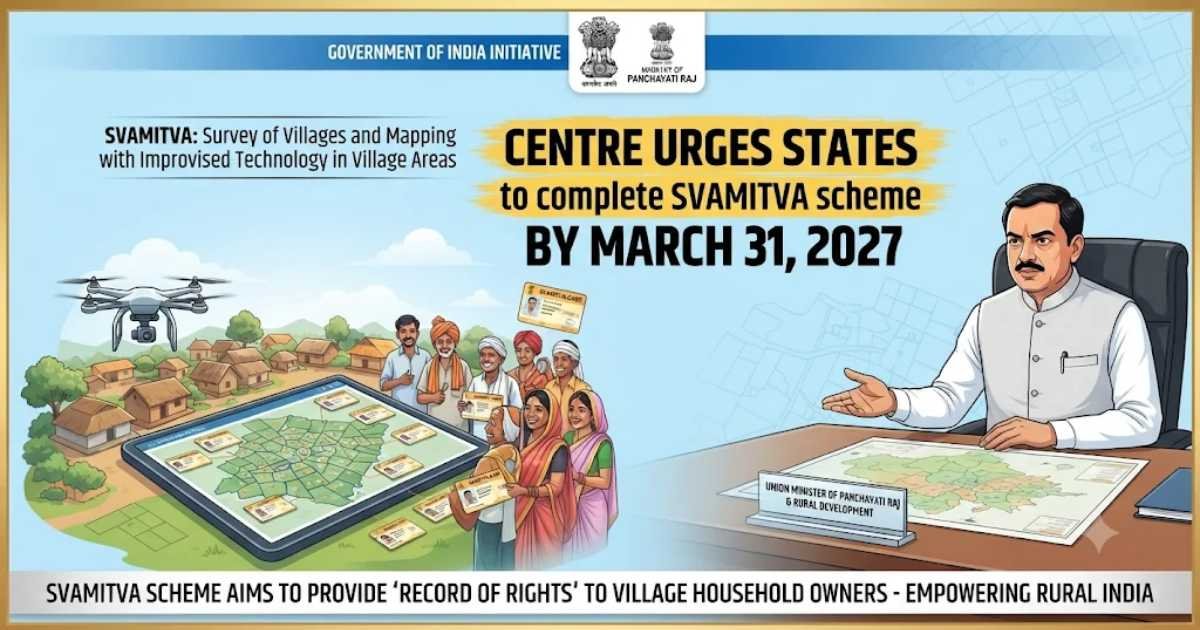
New Delhi: Union Panchayati Raj Minister Rajiv Ranjan Singh has urged states to complete the SVAMITVA scheme by March 31, 2027. He called for mission-mode implementation and time-bound action plans at a review meeting in New Delhi on November 20, 2026.
The Centre and states agreed to finish the pending work within the deadline. Meanwhile, Union Minister of State S. P. Singh Baghel also addressed the meeting, attended by ministers from nine states.
Panchayati Raj Secretary Dr Vineet Joshi joined senior ministry officials and representatives from states, Union Territories and the Survey of India. The meeting reviewed progress, pending verification, property card distribution and coordination among authorities.
Singh said Prime Minister Narendra Modi launched the programme on April 24, 2020. He said it aims to strengthen rural India through clear ownership records, social harmony and financial progress.
The scheme uses drones and geographic information system mapping to identify property boundaries. It also provides legal ownership records to rural households. According to Singh, these records help resolve property disputes and strengthen women’s economic empowerment. Moreover, they support rural economic activity.
Singh said banks now accept SVAMITVA property cards as collateral for loans. As a result, rural residents can seek institutional credit, establish enterprises and pursue livelihood opportunities. This can also reduce their dependence on costly informal borrowing.
Drone surveys have covered 3.28 lakh villages, or 98% of the target of 3.33 lakh villages. Meanwhile, authorities have generated 3.47 crore property cards for 2.20 lakh villages, covering 66% of the target.
The Survey of India has also generated village maps and handed them to states for 3.17 lakh villages, or 95% of the target. In addition, states have completed ground verification in 2.69 lakh villages, representing 81%. Authorities have placed maps for 2.46 lakh villages, or 74%, for objections and claims.
Singh praised states that achieved full coverage. He also acknowledged the cooperation between the Survey of India, state revenue departments and the ministry. However, he asked all states to prepare time-bound plans for the remaining work.
SVAMITVA property cards support access to institutional loans
The review highlighted how property cards can help rural residents obtain institutional credit. Officials reported 16,614 loans worth Rs 1,769.56 crore across Madhya Pradesh, Rajasthan, Maharashtra, Gujarat, Mizoram, Jammu and Kashmir, and Ladakh.
Singh also urged states to use the scheme’s high-resolution spatial data for development planning. The data can help estimate solar potential, plan drainage networks and prepare spatial plans. Furthermore, it can strengthen Gram Panchayat Development Plans and support development based on local needs.
He linked the programme to the vision of Gram Swaraj through empowered villages. He also stressed that rural property owners should be able to use their assets for financial purposes.
Baghel said the scheme provides Records of Rights to households in rural inhabited, or Abadi, areas. He noted that clear ownership records promote financial inclusion and poverty alleviation. They can also strengthen social relations by reducing property disputes.
Baghel called for faster drone surveys and quicker preparation and distribution of property cards. Therefore, he urged states to adopt mission-mode implementation and ensure that rural residents receive the scheme’s benefits.
Officials presented state-wise achievements and outlined the remaining work. Discussions covered faster ground verification, property card distribution, best practices and the use of geospatial maps for rural planning.
State representatives said GIS-based maps were helping authorities plan drainage networks, street lighting and solar installations. They also reported improvements in financial stability, property tax assessment and village-level planning.
Representatives from states and Union Territories briefed the meeting on drone surveys and ground verification. They assured the Centre that they would accelerate the pending work to meet the deadline.
The meeting ended with the Centre and states reaffirming their commitment to close coordination. Their objective is to ensure that every eligible rural household receives clear property ownership records.
