

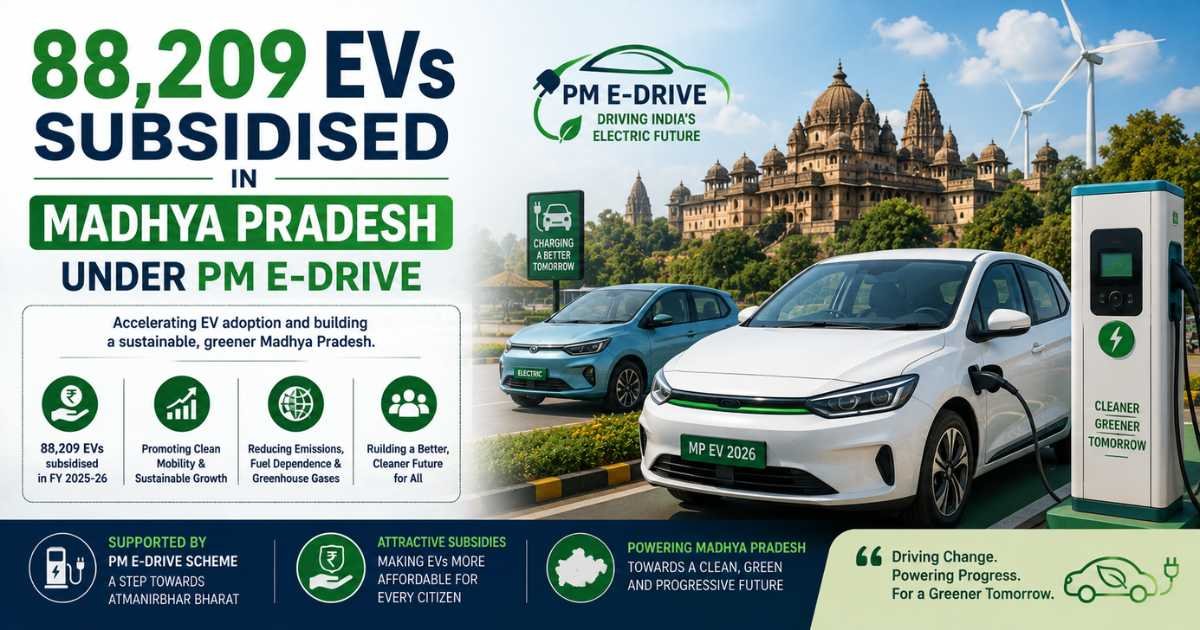
Bhopal: Madhya Pradesh recorded 88,209 EVs receiving subsidies under PM E-DRIVE in FY 2025-26, according to the Centre. The state also recorded 94,277 EV deployments during the year.
The subsidised vehicles included 81,840 electric two-wheelers and 6,369 electric three-wheelers. Together, these vehicles accounted for the 88,209 EVs supported under the scheme.
The Ministry of Heavy Industries released the district-wise figures on August 12. However, the ministry does not centrally track the total demand incentives paid to buyers and original equipment manufacturers in Madhya Pradesh.
The ministry also said it had not conducted an assessment of that amount. Meanwhile, PM E-DRIVE did not allocate any electric buses to Madhya Pradesh.
The Centre has introduced several schemes to promote clean-energy transport across India. These programmes also cover two-tier and three-tier towns in Madhya Pradesh.
The Faster Adoption and Manufacturing of (Hybrid &) Electric Vehicles in India (FAME India) Scheme Phase-II ran from April 1, 2019, to March 31, 2024. It received budgetary support of ₹11,500 crore.
FAME-II supported sales of about 16.72 lakh electric vehicles. These included electric two-wheelers, three-wheelers and four-wheelers.
The scheme also sanctioned 6,862 e-buses for various cities. As of July 31, 2026, operators had deployed 5,299 of these buses.
In addition, the government allocated ₹912.50 crore under FAME-II for EV public charging stations.
88,209 EVs supported across Madhya Pradesh districts
The Production Linked Incentive (PLI) Scheme for Automobile and Auto Component Industry began in September 2021. It carries a budgetary outlay of ₹25,938 crore.
The scheme aims to expand domestic manufacturing of Advanced Automotive Technology products, including EVs.
Similarly, the government notified the PLI Scheme for Advanced Chemistry Cell battery storage in June 2021. It has a budgetary outlay of ₹18,100 crore.
The scheme targets a competitive domestic manufacturing ecosystem for 50 GWh of ACC batteries.
The government notified the PM Electric Drive Revolution in Innovative Vehicle Enhancement (PM E-DRIVE) Scheme on September 29, 2024. It has an outlay of ₹10,900 crore.
PM E-DRIVE supports about 28.30 lakh EVs. These include electric two-wheelers, three-wheelers, trucks, buses and ambulances.
The scheme also provides grants to upgrade vehicle testing agencies. Furthermore, the government allocated ₹4,391 crore for 14,028 e-buses under the scheme.
Of those buses, the government has allocated 14,000. It also allocated ₹2,000 crore for EV public charging stations across India.
The PM e-Bus Sewa-Payment Security Mechanism Scheme started in October 2024. It has an outlay of ₹3,435.33 crore and aims to support more than 38,000 electric buses.
The government has also cut GST on electric vehicles and EV chargers or charging stations to 5%. In addition, battery-operated vehicles receive green licence plates.
Moreover, such vehicles remain exempt from permit requirements. The Ministry of Road Transport and Highways also advised states to waive road tax on EVs.
Such measures can reduce the initial purchase cost of electric vehicles. They also support wider adoption of clean-energy transport.
Indore recorded the highest district-level total, with 12,840 subsidised EVs. Gwalior followed with 9,476 vehicles, while Jabalpur recorded 7,913.
Bhopal reported 6,622 subsidised EVs, while Ujjain recorded 3,622. Chhindwara and Sagar recorded 2,683 and 2,685 vehicles respectively.
The district-wise data showed significant differences in EV adoption across Madhya Pradesh. The figures covered electric two-wheelers and three-wheelers under PM E-DRIVE during FY 2025-26.
