
Uttam Kumar Reddy proposes unified water-security framework for Telangana

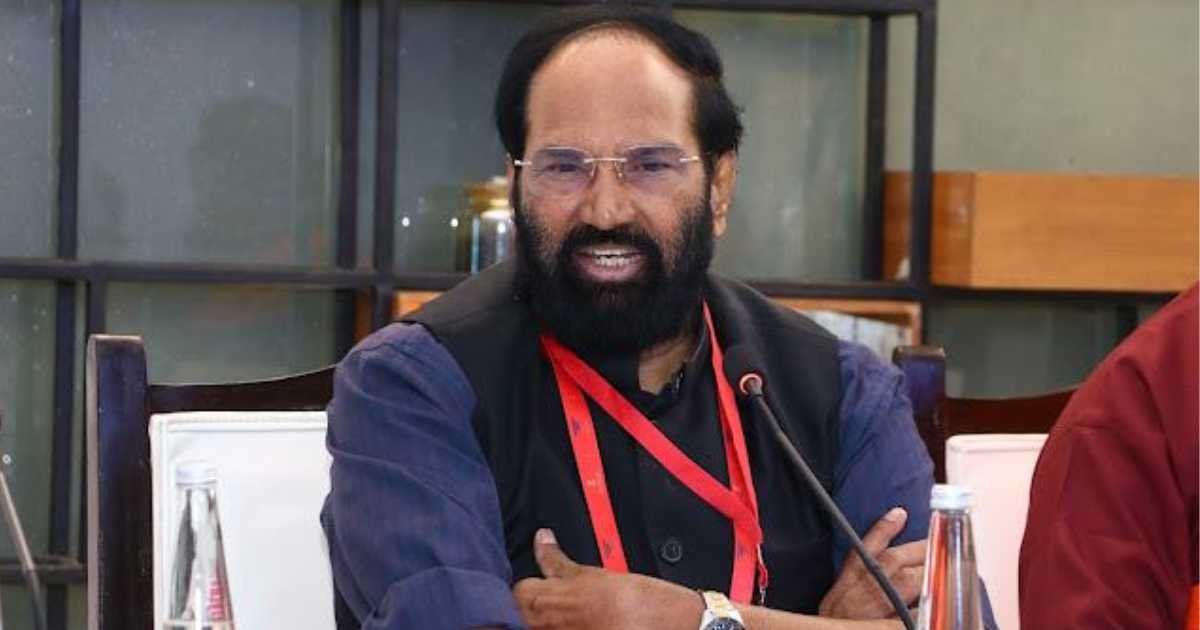
Hyderabad: Irrigation and CAD Minister Capt. N. Uttam Kumar Reddy proposed a unified water-security framework for Telangana at a departmental summit in New Delhi.
The Ministry of Jal Shakti organised the Jal Sanchay Jan Bhagidari summit. The event brought Union and State leaders together on a collaborative Team India platform.
Uttam Kumar Reddy said water security should go beyond engineering works and departmental programmes. Instead, he described it as a public mission linked to drinking water, agriculture, rural livelihoods and urban resilience.
He also called for rainwater conservation to become a people’s movement. Households should have suitable recharge facilities, he said.
Likewise, agricultural fields should use conservation structures. Villages should also have dependable community water bodies.
However, Uttam Kumar Reddy stressed that agencies must design every intervention around local conditions. These include geology, aquifers, runoff patterns and actual water needs.
He said Telangana was already implementing several water-conservation works through different programmes. These included MGNREGS, PMKSY, Finance Commission grants, CAMPA, watershed initiatives, State schemes, local bodies and CSR.
Without convergence, fragmented planning could lead to unsuitable sites and duplicate works. It could also cause repeated reporting and weak maintenance.
The Minister proposed geo-tagging every water-conservation asset. Each asset should receive a unique identity and a responsible agency.
The system should also record the funding source and identify a specific custodian. This would help authorities track assets and measure their actual water-security outcomes.
Water-security framework to track conservation results
Uttam Kumar Reddy said authorities should measure the water-security framework through clear results. These should include restored storage, groundwater recharge and improved water levels.
The system should also track asset functionality and year-round water availability. Thus, the focus would shift from creating structures to measuring their lasting benefits.
The Minister highlighted Telangana’s performance under Jal Sanchay Jan Bhagidari. He said the State was recognised as a top performer in water conservation.
Telangana has 44,360 water bodies and tanks. Authorities have taken up works in 28,739 of them.
Restoration has been completed in 22,428 water bodies and tanks. The figures showed the scale of the State’s conservation effort.
The State has 74 major and medium irrigation projects. Together, they have an irrigation potential of 74.51 lakh acres.
Another 53.18 lakh acres of potential remains to be realised. Therefore, Uttam Kumar Reddy called for action to use the available irrigation potential.
Telangana’s three-year plan for 2026–29 targets the creation or stabilisation of irrigation facilities across 17.28 lakh acres. The plan carries an outlay of Rs 46,110.35 crore.
Of the 4.43 lakh acres required for irrigation projects, the State had acquired 3.95 lakh acres. Uttam Kumar Reddy called for action on the remaining land requirements.
He also sought fair and speedy rehabilitation for 60,531 project-displaced families. The Minister further called for complete restoration of tank chains.
This includes feeder and surplus channels linked to tanks. He also sought the removal of encroachments and obstructions.
In addition, the Minister called for protection of Full Tank Levels and regular updating of official records.
Meanwhile, he said groundwater-recharge structures should follow scientific assessments. Authorities should consider aquifers, fractures and runoff while selecting sites.
Priority should go to over-exploited groundwater zones and drought-prone clusters. Habitations facing drinking-water shortages should also receive priority.
Authorities should record baseline conditions before starting works. They should then measure and publicly disclose post-monsoon results.
For urban areas, Uttam Kumar Reddy sought strict implementation of rooftop rainwater harvesting. He also called for lake rejuvenation and protection of lake inflow channels.
He cited improvements at Saireddy Lake, Bathukamma Kunta and Nallacheruvu as examples of coordinated urban action.
The Minister also raised concerns over reservoir sedimentation. Telangana’s 159 major and medium reservoirs have a combined capacity of 929 TMC.
Studies covering 18 projects found storage losses of 40.97 TMC due to sedimentation. The projects had an assessed capacity of 222.90 TMC.
The loss represented about 22.95 per cent of the assessed capacity. Therefore, Uttam Kumar Reddy stressed the need for restoration and capacity studies.
Telangana has started revenue-based pilot desiltation programmes at the Lower Manair, Mid Manair and Kadem reservoirs.
The programmes target the restoration of 3.74 TMC of storage. They aim to achieve this by removing about 9.51 lakh metric tonnes of sediment.
Based on the pilot results, the State could consider similar works at SRSP, Nizamsagar, Jurala, Nagarjunasagar, Musi and Pocharam.
Uttam Kumar Reddy sought Central assistance for eligible ongoing projects under PMKSY. He also requested suitable flexibility in inclusion conditions where appropriate.
He sought flexibility under FRBM norms and access to Infrastructure Development Fund loans. The Minister also called for time-bound environmental clearances.
He sought guidance for projects affected by the Supreme Court’s position after July 29, 2026.
The Minister also sought timely facilitation of inter-State water-sharing matters. He said Telangana needed technical and financial support for reservoir-capacity studies and restoration.
Uttam Kumar Reddy urged the Central Water Commission and the Ministry of Jal Shakti to deepen coordination with States.
He also called for artificial intelligence to support rainfall and inflow forecasting. He proposed its use in reservoir operations and evidence-based decisions.
The Minister proposed a water-security plan for every village and town. Local plans, he said, should feed into a unified State asset register.
They should also follow common performance-measurement systems. This would allow authorities to compare outcomes and track progress across locations.
“Every rupee spent, every structure created and every community mobilised must produce a measurable and lasting water benefit,” he said.
Finally, Uttam Kumar Reddy said Telangana was ready to share its experience in tank restoration. He also offered its experience in community participation and reservoir-desiltation pilots to other States.
Uttam Calls for Unified National Water-Security Framework
Telangana Minister proposes unique identity, responsible agency and measurable outcome for every water-conservation asset
Seeks Central assistance for irrigation projects, reservoir restoration and AI-based water… pic.twitter.com/B2ePoprRGa
— IPRDepartment (@IPRTelangana) September 2, 2026
