

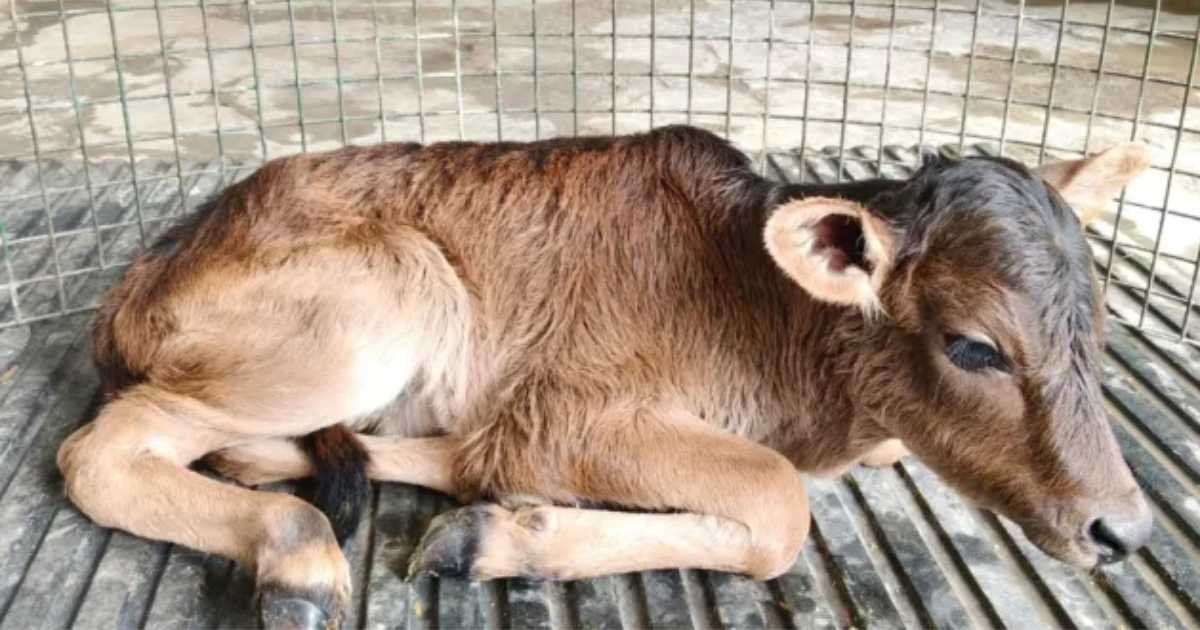
Uttaekhand: Badri calf birth through OPU-IVF technology marked a major step in conserving and improving Uttarakhand’s indigenous cattle breed.
A healthy female calf was born on 11 September 2026 at the Academic Dairy Farm. Scientists transferred a Badri embryo into a Sahiwal recipient cow.
Badri cattle are an important indigenous genetic resource of Uttarakhand. The breed is also recognised as the state animal of Uttarakhand.
ICAR-National Dairy Research Institute (ICAR-NDRI), Karnal, and G. B. Pant University of Agriculture and Technology, Pantnagar, worked together on the programme.
The Uttarakhand Biotechnology Council, Haldi, provided financial support for the research. The work focused on conserving, multiplying and improving valuable Badri cattle germplasm.
Dr Dheer Singh, Director of ICAR-NDRI, Karnal, said OPU-IVF can help multiply elite female germplasm faster. He also said the technology can support structured breed improvement and germplasm conservation programmes.
The research began in 2023 under the leadership of then Vice-Chancellor Dr M. S. Chauhan. G. B. Pant University and ICAR-NDRI then began scientific work on advanced reproductive methods.
Over the past three years, the teams established procedures for OPU-IVF, embryo production and embryo transfer in Badri cattle.
Under the programme, scientists collected oocytes from selected Badri donor cows through ultrasound-guided ovum pick-up. They then matured and fertilised the oocytes in laboratory conditions.
Scientists used semen from a genetically superior Badri bull for in-vitro fertilisation. The Uttarakhand Livestock Development Board provided the semen.
The resulting embryos were cultured under controlled laboratory conditions. Scientists then transferred them into suitably synchronised recipient cows.
One Badri embryo was transferred into a Sahiwal recipient cow. The recipient later delivered the healthy female Badri calf.
Badri calf birth supports advanced breeding work
Badri calf birth also marked progress towards a technology-based conservation programme in Uttarakhand. OPU-IVF can produce multiple embryos from genetically superior female animals.
As a result, the method can increase the multiplication rate of elite germplasm compared with conventional reproductive methods.
Another synchronised crossbred recipient cow was also expected to deliver a Badri calf within 5–7 days.
Meanwhile, the research team is exploring cloning of elite and high-producing Badri cows. The team has already generated cloned Badri embryos through several stages of the ongoing research.
In the next phase, scientists plan to transfer OPU-IVF- and cloning-derived embryos into suitable recipient cows. These will include Sahiwal, crossbred and Badri cows.
The efforts aim to speed up the multiplication of superior Badri germplasm. They also support the long-term conservation and genetic improvement of the breed.
The achievement showed the potential of combining indigenous genetic resources with advanced reproductive biotechnology. It also supported sustainable livestock development in the Himalayan region.
The successful OPU-IVF calf provides a foundation for wider collaboration on Badri cattle conservation. It may also support the wider dissemination of elite Badri germplasm in Uttarakhand.
ICAR-NDRI, Karnal, and G. B. Pant University remain committed to collaborative research and technology transfer. Their work focuses on conserving, improving and sustainably using indigenous livestock breeds.
