

New Delhi: Union Minister Dr Jitendra Singh said steel slag technology could cut construction costs by around 40% and deliver four times the strength of conventional roads.
He said suitable applications could need major maintenance only after about 15 years. Therefore, he called for wider adoption across states, government departments and the private sector.
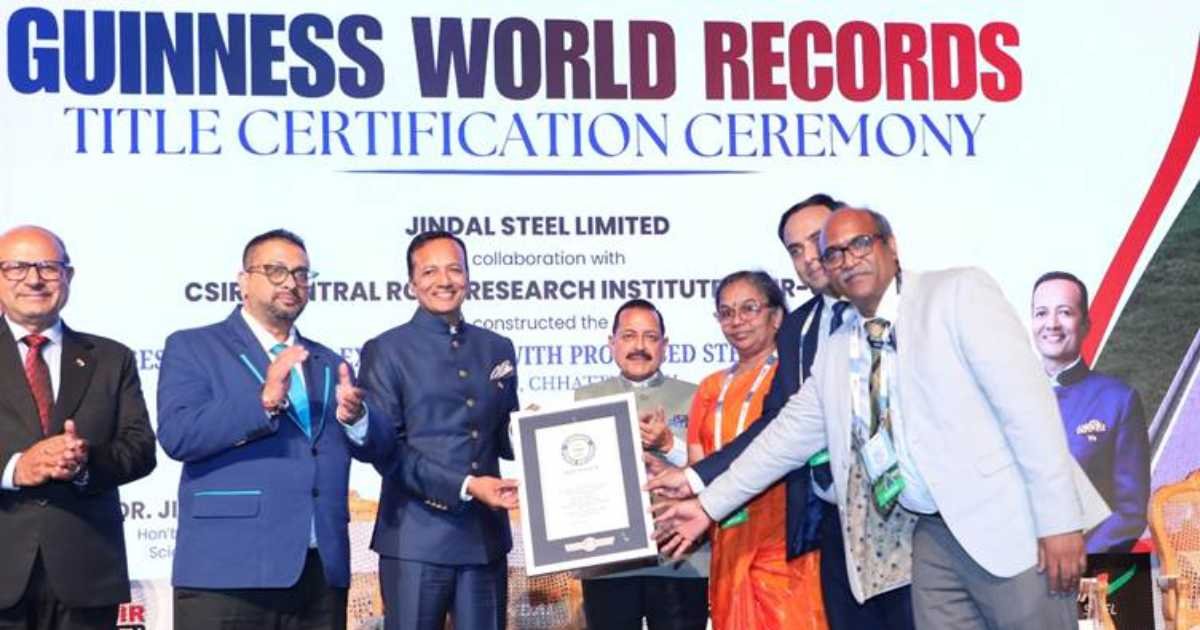
Dr Jitendra Singh made the remarks at an event marking a Guinness World Record. The record recognised the world’s longest road built with processed steel slag aggregates.
The 1.85-km road stands in Raigarh, Chhattisgarh. CSIR-Central Road Research Institute (CSIR-CRRI), New Delhi, and Jindal Steel Limited jointly pursued the project.
The initiative converts processed steel slag, a by-product of steel production, into road aggregates. As a result, it gives industrial waste a productive role in infrastructure.
The programme also featured the virtual inauguration of the road. Organisers released a scientific documentary during the event.
In addition, CSIR-CRRI and Jindal Steel signed a Technology Transfer Agreement. The programme also launched the “Steel Grit” brand and recognised the project team.
Dr Jitendra Singh urged stakeholders to take steel slag technology from one project to many projects. He also called for its expansion from one state to several states.
The minister said adoption should extend beyond the Ministry of Road Transport and Highways. He identified Railways, state governments and private infrastructure companies as potential users.
According to the minister, the initiative supports the government’s “Waste to Wealth” priority. He linked it to Prime Minister Narendra Modi’s emphasis on recycling and productive use of waste.
Dr Jitendra Singh said the project showed how industrial waste could become infrastructure wealth. He credited cooperation between Indian science, technology and industry for the achievement.
India’s expanding highways, expressways, industrial corridors and ports are increasing demand for construction materials. At the same time, the country needs to conserve natural aggregates from mining and quarrying.
The technology addresses both challenges, he said. It creates a productive use for industrial by-products while reducing dependence on natural aggregates.
The minister also highlighted stronger roads for difficult terrain. India’s geographical diversity creates different challenges for road construction, he said.
He recalled his seven-year association with the Northeast. In several areas, heavy rainfall limits road construction to four or five months.
Road sections built during one season can suffer damage before the next construction cycle. Therefore, stronger and more durable road technologies could benefit such regions.
Dr Jitendra Singh also pointed to changes in rural road usage. Roads built mainly for villages and light vehicles can later carry heavy trucks.
Such changes can follow industrial development in surrounding areas. As a result, roads need materials that can handle higher loads and remain durable.
The minister called for a wider awareness campaign on steel slag technology. He said road construction involved more agencies than the Ministry of Road Transport and Highways.
Railways and several government departments also build roads and heavy-duty infrastructure. Meanwhile, private builders and infrastructure operators could provide another route for adoption.
He called for greater coordination between ministries and states. He also sought dedicated awareness programmes for engineers and implementing agencies.
Such programmes could help technical teams assess where the technology would suit local conditions. Dr Jitendra Singh stressed that adoption should depend on technical and economic suitability.
Dr Jitendra Singh said the goal was to move the technology “from one project to many projects, from one State to many States”. He said proven indigenous innovations should enter mainstream infrastructure.
CSIR-CRRI has developed scientific guidelines and processing protocols for the technology. Its quality-control framework also supports technically sound implementation.
Government agencies, scientific institutions and industry can work together to expand steel slag technology. Infrastructure developers can also use it where local conditions support its application.
Steel slag technology moves from record project to wider adoption
The minister described the initiative as an example of “whole-of-government plus whole-of-nation” collaboration. The project brought together government, research institutions, industry and engineers.
He said the technology was indigenous in both its conception and application. The next phase should focus on awareness and pathways for Indian innovations to reach large-scale use.
Dr Jitendra Singh placed the project within the wider Waste to Wealth and circular economy approach. He said India should stop treating every discarded material simply as waste.
Science and technology can create economic value from such resources, he said. He referred to CSIR initiatives involving biofuels from used cooking oil and recovery from electronic scrap.
According to the minister, recycling and resource recovery will become increasingly important for industrial development. The steel slag project shows how this approach can support infrastructure needs.
Dr Jitendra Singh congratulated Dr Satish Pandey and the CSIR-CRRI team for their sustained work. He said scientists needed opportunities to demonstrate their potential through real-world applications.
He also credited Jindal Steel for providing the scale and platform needed for field demonstration. The minister hoped more steel companies would collaborate with scientific institutions on similar solutions.
Steel slag technology has already moved through several applications across India. A major demonstration took place at Hazira in Gujarat.
At Hazira, processed steel slag aggregates were used on a six-lane road connecting an industrial area with Hazira Port. The technology later reached the NH-66 Mumbai-Goa Highway.
Around 80,000 tonnes of steel slag went into processed aggregates for a one-kilometre, four-lane highway section. The technology also reached heavy-duty road infrastructure in Arunachal Pradesh.
That deployment covered a strategic border region. The application showed the potential value of stronger road materials in challenging locations.
The technology has also entered port infrastructure. A 1.1-km steel slag road was built inside Hazira Port.
The road connected the multi-Purpose Berth with the coal yard. This application demonstrated the use of processed steel slag aggregates in industrial and logistics settings.
Such applications require suitable processing and pavement design. They also depend on proper quality control, according to the project details.
The 1.85-km Guinness World Record project could now lead to wider implementation. Dr N. Kalaiselvi, Secretary, DSIR and Director General, CSIR, announced the next major project.
CSIR-CRRI has received a work order for a 40-km road in Odisha from Jindal Steel’s Angul plant. The project will take the technology towards a much larger field application.
Dr Kalaiselvi said CSIR-CRRI and Jindal Steel were positioned to create another milestone. The Odisha project would significantly expand the scale of steel slag road construction.
She said the Guinness achievement came as CSIR prepared to enter its 85th year. She described the record as a significant milestone for the organisation.
Dr Kalaiselvi also highlighted the partnership between CSIR-CRRI and Jindal Steel alsothanked Naveen Jindal and his team for supporting collaboration with CSIR.
She congratulated the scientists and engineers involved in the project. She particularly acknowledged Dr Satish Pandey for helping move the technology from research into field applications.
The technology has progressed from early applications in Gujarat to national highway infrastructure. It then reached Arunachal Pradesh and the Guinness World Record project in Chhattisgarh.
Dr Jitendra Singh said the Guinness record should not become the final destination. Instead, he described it as the beginning of the next adoption phase.
He said replication across India would provide the real measure of success. Steel slag technology should serve projects where technical and economic conditions make it suitable.
The minister again called for stronger engagement with government departments, states and private infrastructure players. He said Indian innovations should become widely used infrastructure solutions.
The project combines science and industry with waste management and infrastructure development. It also connects research with practical requirements in the field.
Dr Jitendra Singh said the achievement showed India was moving beyond developing indigenous technology. The focus was now shifting towards taking such technology to scale.
He said the approach could support infrastructure that is economically efficient and environmentally responsible. It could also improve technical performance where road conditions suit its use.
The next phase will focus on wider awareness and adoption. With the 40-km Odisha project in the pipeline, steel slag technology is moving towards broader national implementation.
The initiative could turn a steel industry by-product into a useful infrastructure resource. It also reflects efforts to link innovation, resource recovery and infrastructure development.
