

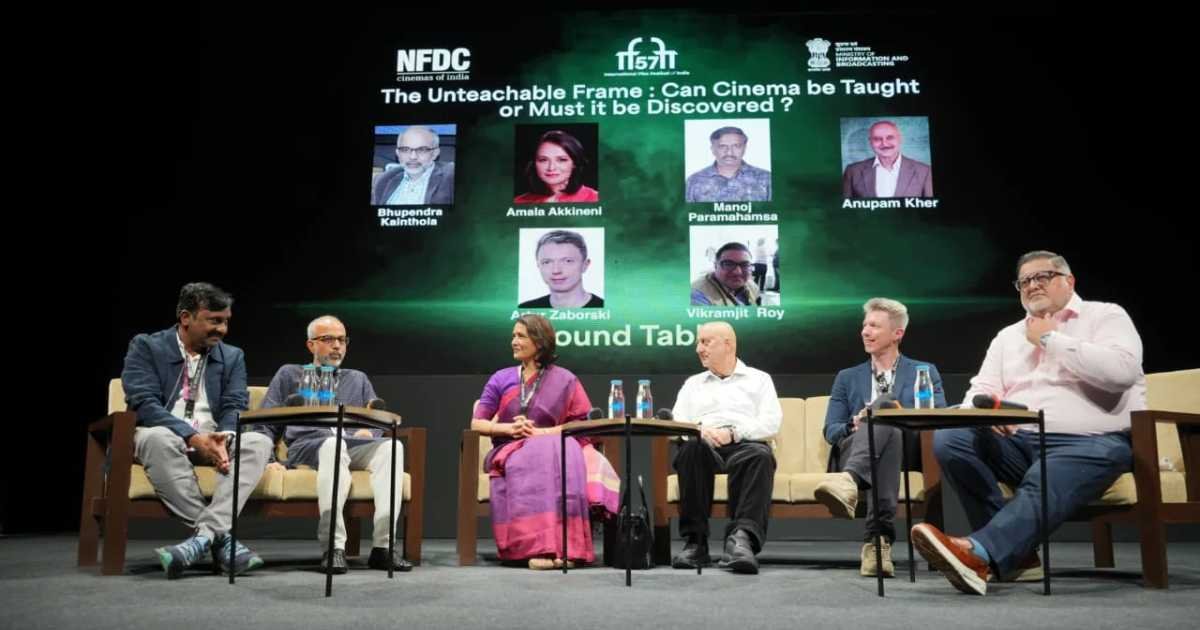
Panaji: Cinema education and the role of film schools in developing creative talent took centre stage at the 57th International Film Festival of India (IFFI) in Goa. Industry experts discussed whether filmmaking can be taught through formal training or must be discovered through personal experience. The panel discussion, titled ‘The Unteachable Frame: Can Cinema Be Taught or Must It Be Discovered?’, was held alongside film screenings on November 22.
The session featured actor and director Amala Akkineni, actor Anupam Kher and cultural journalist Artur Daborski. Former Film and Television Institute of India (FTII) director Bhupendra Kainthola and cinematographer Manoj Paramahamsa also participated. Vikramjit Roy, who has held leadership positions at Sony Pictures India and the National Film Development Corporation (NFDC), moderated the discussion.
Amala Akkineni, director of Annapurna College of Film and Media, highlighted the collaborative nature of filmmaking. She said film schools help students understand how different filmmaking disciplines depend on one another. She urged educators to challenge stereotypes and encourage more women to pursue professional training. Aspiring filmmakers, she added, must remain committed and be willing to make extra efforts.
Anupam Kher, founder of Actor Prepares, stressed the importance of formal training in developing acting skills. Recalling his experience at the National School of Drama (NSD), he said, “I would not have been sitting here had I not gone to National School of Drama.”
Kher recalled his debut film Saaransh, in which he portrayed a 65-year-old man at the age of 28. He credited his NSD training with preparing him for the challenging role. He identified observation, imagination and emotional memory as three essential qualities for actors. Personal experiences, he explained, remain stored in memory and help performers portray characters convincingly.
He described acting as an engagement with the nine emotions, known as Navarasas. Actors must recall and express these emotions according to the demands of a scene or story. Film schools help aspiring performers understand and communicate these emotions effectively. Advising young actors to learn from everyday experiences, he said, “Every experience teaches you something. What you learn as a human being will help you in your acting.”
Kher also cautioned young actors against complacency. He observed that competence can sometimes become an obstacle to brilliance. Artists must therefore continue improving their skills and refining their craft.
Cinema education must combine creativity and practical training
Artur Daborski emphasised the importance of continuous practice and exposure to international cinema. He said film festivals introduce young filmmakers to diverse cinematic traditions and industry professionals. Understanding developments in world cinema, he noted, helps aspiring filmmakers create original work.
Explaining the approach at Warsaw Film School, Daborski said students receive opportunities to make films in a supportive environment. This allows them to experiment and learn from mistakes without facing the financial pressures of professional productions. Such practical exposure is essential for developing filmmaking skills, he added.
He also highlighted the business aspects of filmmaking. Students must learn to pitch projects to producers, secure funding and understand the professional ecosystem. Participation in film festivals is another important part of their preparation.
Discussing the films sought by European festivals, Daborski encouraged young directors to explore subjects that trouble them or challenge their beliefs. He said festivals value films that engage meaningfully with important social and human concerns.
Bhupendra Kainthola highlighted the relationship between artistic expression and formal training. “Art can be discovered, but craft has to be taught,” he said. He stressed that creativity must be supported by discipline, structured learning and professional processes.
Drawing on his experience at FTII, Kainthola said many students pursue filmmaking despite conventional career expectations within their families. Public-funded institutions such as FTII must provide an enabling environment to nurture their creative ambitions, he added.
Cinematographer Manoj Paramahamsa pointed out the practical limitations of professional film sets. Beginners have little scope to experiment through trial and error during actual productions. Film schools therefore provide a structured environment to learn the fundamentals of filmmaking.
He said training must extend beyond technical knowledge. Students also need skills in managing teams, coordinating human resources and working collaboratively. These abilities are essential for successfully executing film projects.
The panel also examined the growing influence of Artificial Intelligence (AI) on filmmaking and film education. Paramahamsa said AI tools are helping simplify repetitive tasks, generate preliminary storyboards and improve production workflows. Technological advances also allow filmmakers to modify backgrounds and create sophisticated visual environments after filming.
Kher acknowledged the need to adapt to technological changes but stressed that human emotions remain central to creative expression. Referring to AI-generated virtual avatars, he said technology could create images and performances but could not reproduce the heart and soul of human acting.
The discussion highlighted the continuing importance of cinema education through a combination of formal training, practical exposure and experimentation. The speakers stressed that aspiring filmmakers must remain adaptable, technologically aware and committed to continuous learning.
The 57th International Film Festival of India is being held in Goa from November 20 to 28, 2026. The festival brings together filmmakers, industry professionals and cinema enthusiasts from India and abroad. Through screenings, masterclasses and interactive discussions, IFFI provides a platform for cinematic exchange, learning and collaboration.
