

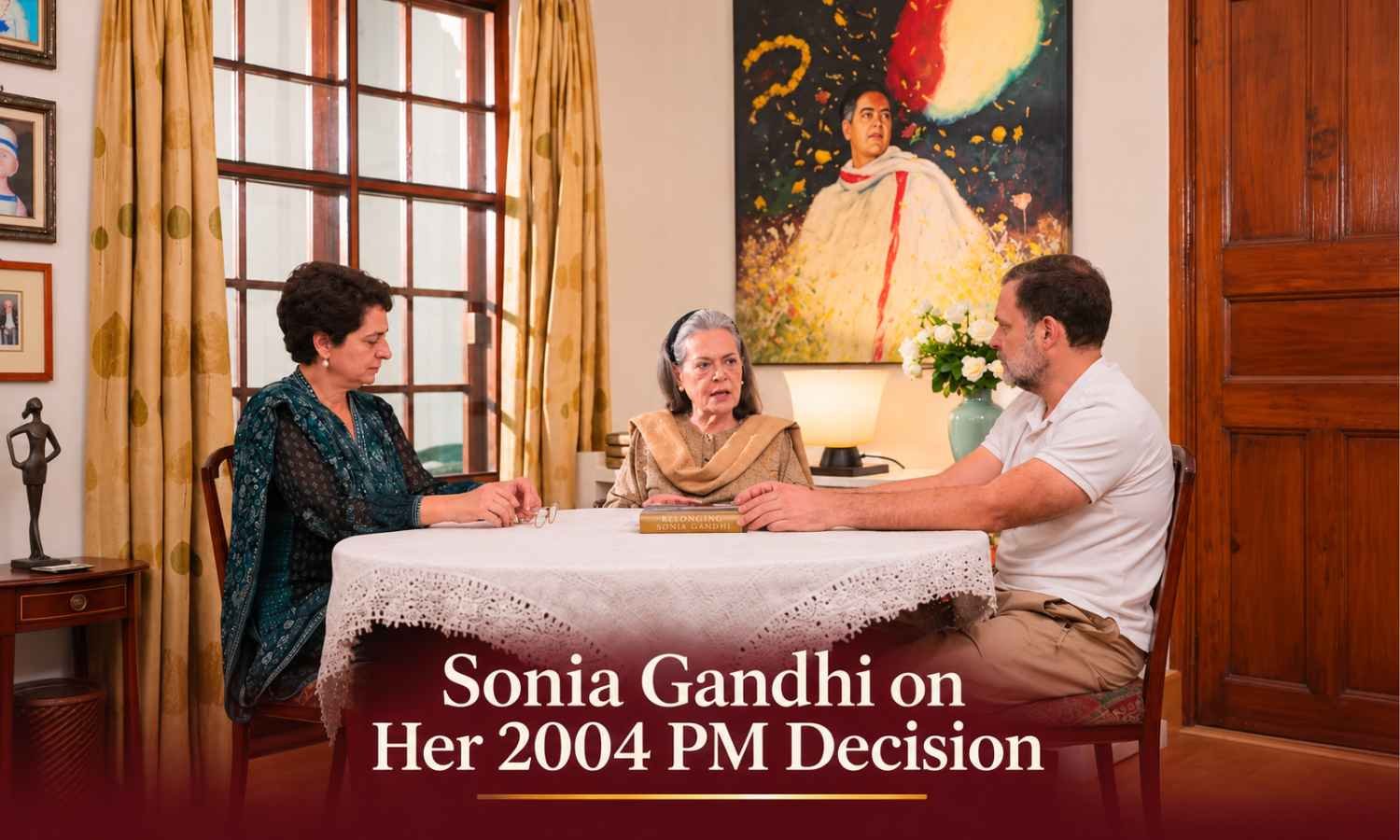
NEW DELHI: Congress Parliamentary Party chairperson Sonia Gandhi has revealed that she struggled with a sense of responsibility towards party workers while deciding not to become Prime Minister in 2004. She also acknowledged that the attraction of political power could influence personal judgement and lead people to justify retaining authority. Her reflections offered an account of the conflict she experienced between her political responsibilities and the decision to decline the country’s highest executive office.
Sonia discussed the issue during a 23-minute conversation with her children, Rahul Gandhi and Priyanka Gandhi Vadra, released on Tuesday. The video accompanied her memoir “Belonging”, which recounts her journey from childhood in Italy to family and public life in India. The discussion covered the 2004 political developments, personal attacks, marriage to Rajiv Gandhi, cultural adjustment and health challenges. It also revealed differences in how Sonia and her children viewed some difficult experiences.
Recalling the events of 2004, Sonia said she felt a strong obligation towards Congress workers who had campaigned across the country. Having led the election campaign, she wondered whether declining the Prime Minister’s position would amount to abandoning those who had supported the party. She remembered workers campaigning under difficult conditions, sometimes without adequate food or other basic facilities. Their commitment weighed heavily on her mind as she considered her responsibilities following the election.
Sonia Gandhi 2004 decision: Reflections on power
“I felt in a way I owed it to the people, especially the workers who throughout the country had rallied around to vote for the Congress,” Sonia recalled. She said she struggled with the thought of simply withdrawing after leading the campaign. However, she also questioned whether this sense of responsibility could have become a justification for accepting political power. She acknowledged that people might interpret her hesitation as an expression of power’s attraction.
Rahul Gandhi offered his recollection of the atmosphere surrounding his mother’s decision. He suggested that some political figures present during the discussions appeared pleased when Sonia declined the Prime Minister’s position. Rahul described one individual (Dr Manmohan Singh) as particularly suitable for the office because of his qualities and capabilities. He referred to several others as aspirants who could not realistically occupy the position. However, he did not identify the individuals involved.
“So then my mother decides no. There is actually joy in the room,” Rahul recalled. Sonia approached the discussion by examining her own motivations rather than commenting on the reactions of others. She said she did not believe that she had wanted power for its own sake. Nevertheless, she acknowledged that her sense of duty towards Congress workers required careful examination. She wondered whether it might also have provided a reason to justify remaining in a position of authority.
The Sonia Gandhi 2004 decision discussion led her to reflect on the psychological influence of political power. She observed that people could develop arguments to justify keeping authority once they acquired it. “Once you are there and you have it, you may find many excuses to keep it,” she said. Sonia stressed that she was examining her own thinking rather than offering a definitive explanation. She maintained that her concern for party workers had been genuine, even as she questioned her motivations.
Rahul criticises political attacks on Sonia Gandhi
The conversation subsequently turned to the criticism and personal attacks Sonia Gandhi had faced during her political career. Rahul said his mother had omitted several important experiences from her memoir. He particularly referred to incidents involving humiliation, abuse and the conduct of people who had treated her unfairly. Rahul believed that Sonia had shown considerable generosity towards her critics and had chosen not to reveal the full extent of the hostility she encountered.
Rahul said he had personally witnessed his mother face deeply unpleasant treatment. He found it particularly disturbing that much of the criticism concerned her foreign origins, despite her efforts to adapt to Indian society. He argued that Sonia had conducted herself consistently in public and private life. Priyanka supported his observations, saying their mother had made sustained efforts to understand Indian customs and adjust to a different cultural environment.
Sonia responded that she no longer carried resentment towards those who had criticised her. She acknowledged that some individuals had made unpleasant remarks but said the passage of time had changed her perspective. Instead of dwelling on those experiences, she preferred to remember the acceptance she had received from ordinary Indians. She described this affection as an expression of the country’s generosity and said most people had welcomed her as one of their own.
“It is also the generosity of the people of India who have embraced me,” Sonia said. When she referred to people who had made unpleasant remarks, Rahul interjected that they represented only a small number. Sonia emphasised that most Indians had accepted her and treated her as a daughter. She said the affection she received outweighed the hostility and remained central to her love for India.
Sonia recalls marriage and adjustment to India
Sonia also revisited her childhood in Italy and the circumstances surrounding her marriage to Rajiv Gandhi. She recalled that her father initially opposed the marriage proposal because he feared she would enter an unfamiliar political and social environment. Rajiv had travelled to Turin and Orbasano to seek her father’s approval. However, her father expressed reservations about the world of politicians and wealthy families, which he believed differed considerably from the life his daughter knew.
Sonia explained that her father’s concerns reflected perceptions of politicians prevalent among some people in Italy at the time. She also revealed the significance of the photograph selected for the cover of “Belonging”. Rajiv had taken the photograph during the visit when he approached her father about their marriage. Sonia said she particularly enjoyed revisiting these early memories while preparing the book, including her childhood and the circumstances in which she met her husband.
Recalling her arrival in India in 1968, Sonia acknowledged that adjusting to a different social and cultural environment had taken time. She said several aspects of life initially surprised her, especially the widespread poverty she witnessed. Even in Delhi, living conditions were difficult for many people. Sonia said she gradually became accustomed to Indian society and developed a better understanding of its customs and everyday practices.
Rahul discussed his own experiences of visiting Italy and recognising the differences between his two family backgrounds. He recalled becoming particularly conscious of his Italian heritage at the age of 18. Although he had visited Italy during childhood, the cultural differences became clearer as he grew older. Priyanka also remembered their Italian grandmother’s visits to India and her ability to develop friendships despite not speaking English or Hindi.
Priyanka recalled that her grandmother became emotional after an interaction with Sonia and remarked that her daughter had become completely Indian. The family discussed the incident while reflecting on Sonia’s gradual adjustment to life in India and the changes in her relationship with her Italian background.
Sonia discusses health and privacy in Belonging
The conversation later turned to Sonia Gandhi’s health and her decision to discuss previously private medical experiences in the memoir. Rahul questioned why his mother had earlier discouraged her children from speaking publicly about her health problems but had now chosen to address them in the book. Sonia explained that she valued her privacy and feared that public discussion of her medical condition could affect her work. However, she reconsidered that position because sharing her experiences might help other women.
Sonia recalled experiencing recurring stomach problems and described the uncertainty surrounding medical investigations as frightening. She also spoke about the anxiety she experienced before surgery. When Priyanka asked what had helped her cope, Sonia emphasised support from family members and close friends. She said their presence had been particularly important during a period when she faced uncertainty about her health and treatment.
Priyanka discussed the caution exercised by Sonia’s doctors, who recommended further investigations after observing recurring symptoms without a clear explanation. She credited their approach and the screening process with helping ensure early detection. Priyanka also discussed the importance of appropriate medical checks for women with a strong family history of breast cancer. The conversation did not clearly establish Sonia’s specific diagnosis, although it referred to medical investigations, surgery and early detection.
Rahul recalled that his mother maintained a generally positive outlook throughout the difficult period. Although she experienced anxiety and emotional strain, he said she remained optimistic while dealing with her medical condition. Sonia explained that she had decided to share some of these experiences because they might encourage other women to speak about their health problems and seek support when necessary.
Sonia credits family and friends for memoir
Discussing the preparation of “Belonging”, Sonia said completing the manuscript of more than 500 pages had taken several years. She expressed satisfaction with the finished work and acknowledged the assistance of a close friend, Manju, who regularly spent time with her during the writing process. Sonia also recalled seeking Priyanka’s help whenever she needed assistance with memories or other aspects of the manuscript.
Rahul and Priyanka joked about their mother’s selective memory, suggesting that she remembered certain experiences in considerable detail while leaving others aside. Sonia responded that memories from the distant past often became easier to recall with age. She said she particularly enjoyed revisiting her childhood, meeting Rajiv Gandhi and the early years of their relationship.
The family also reflected on changes in Sonia’s personality following Rajiv Gandhi’s entry into politics and his subsequent assassination. Rahul recalled his mother as a different person before his father became politically active. Priyanka remembered Sonia being happier and more carefree during the family’s earlier years. Their recollections illustrated how political responsibilities and personal tragedies had affected family life.
Towards the conclusion, Sonia returned to Rahul’s criticism of the treatment she had received during her political career. She acknowledged the unpleasant experiences but maintained that they no longer defined her relationship with India. Instead, she emphasised the affection and acceptance of ordinary people across the country. The Sonia Gandhi 2004 decision and her broader reflections on political life formed part of a conversation in which she revisited both difficult experiences and the relationships that shaped her life.
