
Shivraj Singh Chouhan highlights role of agriculture and rural development in poverty reduction

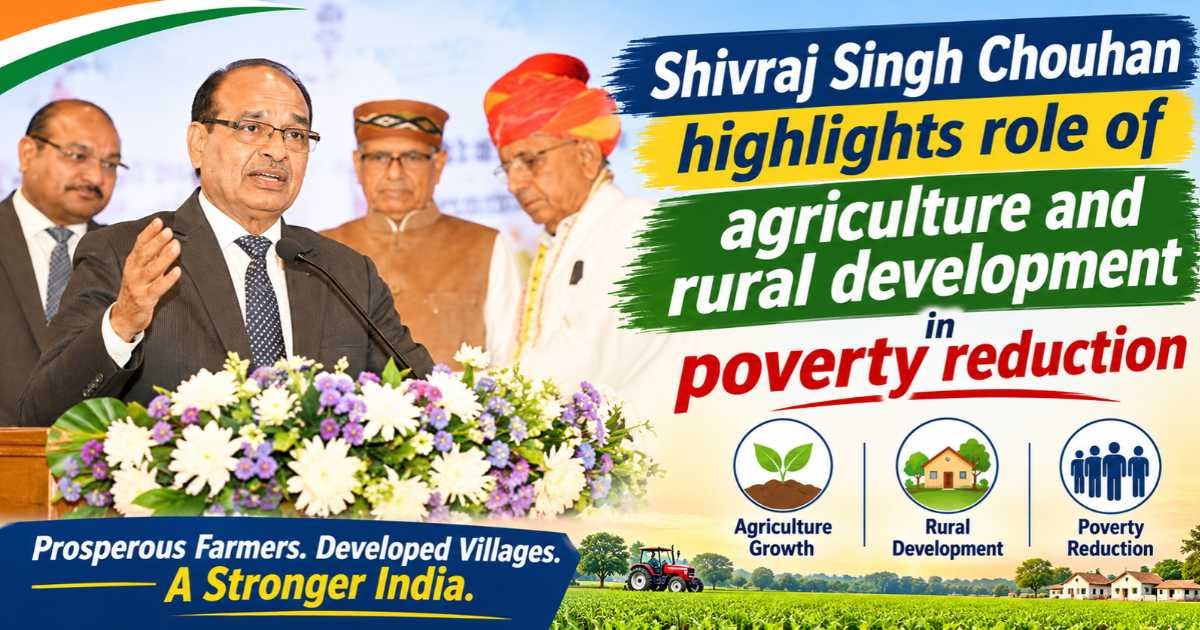
New Delhi: Union Minister Shivraj Singh Chouhan said India had made historic progress in poverty eradication, with extreme poverty declining from 27.1% to 2.6%. He cited a recent World Bank report stating that nearly 500 million people had moved out of poverty. Chouhan made the remarks at a joint workshop of the Agriculture and Rural Development ministries in New Delhi on November 23.
The one-day workshop at the Dr Ambedkar International Centre reviewed the role of agriculture, agricultural research, land resources and rural development. Chouhan chaired the meeting, attended by Union Ministers of State Bhagirath Choudhary and Kamlesh Paswan. Senior officials from four departments, scientists and employees at various levels also participated.
The departments included Agriculture and Farmers’ Welfare, Rural Development, Land Resources, and Agricultural Research and Education. Officials reviewed how government programmes had contributed to reducing poverty. They also discussed priorities for the next phase. Chouhan described the progress as extraordinary and praised the collective efforts of officials and employees.
He said the achievement was not the work of one individual or department. Instead, it reflected the combined efforts of those who designed and implemented development programmes. He praised employees for translating policies into action and improving people’s lives.
Chouhan urged officers and staff to celebrate the achievement with pride. He recalled Prime Minister Narendra Modi’s message that officials had not merely framed schemes but had helped build the nation. The Minister said employees at every level were important to the development process.
He left the stage and sat among employees to interact directly with them. He sought their experiences and suggestions on implementation. Chouhan said he wanted staff, from Section Officers and Assistant Section Officers to Secretaries, to have a voice in improving government programmes.
Poverty eradication through agriculture and rural development
Chouhan said the next priority was to ensure that people who had risen above the poverty line did not fall back into poverty. He said the government aimed to lift the remaining 2.6% to 2.7% of the population out of poverty and improve their living standards. He stressed that India must protect its gains while reaching those still left behind.
Highlighting agriculture, the Minister said the sector’s decadal growth rate had reached 4.45%, surpassing levels recorded during the Green Revolution. He said agriculture growth during that earlier period generally remained between 3% and 3.5%. The progress over the past 12 years, he added, reflected major advances in farming and allied activities.
He cited more than ₹4.66 lakh crore in direct assistance through PM-KISAN Samman Nidhi. Foodgrain production had reached 376.56 million tonnes, while horticulture production stood at 386.91 million tonnes. Affordable agricultural credit, crop insurance, natural farming, 10,000 Farmer Producer Organisations and digital initiatives such as AgriStack had also supported farmers.
A presentation by the Department of Agricultural Research and Education and ICAR highlighted the economic returns from agricultural research. It said every rupee invested in agricultural research and education generated an economic benefit of ₹13.85. Investment in animal husbandry research yielded ₹20.81 for every rupee.
Since 2014, researchers had released 3,436 new crop varieties, with 93% described as climate-resilient. The presentation also cited biofortified crop varieties, fish production of 19.78 million tonnes and more than 500 agricultural machines. Digital outreach through Krishi Vigyan Kendras was reaching five crore farmers annually.
The Minister also highlighted rural development programmes and their impact on village livelihoods. Under the Deendayal Antyodaya Yojana–National Rural Livelihoods Mission, more than 10 crore women had joined self-help groups. Of them, 3.76 crore had become Lakhpati Didis.
The Pradhan Mantri Awaas Yojana–Gramin had enabled the construction of 3.99 crore permanent houses. Meanwhile, the Pradhan Mantri Gram Sadak Yojana had created 7.99 lakh kilometres of all-weather rural roads. Under Viksit Bharat–G RAM G, rural households are assured of 125 days of employment.
Chouhan said social assistance programmes and 99.9% transparency in Direct Benefit Transfer had helped reach beneficiaries. He also cited watershed development under the Pradhan Mantri Krishi Sinchayee Yojana. The programme had supported water conservation and land improvement across 3.40 crore hectares, benefiting 61.15 lakh farmers.
Watershed development and rural livelihoods
According to the presentation, watershed interventions had contributed to increased irrigated areas and milk production. Farmers’ average annual incomes had recorded growth of up to 70%. The Minister said these initiatives had strengthened rural livelihoods and improved the use of land and water resources.
During the concluding session, Chouhan invited officials to suggest improvements to budgets and schemes. He said employees had already offered useful ideas on PM-KISAN and e-NAM. He encouraged staff to share proposals on increasing farmers’ incomes, modifying existing schemes or introducing new initiatives.
Chouhan said he would hold informal department-wise meetings with employees at lower levels. He assured them that he would remain accessible regardless of their position. He also asked departments to communicate their achievements to farmers and the public, rather than keeping them confined to official files.
The Minister said targets for 2029, 2030–31 and Viksit Bharat @2047 must be achieved on time. He identified global markets as the next major goal for Indian agricultural products. Through Free Trade Agreements, he said, India should strengthen its presence and competitiveness in international markets.
