

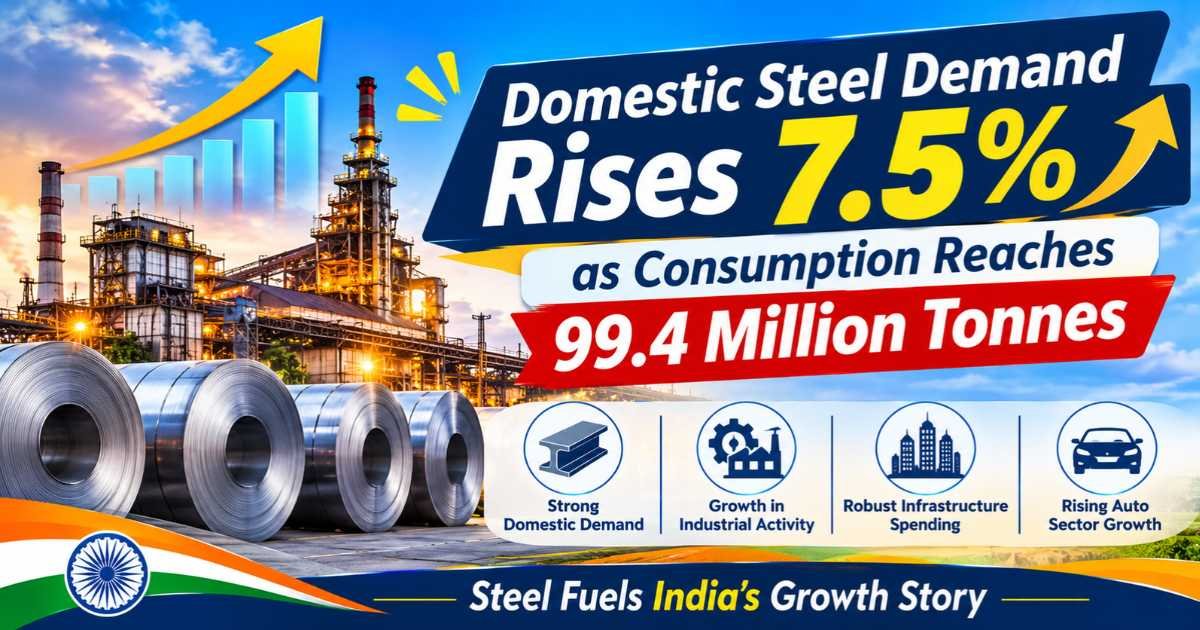
New Delhi: India’s finished steel consumption rose 7.5% to 99.4 million tonnes during April-October 2026. Consumption stood at 92.4 million tonnes in the same period last year. Domestic steel demand remained strong, while prices showed month-on-month stability, according to provisional Joint Plant Committee data released on November 26.
Crude steel production increased 2.6% to 99.2 million tonnes during the seven-month period. Meanwhile, finished steel production grew 4.1% to 95.7 million tonnes. In October, crude steel output reached 14.5 million tonnes, up 3.6% year-on-year. Finished steel production rose 5.2% to 13.8 million tonnes.
Hot metal production also increased 2.7% to 56.8 million tonnes during April-October. The seven large producers accounted for 55.6 million tonnes of crude steel. Other producers contributed 43.6 million tonnes. Public sector producers accounted for 15.5% of crude steel output.
Steel prices remained broadly steady in November compared with October. TMT prices fell 0.9% to ₹66,020 per tonne, while HR coil prices edged up 0.1% to ₹77,703. CR coil prices declined 0.1% to ₹86,890. GP sheet prices dropped 0.5% to ₹94,920 per tonne. However, prices of these products remained significantly higher than a year earlier.
Steel imports rise as India remains a net importer
India imported 4.90 million tonnes of finished steel during April-October. This marked a 28.9% rise from 3.80 million tonnes a year earlier. Exports increased 15.5% to 3.98 million tonnes. Consequently, India remained a net importer of finished steel by volume.
China led finished steel imports with 1.55 million tonnes. South Korea followed with 1.52 million tonnes, while Japan supplied 0.63 million tonnes. HR coil and strip formed the largest import category. They accounted for 1.73 million tonnes, or 35.3% of total imports.
The UAE was the largest export destination at 0.55 million tonnes. Vietnam followed at 0.51 million tonnes. HR coil and strip topped exports with 1.54 million tonnes. Pipes accounted for 0.54 million tonnes.
Alloy steel production rose 33% to 6.91 million tonnes during April-October. Consumption increased 30.2% to 7.50 million tonnes. In contrast, stainless steel production declined 4.6% to 2.46 million tonnes. However, stainless steel consumption increased 22.2% to 3.19 million tonnes. Imports surged 143.3% to 1.01 million tonnes.
The Ministry of Steel also reported progress at major public sector steel plants. SAIL’s Universal Rail Mill at Bhilai increased prime rail production by 147% over eight years. Output rose from 369,000 tonnes to 911,000 tonnes. Its prime rail acceptance rate improved from 85% to 96%.
SAIL’s Rourkela Steel Plant recorded its highest April-October saleable steel production at 2.441 million tonnes in FY 2026-27. In addition, IISCO Steel Plant in Burnpur achieved more than 20,000 heats from a single converter lining. This was the highest converter lining life recorded in the Indian steel industry.
Green steel certification expands across producers
Under the Green Steel Initiative, 112 steel producers had received Green Steel Certificates through lists issued up to October 2026. The certificates cover TMT bars, coils, plates, wire rods and pipes. Most certified products received 5-star ratings.
NMDC has set a target of achieving net-zero operational emissions by 2047. It aims to reduce emissions by at least 90% through energy efficiency, renewable energy, fleet electrification and low-carbon fuels. The plan also includes carbon capture, utilisation and storage.
