

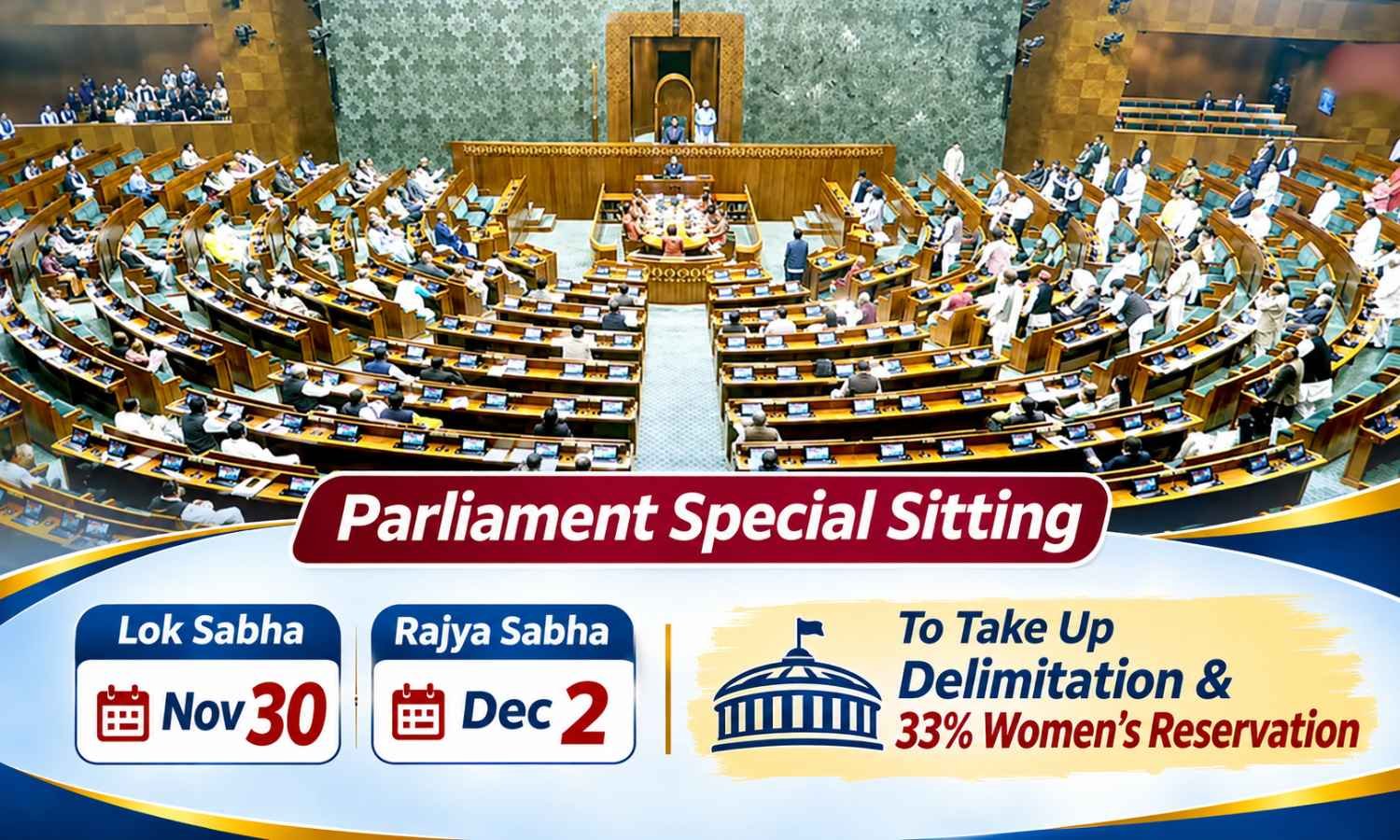
New Delhi: The Lok Sabha will return on November 30 for a special sitting expected to take up revised bills linking delimitation with women’s reservation. The Rajya Sabha will then meet on December 2, and the sittings may end on December 3.
Parliamentary Affairs Minister Kiren Rijiju announced the sitting on November 26. He said the government had asked both presiding officers to recall the Houses for essential government business.
Parliament has not met since August 13, when the Monsoon Session ended with an adjournment sine die. However, the session never went through a formal prorogation. As a result, the government could seek the sitting under existing rules without a new presidential summons. The Opposition has sharply criticised the unusually long gap and the choice of a special sitting over a regular Winter Session.
At stake is the government’s bid to revive a package that the Lok Sabha rejected on April 17. The Constitution (131st Amendment) Bill and its companion measures proposed lifting the Lok Sabha’s maximum strength to 850 from 543. They also aimed to make the 2023 Nari Shakti Vandan Adhiniyam operational ahead of the 2029 Lok Sabha polls.
The package won 298 votes to 230. It still missed the required two-thirds of those present and voting, the bar for a constitutional amendment.
Party splits lift NDA numbers after women’s reservation defeat
Since the April vote, roughly two dozen MPs who opposed the bill have moved closer to the ruling camp. The shift came from splits within the Trinamool Congress and the Shiv Sena (UBT). In addition, the Shiromani Akali Dal has formally joined the NDA. Together, these moves have taken the ruling alliance to an effective strength close to the mid-320s.
Even so, success will depend on attendance and on three parties outside the NDA. The DMK has 22 MPs, the NCP (Sharadchandra Pawar) has 8 and the YSR Congress Party (YSRCP) has 4. With their combined backing, the government’s tally could climb beyond 350. That would bring it near or past the two-thirds mark, depending on the number of MPs present and voting.
NCP (SP) working president Supriya Sule said her party would go through the bill’s full text. She added that the party could back it if it was in the national interest. Earlier, she had listed three conditions, the first being the implementation of women’s reservation.
She had also sought a uniform 50 per cent rise in Lok Sabha seats for every state. Her third condition was adequate representation for Opposition parties in the delimitation commission.
The DMK, too, plans to examine the final version of the bills. At the same time, it has insisted that the south’s relative share of representation must not shrink. Similarly, YSRCP appears willing to back the package if the bills address its worries about state-wise share.
Congress wants women’s reservation within existing 543 seats
The Congress backs a 33 per cent quota for women but wants it applied within the current 543-seat Lok Sabha. It does not want the quota tied to a bigger House and redrawn constituencies. Congress president Mallikarjun Kharge has repeatedly called for an all-party meeting. In April, Leader of Opposition Rahul Gandhi and others argued the package was more about shifting the federal balance than about women’s reservation.
Congress general secretary Jairam Ramesh said the sitting followed what he called 105 days of Operation Lotus. He said the government was hoping for a “super-tainted two-thirds majority”. Calling the exercise an insult to the Constitution and an assault on it, Ramesh said the battle had begun.
Congress MP Manish Tewari said a regular Winter Session should not give way to a special sitting. He charged that the government was mocking Parliament as an institution. CPI(M) MP John Brittas warned that women’s empowerment should not serve as cover for electoral engineering.
On Constitution Day, Union Home Minister Amit Shah said the Congress had stood in the way of the women’s quota. He said the BJP and Prime Minister Narendra Modi were determined to see women get their 33 per cent share. Turning to the Opposition, he said, “You cannot stop us.” The NDA has cast Opposition resistance as a stand against women’s empowerment itself.
Regional leaders want 50 per cent seat assurance in law
The ruling alliance argues that the Lok Sabha must grow to keep pace with population changes. In its view, a bigger House would accommodate reserved seats and leave general seats untouched. Yet southern states have long argued that sharing seats on population alone would punish them for their success in curbing population growth.
In April, the government verbally assured every state of an equal 50 per cent rise in seats. But several regional leaders and Opposition parties insist on seeing the promise in the law itself. The stand of the DMK and NCP (SP) will turn on whether the new bills carry such a clause.
If the bills pass, a Delimitation Commission would be constituted to begin the delimitation process once the next census is complete. Women would then get a one-third quota in the 2029 polls to the Lok Sabha and the Assemblies. If the bid fails, the women’s reservation law of 2023 would still depend on a later round of delimitation. Besides, the Lok Sabha would stay frozen at 543 seats.
The constitutional amendments are likely to take up almost the whole sitting. Question Hour and Zero Hour will have little room. So far, the government has not issued a formal list of business.
The Union Cabinet is due to finalise its approach at a meeting on November 27. Meanwhile, Sonia Gandhi will chair a session of the Congress Parliamentary Strategy Group.
