

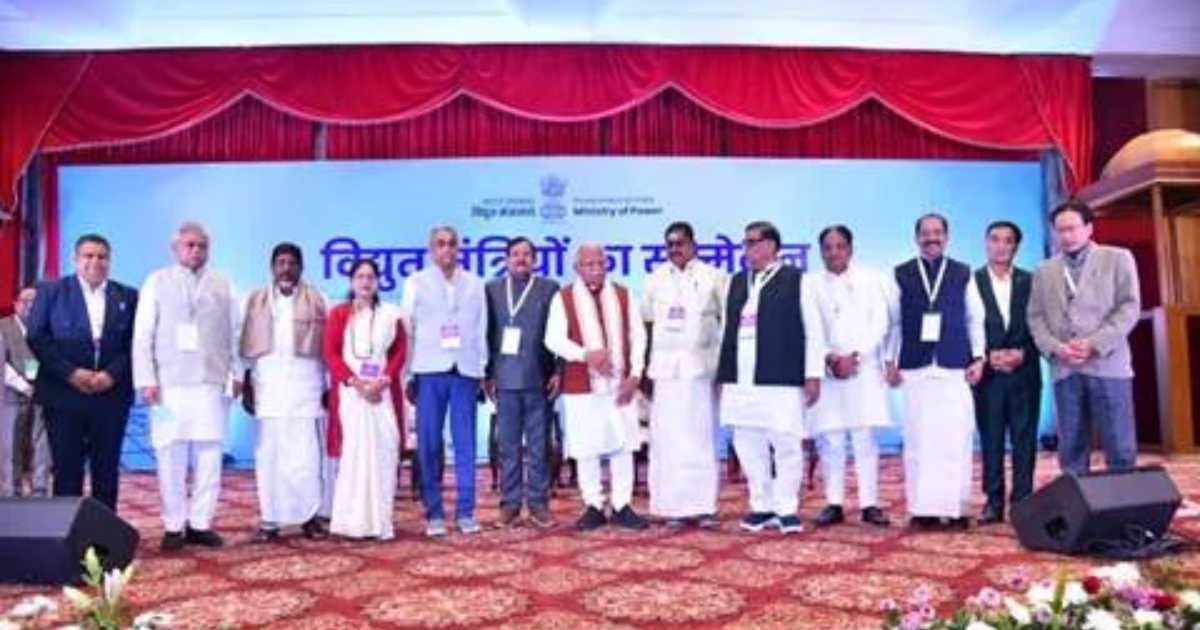
New Delhi: A two-day Power Ministers’ Conference began in New Delhi on 27 November 2026. Union Power Minister Manohar Lal is chairing the meeting, which will conclude on 28 November. Ministers, senior officials and electricity regulators from 28 States and 8 Union Territories are participating. The conference is examining a potential investment of Rs. 200 lakh crore in the power sector over the next two decades.
The national-level meeting provides a platform for Centre-State discussions on policy priorities and implementation challenges. Its agenda covers energy security, stronger electricity infrastructure and faster sectoral reforms. Notably, the previous national-level conference took place in 2024.
Welcoming the participants, Manohar Lal called for closer cooperation between the Centre and States. He highlighted India’s progress in expanding power generation, integrating renewable energy and strengthening the national grid. However, he said the next phase requires integrated planning of generation, storage, transmission and distribution.
The Minister also stressed the need for States to implement smart meters, citing their benefits for consumers. He said cooperation with States and Ministry of Power initiatives had helped DISCOMs achieve profitability after a prolonged period. Moreover, he urged all stakeholders, including private sector players, to work together to realise the investment potential.
Conference reviews DISCOM finances and infrastructure priorities
Manohar Lal congratulated States and distribution companies on their financial turnaround. DISCOMs collectively recorded a positive profit after tax (PAT) in the financial year 2024-25. He stressed that their financial position must remain strong. Therefore, policy, operational and regulatory changes should help sustain this improvement.
The conference agenda includes implementing Resource Adequacy (RA) plans and accelerating energy storage deployment. Participants will also examine inter-State and intra-State transmission challenges. In addition, discussions will cover the financial viability of DISCOMs and implementation of the Revamped Distribution Sector Scheme (RDSS). Its focus areas include smart metering, feeder separation and household electrification. Issues related to nuclear sites are also on the agenda.
Minister of State for Power Shripad Yesso Naik urged States and Union Territories to share their experiences. He asked them to highlight implementation difficulties, regulatory concerns and areas requiring Central Government support. Furthermore, he called for a shift from policy formulation to effective execution. He emphasised measurable outcomes and an integrated, sustainable power sector.
Power Secretary Pankaj Agarwal said the Prime Minister’s guidance was to move beyond energy security towards energy independence. He linked this goal to the vision of Viksit Bharat @ 2047. Agarwal described the past year as one of record growth. He said India’s installed power capacity had reached about 563 GW, with more than 55% coming from non-fossil sources. During the preceding 12 months, India added around 60 GW of capacity. Non-fossil sources accounted for 87% of that addition.
A joint session with the Forum of Regulators and State Electricity Regulatory Commissions is scheduled for 28 November. It will bring together State Power Ministers, regulatory commission chairpersons, State Power and Energy Secretaries and Ministry officials. The participants will discuss key issues affecting the power sector. Senior Ministry officials and representatives from participating States and Union Territories are also attending the conference.
