

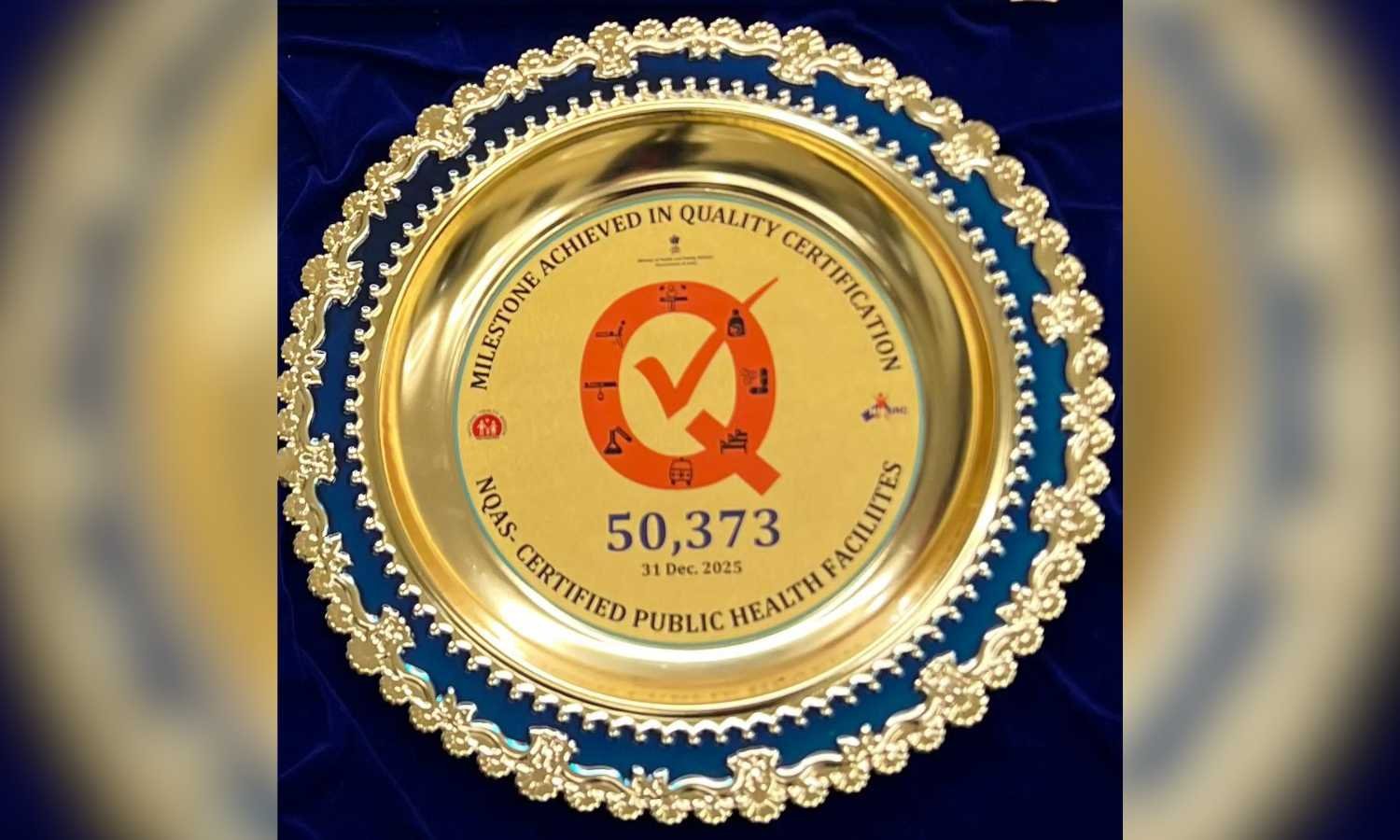
New Delhi: The Government of India said it had crossed a historic milestone of more than 50,000 NQAS certifications, marking a major leap in quality standards across public healthcare facilities nationwide. As of December 31, 2025, as many as 50,373 public health facilities had secured certification under the National Quality Assurance Standards framework.
The Ministry of Health and Family Welfare established the NQAS framework to ensure quality, safety, and patient-centred care. Officials said the achievement reinforced the government’s commitment to equitable access to high-quality healthcare, especially for poor, vulnerable, and marginalised communities.
The NQAS initiative began in 2015 with just 10 certified facilities. Initially, it focused on district hospitals to improve safety and service quality. Over time, the programme expanded to cover sub-district hospitals, community health centres, and Ayushman Arogya Mandir facilities at primary and sub-health levels.
The introduction of virtual assessments significantly accelerated the expansion. Certified facilities increased from 6,506 in December 2023 to 22,786 in December 2024. By December 2025, the number rose sharply to 50,373, reflecting rapid scale-up within a single year.
NQAS certifications expand across all levels of public healthcare
Of the total NQAS certifications, 48,663 were awarded to Ayushman Arogya Mandirs, including sub-health centres, primary health centres, and urban primary health centres. In addition, 1,710 secondary care facilities, including community health centres, sub-district hospitals, and district hospitals, received certification.
Officials said the expansion showed that quality assurance had become institutionalised across all tiers of public healthcare. The effort also aligned with India’s pursuit of Universal Health Coverage under the National Health Policy 2017, which emphasises affordable and quality healthcare without financial hardship.
The ministry attributed the progress to multi-pronged acceleration strategies. These included continuous capacity building, digital innovations, a larger pool of trained assessors, and ongoing quality improvement mechanisms.
Crossing the 50,000 mark, officials said, reflected India’s resolve to build a resilient and self-reliant health system. The achievement also aligned with the principles of Aatmanirbhar Bharat and “Sabka Saath, Sabka Vikas, Sabka Vishwas, Sabka Prayaas”.
The government said it remained committed to sustaining and expanding NQAS certifications further. It has set an interim target to achieve certification for at least 50% of public healthcare facilities by March 2026, aiming to embed quality and patient-centred care across the system.
