

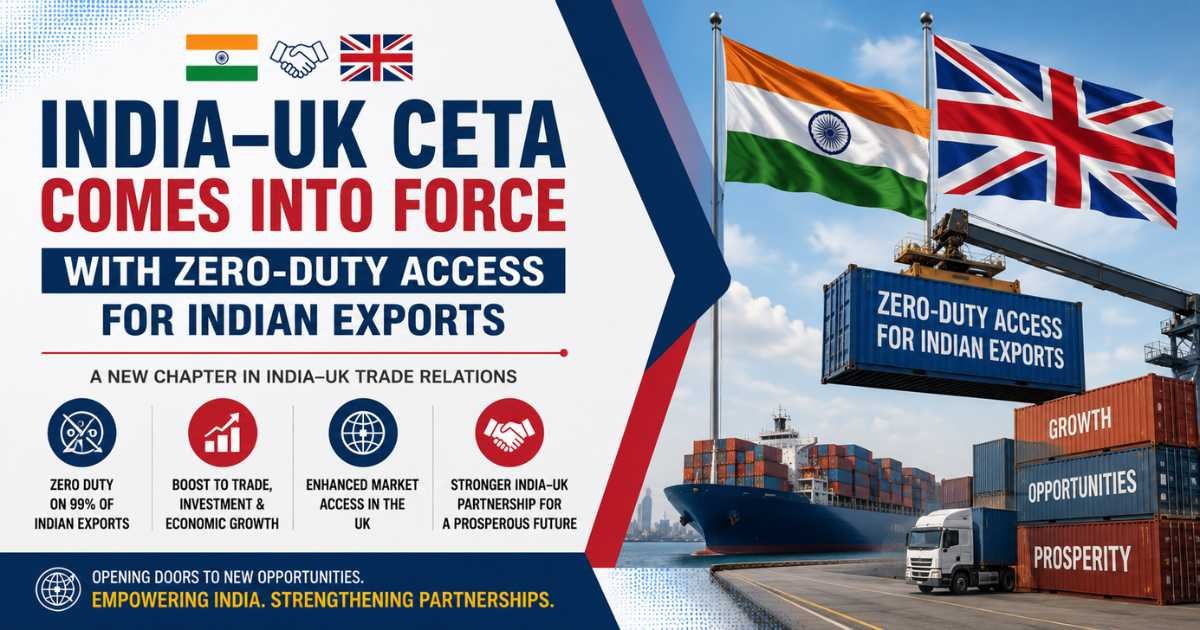
New Delhi: India–UK CETA and the Agreement on Social Security came into force on Wednesday, giving nearly 99% of Indian exports zero-duty access to the UK market and marking a major milestone in bilateral economic ties.
The Ministry of Commerce and Industry held a formal event at Vanijya Bhawan in New Delhi to mark the agreement’s implementation. British High Commissioner Lindy Cameron, Commerce Secretary Rajesh Agrawal, industry representatives and exporters attended the programme.
Union Commerce and Industry Minister Piyush Goyal said the agreement marked a defining moment in India–UK relations. He added that the pact covers almost 100% of trade value and creates new opportunities for exporters, manufacturers, farmers and MSMEs.
Moreover, Goyal said the agreement will benefit sectors such as textiles, leather, gems and jewellery, engineering goods, chemicals, marine products and processed foods. He also said Indian IT, financial, education and professional services would gain from expanded market access.
The Minister said the Agreement on Social Security exempts Indian professionals on temporary assignments in the UK from double social security contributions for up to five years. As a result, Indian professionals and businesses are expected to become more competitive.
India–UK CETA begins with first export shipments
Commerce Secretary Rajesh Agrawal said India–UK CETA followed more than 800 technical sessions across 14 negotiation rounds. He noted that the agreement covers both goods and services and strengthens cooperation between two complementary economies.
Meanwhile, the government flagged off more than 50 export consignments worth over USD 140 million from more than 20 ports, airports, Inland Container Depots, Special Economic Zones and factories. The shipments included electronics, pharmaceuticals, gems and jewellery and other products.
The government also issued the first Certificates of Origin through the eCoO 2.0 platform on a self-certification basis. Additionally, the digital process reduces compliance costs and simplifies procedures, especially for MSMEs.
British High Commissioner Lindy Cameron called the agreement a historic milestone. She said India was the UK’s eleventh-largest trading partner in 2025, with annual bilateral trade approaching £48 billion.
Furthermore, Cameron said the agreement is expected to increase bilateral trade by more than £25 billion annually over time. She added that it would contribute nearly £5 billion each year to both economies while making trade faster, simpler and more affordable.
Industry bodies welcomed the agreement and said duty-free market access and simplified Rules of Origin would improve the competitiveness of Indian products. They also expressed confidence that the pact would generate jobs, encourage investment and support the vision of Viksit Bharat.
