

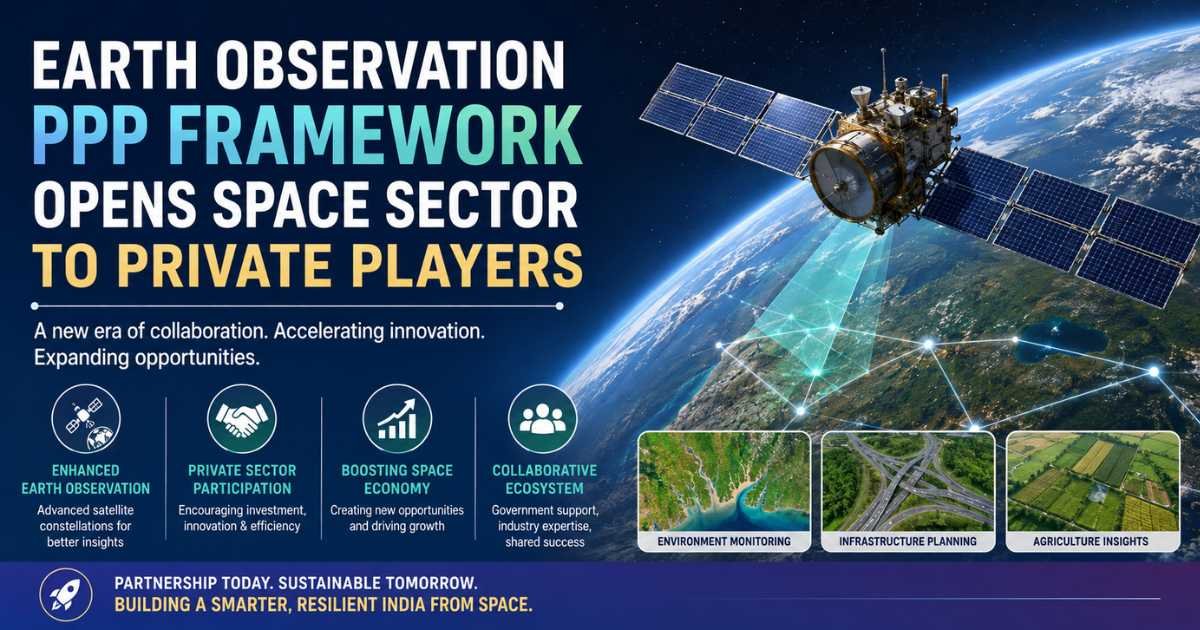
New Delhi: The government has created an Earth Observation PPP framework to let private companies develop and operate satellite constellations. The move aims to expand India’s space-based observation capabilities and strengthen the domestic space economy.
The Indian National Space Promotion and Authorization Centre (IN-SPACe) formulated the framework for the development, deployment and operation of Earth Observation (EO) satellite constellations.
Under the framework, Non-Government Entities (NGEs) can design, build, own and operate EO satellite constellations. These entities include private companies, start-ups and, where relevant, academic and research institutions.
The government expects the model to create a self-reliant Earth Observation ecosystem. It also aims to increase domestic manufacturing, encourage innovation and expand the use of satellite data.
The framework covers the complete satellite mission cycle. Therefore, private players can take responsibility for satellite manufacturing, launches, ground infrastructure and downstream applications.
Indian industry will manufacture a range of EO satellites under the proposed constellation programme. The planned fleet includes 5 ultra-high resolution optical satellites with 4 bands.
It will also include 3 multispectral satellites with 8 bands. In addition, the programme covers 2 hyperspectral optical satellites with 250 bands and 2 Synthetic Aperture Radar (SAR) satellites in X-band.
Private developers can use Indian launch vehicles to place the satellites in orbit. These launches may use vehicles operated by private companies or ISRO.
The private consortium will also establish ground stations, mission control systems and data reception and processing facilities. Furthermore, it will develop value-added products, analytics and decision-support tools.
These tools will serve government departments, strategic users and commercial customers. Academic and research institutions can also work with industry on capacity building and application development.
Earth Observation PPP gets financial and policy support
The government has introduced several measures to attract private investment into Earth Observation and related space missions.
For example, the Antariksh Venture Capital Fund has an allocation of Rs. 1,000 crores. The fund aims to catalyse private investment in the space sector.
In addition, the Technology Adoption Fund (TAF) has an outlay of Rs. 500 crores. It can provide support of up to 60% of project costs for start-ups and MSMEs.
Larger industries can receive support of up to 40% of project costs. However, the assistance remains subject to a ceiling of Rs. 25 crores per project.
The fund will support the commercialisation of early-stage space technologies, including technologies linked to Earth Observation.
The Seed Fund Scheme also provides grants of up to Rs. 1 crore to start-ups and NGEs. These grants can support applications in agriculture, disaster management, urban planning and marine domain awareness.
Moreover, the government has allocated Rs. 500 crores for Common Technical Facilities. It is also supporting State Governments in establishing Space Manufacturing Clusters.
The government has introduced differential pricing for NGEs purchasing Indian satellite data. This measure aims to provide greater demand certainty for EO data and services.
Furthermore, ISRO can transfer technology to NGEs. The technology transfer can cover satellite sub-systems and launch vehicle technologies.
IN-SPACe will also provide facilitation support to private players. Resident Experts can offer technical assistance to industry at no cost.
The agency has also introduced a Pre-Incubation Entrepreneurship Development Programme. In addition, IN-SPACe functions as a single-window mechanism for NGE space activities.
The agency serves as the nodal body for authorisation, promotion and facilitation of private space activities. Therefore, private companies can use a single institutional channel for their EO missions.
These measures operate alongside the Indian Space Policy-2023. The policy provides the broader regulatory framework for private participation in India’s space sector.
IN-SPACe has already approved and signed an agreement for India’s first indigenous, fully commercial EO constellation under the Earth Observation PPP model.
The consortium, named Allied Orbits Private Limited, is led by PixxelSpace India. Dhruva Space, PierSight Space and Satsure Analytics India are also part of the consortium.
The consortium will design, build, own and operate a 12-satellite constellation. The satellites will provide panchromatic, multispectral, hyperspectral and SAR capabilities.
The project will also include indigenous ground infrastructure. The consortium plans to invest more than Rs. 1,200 crores in the project.
The government expects the constellation to become operational by 2029. Moreover, all satellites will be manufactured domestically and launched on Indian launch vehicles.
Mission control will remain in India. As a result, the project is expected to strengthen domestic capabilities across satellite manufacturing, launch services and data processing.
The planned constellation will support several national applications. In disaster management, it will provide near-real-time imagery with high revisit frequency.
Such imagery can support early warnings, damage assessment and post-disaster response coordination. Therefore, government agencies can receive faster information during emergencies.
In agriculture, multispectral and hyperspectral data can help monitor crop health. The data can also support yield estimates and identify soil and water stress.
These capabilities can support government programmes related to farmer welfare and food security. In addition, better satellite data can improve agricultural planning.
The constellation will also strengthen climate monitoring. It can help track land-use and land-cover changes, glacial dynamics and coastal changes.
Furthermore, the data can support environmental monitoring and India’s climate action and reporting commitments.
Urban planners can use the imagery to map infrastructure and land records. It can also provide planning inputs for smart city projects and infrastructure development.
The satellites will also support border surveillance. SAR and ultra-high resolution optical systems can provide day-and-night and all-weather observation.
Consequently, the capabilities can support strategic and security requirements while reducing dependence on foreign satellite imagery.
The government also expects the Earth Observation PPP initiative to strengthen India’s space economy. Private manufacturing could generate skilled employment and attract investment from domestic and foreign sources.
The framework also aims to expand India’s share of the global space economy. At the same time, it places private industry at the centre of manufacturing and downstream innovation.
Overall, the PPP model seeks to build a self-reliant and data-sovereign Earth Observation ecosystem. The government will continue to act as an enabler, regulator and anchor customer.
Minister of State (Independent Charge) for Science and Technology, Earth Sciences and several other departments, Dr. Jitendra Singh, provided the information in a written reply in the Lok Sabha on Wednesday.
