

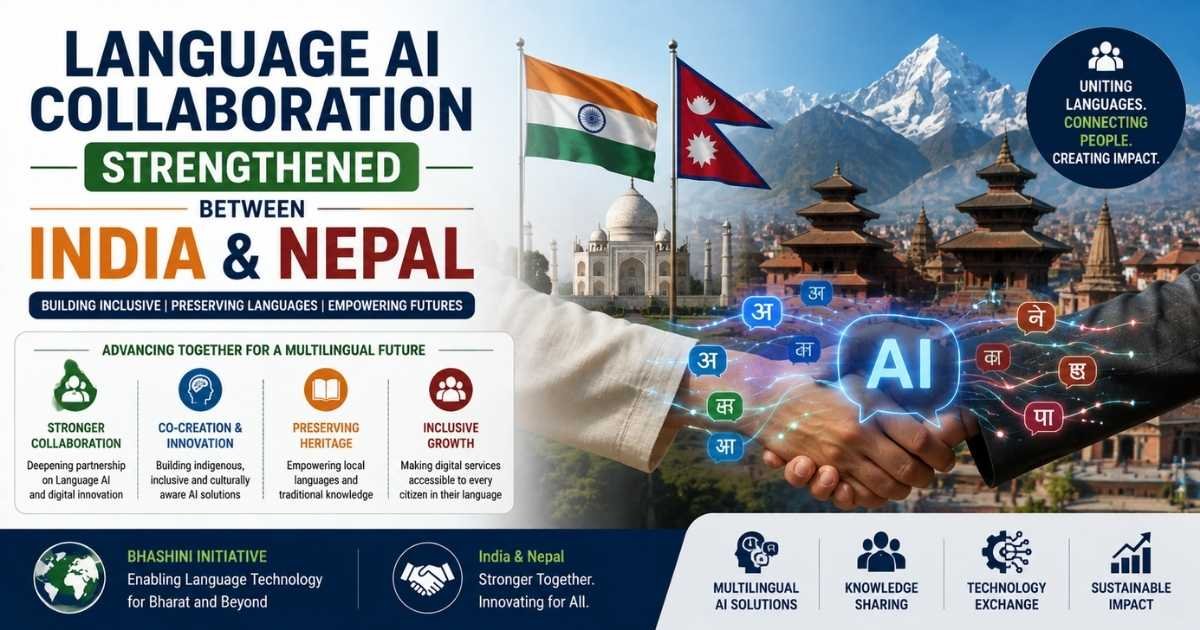
New Delhi: India and Nepal strengthened Language AI collaboration through a BHASHINI SANGAM workshop held in Kathmandu.
The Digital India BHASHINI Division organised the workshop with the Embassy of India in Kathmandu and Kathmandu University. The event brought together stakeholders from government, academia, technology and research.
Participants explored how multilingual and voice-first artificial intelligence can improve access to digital services. They also discussed access to information and opportunities in people’s preferred languages.
The workshop built on a Memorandum of Understanding between the Digital India BHASHINI Division and Kathmandu University. The agreement supports cooperation on language technology and digital public infrastructure.
The latest engagement focused on taking that partnership forward. In particular, participants discussed co-creating technology, datasets and applications suited to local linguistic needs.
The workshop also brought together researchers, developers, startups, language experts and community representatives. They exchanged ideas on language datasets, research and practical Language AI solutions.
BHASHINI SANGAM is an international engagement initiative of the Digital India BHASHINI Division. It connects governments, academics, researchers, developers, startups and language communities.
The initiative aims to explore Language AI across linguistic and geographical boundaries. It also promotes technology development that combines technical capabilities with local knowledge.
Furthermore, BHASHINI SANGAM seeks to preserve languages and cultures in the digital age. The programme aims to ensure that languages, knowledge and cultural identities remain represented in future technologies.
The initiative also seeks to turn shared linguistic and cultural links into joint innovation. Through such cooperation, it aims to support a more inclusive multilingual AI ecosystem across borders.
During the workshop, the BHASHINI team demonstrated its multilingual AI capabilities. The demonstrations covered speech recognition, real-time translation and voice-enabled interaction.
The team also demonstrated document processing capabilities. These examples showed how Language AI can make digital services more natural and accessible.
A dedicated BhashaDaan session highlighted the importance of language data. Participants examined how community contributions can help create more representative artificial intelligence systems.
The session covered contributions involving speech, text and image data. Therefore, it also highlighted the role of communities in building language technologies.
The workshop also examined potential applications in Nepali and other languages. This discussion connected the BHASHINI technology ecosystem with Kathmandu University’s academic and research capabilities.
The participants explored solutions that could address the needs of communities in India and Nepal. The discussions also covered opportunities for future research and technology development.
Shri Suman Shekhar, First Secretary at the Embassy of India in Kathmandu, highlighted the existing partnership. He said the MoU provided a strong foundation for further cooperation.
He also said the two sides could develop local applications in Nepali, Maithili and other languages. Such applications, he added, could create value for people across India and Nepal.
Shri Amitabh Nag, CEO of the Digital India BHASHINI Division, also highlighted the shared linguistic and cultural links between the countries. He said these connections created a strong opportunity for joint Language AI development.
Nag said the goal extended beyond making technology understand Nepali, Newari and Maithili. He stressed the importance of developing technology with these languages and their communities.
Language AI development gains a community focus
The workshop placed local languages and communities at the centre of the Language AI discussion. Participants examined how technology could reflect the linguistic realities of people who use it.
Researchers, students and language experts took part in the discussions. Developers, startups and ecosystem partners also contributed ideas on research and practical applications.
The engagement therefore linked government, academia, technology and communities. It also created a platform for discussing shared approaches to datasets and language technology.
The workshop further explored how local knowledge can support technology development. Such collaboration can help create applications that respond to specific language and cultural contexts.
The Digital India BHASHINI Division is part of the Digital India Corporation under the Ministry of Electronics and Information Technology. It serves as India’s national platform for AI-powered multilingual digital inclusion.
BHASHINI currently supports 36 Indian text languages and 23 Indian voice languages. It also supports 35 international languages.
The platform powers more than 800 government websites. In addition, it has enabled more than 9 billion cumulative AI inferences.
BHASHINI processes more than 24 million AI inferences each day. These capabilities support wider access to Digital Public Infrastructure through multilingual technologies.
The Nepal workshop therefore added an international dimension to India’s Language AI efforts. It also provided a platform to explore applications that could work across shared linguistic communities.
The collaboration with Kathmandu University supports this broader direction. It combines academic and research capabilities with BHASHINI’s technology ecosystem.
Meanwhile, the Embassy of India’s participation strengthened the institutional link between the two countries. The workshop also brought multiple stakeholder groups into a common discussion.
The engagement focused on practical cooperation rather than technology alone. Participants considered datasets, applications, research and community involvement as connected parts of multilingual AI development.
Language preservation also remained an important theme. The initiative seeks to ensure that languages and the knowledge they carry remain visible in the digital environment.
The workshop highlighted Nepali, Newari and Maithili among the languages relevant to future collaboration. It also opened discussion on other languages used by communities across India and Nepal.
Through BHASHINI SANGAM, the Digital India BHASHINI Division is seeking partnerships beyond India’s linguistic and geographic boundaries. The initiative aims to develop multilingual technologies through shared knowledge and local participation.
The Kathmandu engagement marked another step in that effort. It brought together government institutions, researchers, technology stakeholders and communities around a shared Language AI agenda.
The workshop also reinforced the role of multilingual technology in digital inclusion. By supporting preferred-language access, such systems can help connect more people with digital services and information.
The India-Nepal engagement is expected to support further co-creation around language datasets and applications. It also provides a foundation for continued cooperation between the BHASHINI ecosystem and Kathmandu University.
Overall, the workshop advanced a shared India-Nepal Language AI ecosystem. It linked technology with academic research, government participation and community knowledge.
The engagement also underlined the importance of developing AI around real linguistic needs. Through continued collaboration, BHASHINI SANGAM aims to strengthen multilingual innovation and digital inclusion across borders.
